Beaufort County Sheriff stands behind ICE program, 150 attendees demand answers
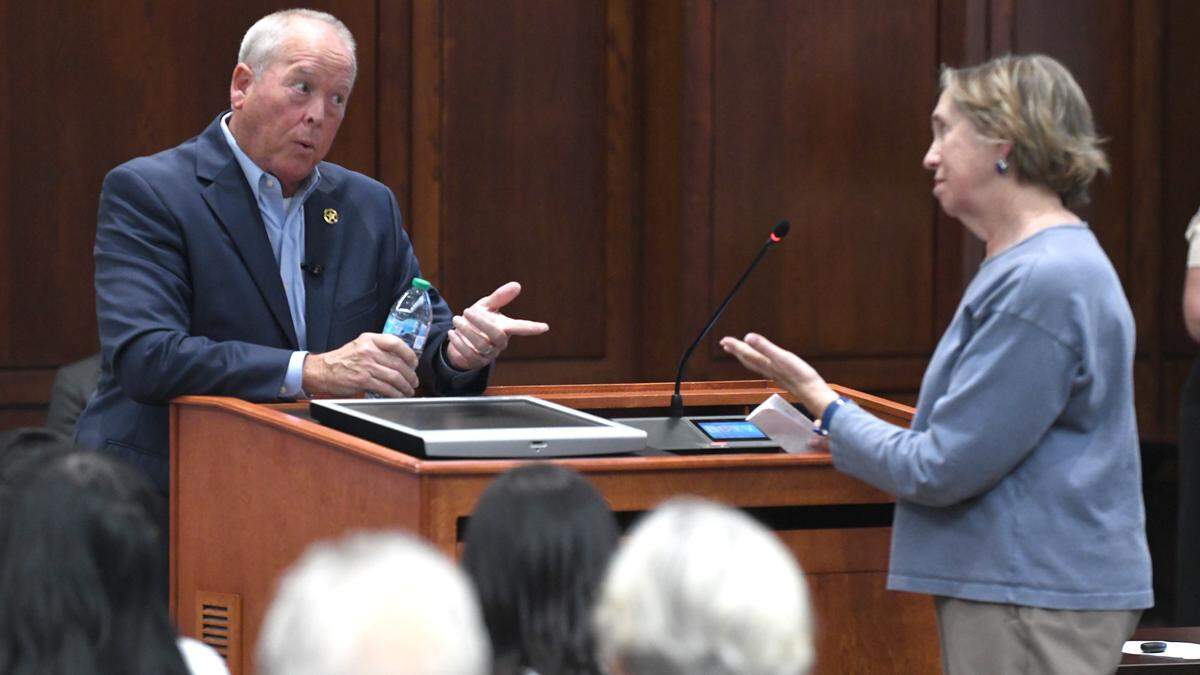
In a rare departure from his usual position behind the lectern, Beaufort County Sheriff P.J. Tanner stood in front of it Tuesday evening, his elbows resting on the wooden platform. He stood mere inches from the public, fielding questions about his office’s previous and potentially future involvement with federal immigration enforcement.
The session centered on U.S. Immigration and Customs Enforcement (ICE) and its 287(g) program, which deputizes local law enforcement officers to enforce immigration laws. The controversial program has expanded during President Donald Trump’s second term and has gained traction in South Carolina.
Tanner’s department participated in the program more than a decade ago. In February, he applied for Beaufort County to rejoin. So far, the application has not been approved.
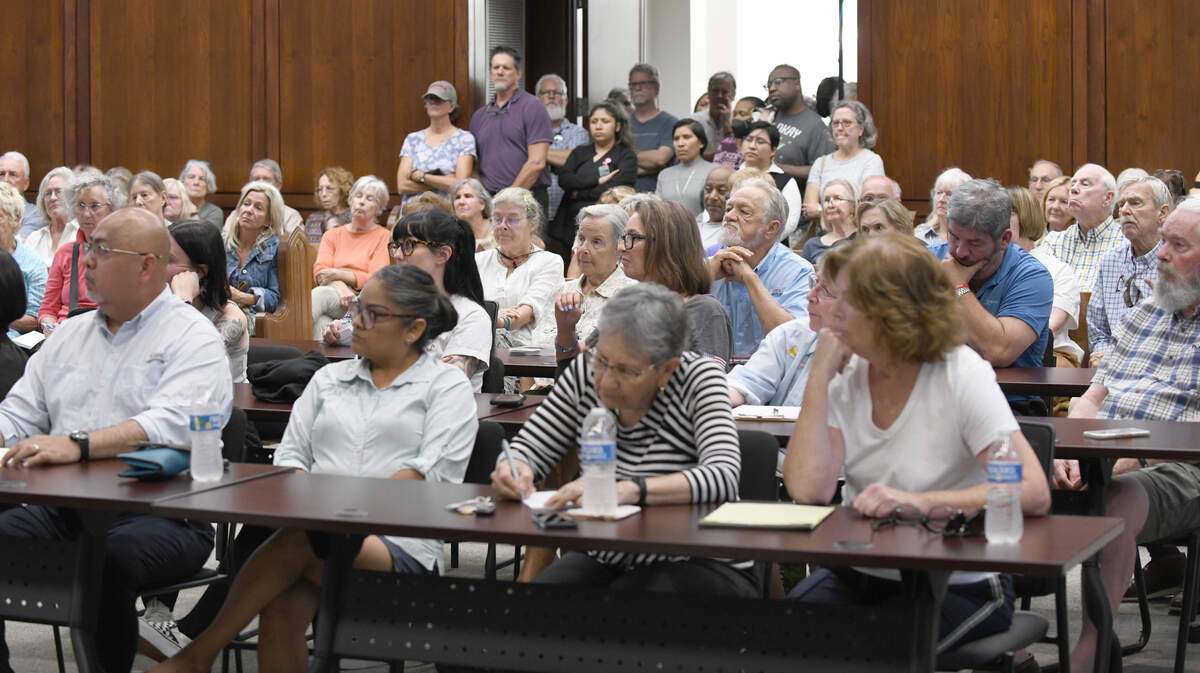
Just before 5 p.m., upwards of 150 community members filled the former federal courtroom at the Beaufort County Sheriff’s Office Headquarters. Attendees spilled into the hallway, while others stood shoulder to shoulder along the room’s edges.

Several sat ready to take notes with pads of paper and pens. Immigration attorneys, small business owners and advocates from statewide civil liberties groups filled the pews.
By the time Tanner took to the front of the room, it had reached full capacity — so much so that residents and reporters were turned away at the doors. Nearly 1,000 people logged on virtually to watch the meeting from their computer screens.
The meeting itself — designed to be a Q&A between the public and the county’s top law enforcement official — was a rare kind of event in the state, said Paul Bowers, communications director for the state’s branch of the ACLU. He said that most law enforcement leaders throughout the state have not yet faced the public about issues relating to 287(g), despite submitting applications to join the program
Words from the podium
At the start of the meeting, Tanner cautioned that he had “limited information” to share.
But over the next hour, community members pressed him for answers — some from their seats, others face-to-face at the podium. One by one, they challenged the program and the department’s decision to participate.
Aimee Deverall, an immigration attorney who lived and worked in Beaufort County during the program’s previous implementation, urged the sheriff to withdraw the department’s application.
Her clients, she said, are already asking whether they should report crimes committed against them — fearful their immigration status could be used against them. It’s not a question she finds easy to answer.
Also speaking was Ana Ramirez, a longtime Beaufort County resident and local advocate for the immigrant community. She said she stepped into advocacy recently, inspired by her daughter, Gabriella Garcia. Ramirez questioned why the sheriff would voluntarily rejoin a program she believes harms public trust — and shared a personal account from its first run.
“In the time you first deployed this program, your office, took a family member of mine who had no reason to be taken,” she said. “Your job is protect and serve all, and right now, you are not protecting my community.”
But Sheriff Tanner did not waver in his support for the program, saying it is just one tool his department could use to keep the county safe. Specifically, taking part would grant his office access to federal databases and intelligence that would otherwise be unavailable to the department.
Despite repeated concerns about eroding trust between law enforcement and the immigrant community, Tanner did not acknowledge that trust had been lost or was at risk.
He repeatedly sought to reassure the room that what some fear could happen under the program, such as arrests by plainclothes federal agents in unmarked vehicles, has not happened in Beaufort County before and, he said, will not happen under 287(g).
“No one runs my office but me,” Tanner said. “County Council doesn’t run my office. The state of South Carolina doesn’t run my office. The federal government doesn’t run my office ... I make the decision, and the buck stops right here with me.”
Despite this, community members still questioned how the sheriff’s department could ensure that.
The history of ICE’s 287(g) program in Beaufort County
The 287(g) program has been rapidly expanding since Trump took office for his second term.
Only 135 agreements between individual agencies and ICE were in place in January. By July 9, ICE had signed 806 agreements across 40 different states, including South Carolina. So far, Beaufort County is not on the list of participating or pending agencies, meaning they are not yet a part of the program.
These partnerships between ICE and local police departments have been criticized over the years, with some arguing the program encourages racial profiling and reduces trust in police.
In February, Tanner applied to reestablish a local 287(g) “task force” with ICE. This task force model, which Beaufort County previously used from 2008 to 2012, is one of three frameworks under 287(g).
Under this model, ICE trains and equips local officers to enforce federal immigration laws. Officers can question individuals about immigration status and detain them for potential deportation.
By contrast, the other two models — the jail enforcement model and the warrant service officer program — focus on investigating people who have already been arrested and booked into local detention centers.
The Beaufort County Sheriff’s Office was one of just 18 local law enforcement agencies across the county, and the only in South Carolina, to deploy a 287(g) task force more than a decade ago.
At the time, the department had five deputies trained as immigration agents. If approved this time around, Tanner said, he would only need one deputy to reap the intelligence benefits he is seeking.

This story was originally published July 9, 2025 at 1:49 PM.