Beaufort Co. Sheriff applies for local ‘task force’ with ICE as program returns under Trump
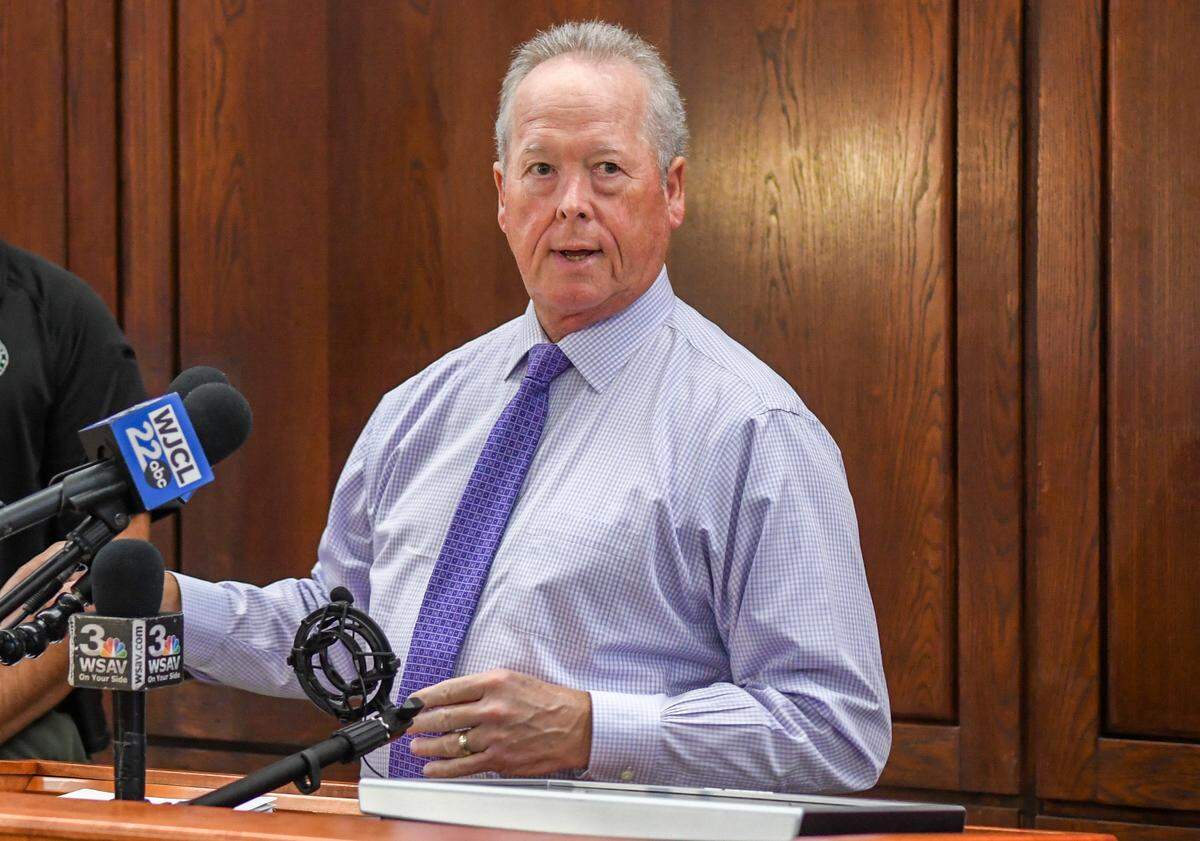
The Beaufort County Sheriff’s Office has once again applied to form a local “task force” with Immigration and Customs Enforcement, part of a controversial program brought back by President Donald Trump. But as Sheriff P.J. Tanner awaits a response, it is unclear what changes the initiative would bring to local policing.
Tanner said he sent a letter in early February to the Department of Homeland Security requesting a task force contract under ICE’s 287(g) program. The application process takes time, the sheriff said, but he hopes to hear back about a decision by the end of the year.
Under the task force model, ICE provides training and resources to participating police departments, allowing local officers to help enforce federal immigration law. Officers in the program have authority to question people about their immigration status and detain them for possible deportation.
The task force model is one of three branches of the 287(g) program, allowing deputies to enforce immigration law during their day-to-day duties. It’s more expansive than the other two models, which primarily involve prosecuting undocumented people who have already been arrested.
The 287(g) program is expanding under President Donald Trump, who campaigned on a promise to deport millions of people who have entered the United States illegally. Trump revived the program’s task force model in the first weeks of his second term after it was discontinued in 2012 during the Obama administration.
As of March, over 350 law enforcement agencies across the U.S., primarily county sheriff’s departments, had opted into the program. In the Palmetto State, ICE has 287(g) contracts with the South Carolina Law Enforcement Division and sheriff’s offices for Charleston, Chester, Horry, Lexington and York counties.
Such partnerships between ICE and local police departments have been criticized in Beaufort County and nationwide, with some arguing the program encourages racial profiling and reduces trust in police.
The sheriff’s office was part of a 287(g) task force for about four years until early 2013, when the Obama administration scaled back the task force model nationwide.
Tanner applied for the program again in early 2017 as Trump began his first term, leading to small protests and public outcry among certain Beaufort County residents. But the sheriff’s office “never received confirmation” regarding a contract, Tanner said.
Jasper County Sheriff Chris Malphrus, who took office in January, said his department was not applying for the 287(g) program but would assist ICE with any local efforts if necessary.
What happens now?
In its previous partnership with ICE, Tanner said, the Beaufort County Sheriff’s Office focused on prosecuting “the worst of the worst” — people without permanent legal status who were charged with high-level crimes.
“We weren’t out checking immigration status at grocery stores or public venues,” Tanner said.
He said his agency was most concerned with those in the county jail who had committed other crimes and had a status that showed they were in the U.S. illegally.
“Those were the ones that we spent 95% of our time and attention,” Tanner said.
Asked if his agency’s strategy would be similar under a revitalized Trump-era 287(g) program, Tanner said it was too soon to know.
“I don’t know what the new makeup of a task force under this administration would be asking us to do,” Tanner said. “Those are the questions that I can’t answer at this point, because we’re not a part of a task force at this time.”

Other unknowns include how many Beaufort County sheriff’s employees might take part in the program and whether the agency would hire new deputies as a result, Tanner said.
The agency’s last task force with ICE included six Beaufort County deputies, a number of whom were Hispanic and bilingual. The deputies had a “complete change of duty” under the task force but were paid the same amount as before, Tanner previously said.
After being trained at an ICE academy, Tanner said, the group was given access to the “IDENT system,” a database used by DHS containing information on millions of people that is used to identify national security threats and immigration violations.
Locals take issue with 287(g)
A number of civil rights watchdog organizations strongly oppose the 287(g) program, arguing the initiative isn’t cost-effective for local police departments and often targets people with minor criminal histories.
Sheriff’s departments that participated in 287(g) agreements in North Carolina and Arizona were accused of unconstitutional policing and racial profiling following investigations by the Department of Justice. The reviews found that local deputies conducted “sweeps” in largely Latino neighborhoods and that Latino drivers were up to 10 times more likely to be pulled over by police.
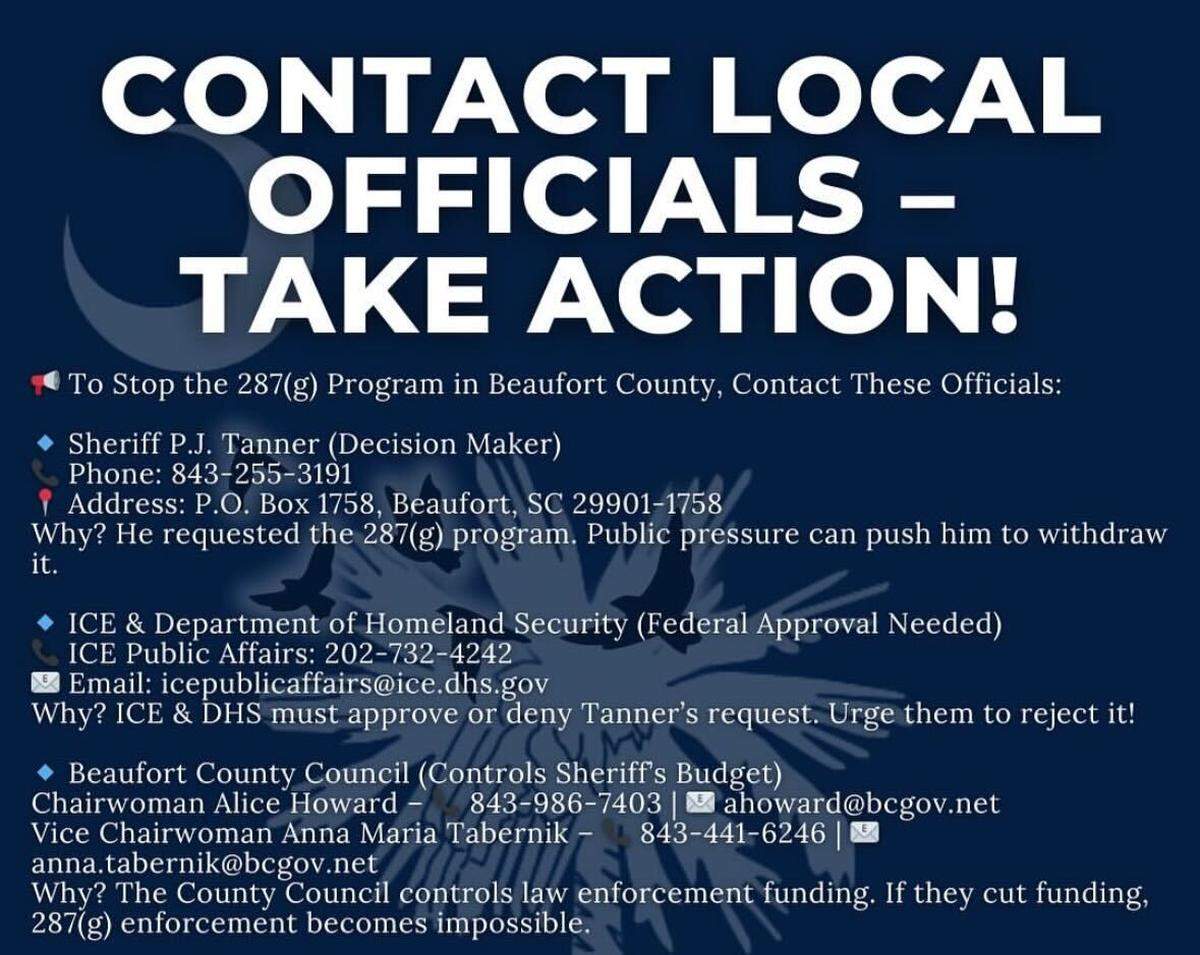
Those concerns were top-of-mind for Hilton Head Island native Gaby Garcia, who organized a social media campaign asking residents to contact local decision-makers — including Tanner and Beaufort County Council Chairman Alice Howard — to express their opposition to 287(g).
Garcia said the program is a “misuse of local law enforcement resources” and can breed distrust in police within Latino communities. After a car crash or incident of domestic violence, she said, a resident might avoid calling 911 in fear of themselves or a family member being questioned about their immigration status.
But Garcia emphasized that most detractors of 287(g), including herself, are not against policing in general.
“I am not anti-police. I have friends in law enforcement; I respect them, I love them,” Garcia said. “But I just don’t believe in this policy, because I think it harms minorities, creates fear and diverts resources away from actual crimes.”
Fernando Soto, founder of the Spanish-language South Carolina news site Nuestro Estado, pushed back on the idea that 287(g) is crucial for deterring crime. Even without the program, he said, federal agents are able to put “ICE holds” on accused criminals and begin deportation proceedings in tandem with their criminal cases.
Soto said police agencies with 287(g) agreements should reach a “middle ground” with ICE, creating a certain classification of high-level crimes that dictate when immigration agents will get involved with a case.
“There are a lot of people that get caught up in a system where the penalty doesn’t match the infraction,” Soto said, referring to non-violent crimes and minor traffic offenses. “It creates a ripple effect of fear in the community, where people don’t want to go to work; they don’t want to go to school. That in turn affects our local economy, because so much of it depends on immigrant labor.”
As 287(g) agreements are weighed in Beaufort County and across the state, Soto urged Latino residents to know their rights and how the Constitution protects them in the event of an attempted deportation.
“People need to be alert,” he said. “People need to be prepared in case these things happen.”
This story was originally published March 21, 2025 at 12:31 PM.