Being black means you’re far more likely to get arrested for pot in Beaufort Co., data shows
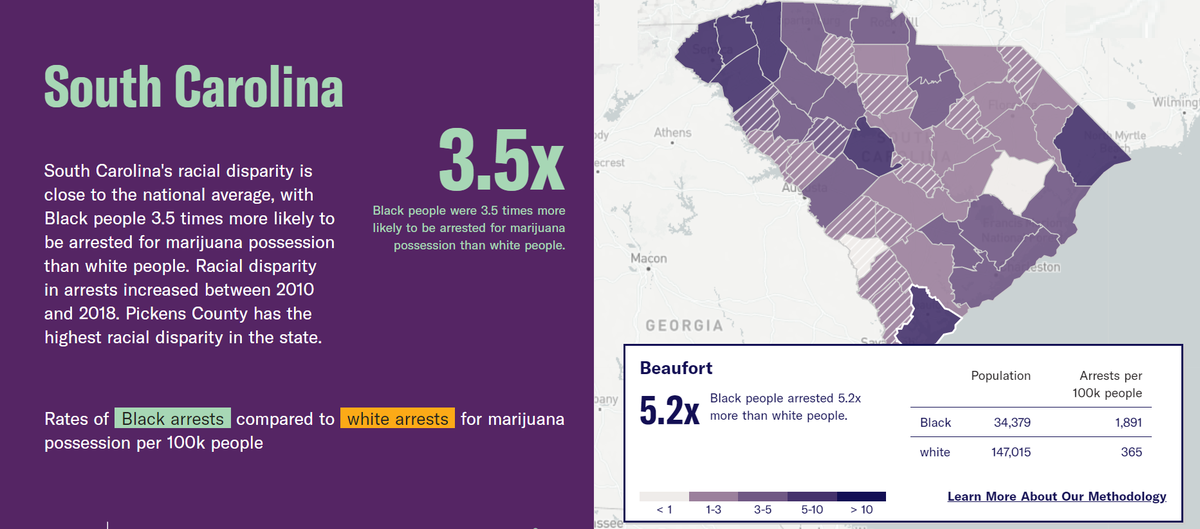
If you’re black in Beaufort County, you’re 5.2 times more likely to be arrested for marijuana possession than your white neighbors.
That number comes from a report from the American Civil Liberties Union last month and is fueling questions about race, law enforcement and the long-term effects of those arrests.
For police, its about doing what the job requires.
“We apply the law universally, and when we encounter or observe a violation of the law, we’re required to take action,” said Beaufort County Sheriff’s Office Maj. Bob Bromage.
For Kenneth Doe, pastor of the Bethesda Christian Fellowship on St. Helena, its about something more.
He said he has dealt with “lots and lots” of cases of young, black men being arrested or cited for possessing marijuana in his community.
He often accompanies those arrested to court as a silent observer or offers counsel to families dealing with the legal system.
Doe sees a problem with how local law enforcement applies marijuana possession laws.
“If the typical person in the St. Helena community is standing at the corner of Martin Luther King Drive and Sea Island Parkway, there’s almost an automatic suspicion,” he said.
“The problem of how we look at one another has been a problem as long as there’s been a Beaufort County,” he said.
The total number of arrests and width of racial disparity cited by the ACLU are well below other counties such as Pickens, Ocanee and Horry, the report shows.
But the rate at which African Americans in Beaufort County are charged with simple pot possession is above the national average of 3.5.
It is also stark because of the population makeup of the county.
Approximately 78 percent of the county is white; about 18 percent is African American, according to a recent census count.
But black residents of Beaufort County made up 46 percent of simple marijuana possession arrests from 2009 to 2018, according to the FBI’s Uniform Crime Reporting program, in which law enforcement agencies across the country self-report crime statistics.
The discrepancy ticked up in 2018: black residents made up slightly more than half of the county’s arrests for marijuana possession.
The sheriff’s office was able to fill in the gaps of the FBI’s data for the last two years.
Bromage said there were 473 arrests, including citations, for simple possession of marijuana in 2019. Black residents made up 53 percent of those.
Deputies have made 240 simple marijuana possession arrests in 2020 through May 12, he said, in which 135 of those arrested were black and 82 white.
The enforcement of marijuana laws continued even as more people were forced inside due to coronavirus, public records show.
The FBI and the Beaufort County Sheriff’s Office numbers include both arrests and citations for simple possession. The difference depends on the amount of pot found and other charges that may be added.
That amount and those additional charges can also mean the difference between receiving a ticket or spending a night in jail.
But all roads lead to the court system.
For Doe, the effect on the community is clear.
“When it comes to the negative effect of incarceration, of money spent, it’s just hard to keep rebounding from it,” he said.
“I think there are some healing things that need to come from the community side, and there are healing things that can come from law enforcement,” he said.
Uncomfortable conversations?
S.C. Sen. Tom Davis is no stranger to tough positions.
The Republican senator led the charge to legalize medicinal marijuana through the statehouse, while facing opposition from the S.C. Law Enforcement Division and the S.C. Sheriffs’ Association. While working out compromises and amendments with those groups, the state Senate kicked back a vote on Davis’ bill.
Davis faced dark money attacks in the form of anonymous mailers, blasting the headline “Don’t let Tom Davis turn South Carolina into a Pot Party.”
When it comes to enforcement of marijuana possession laws, Davis’ approach is a simple one: the law is the law.
But he said when all the data points to a disparity in pot arrests between black and white residents in Beaufort County, it’s time to re-evaluate.
“A reasonable conclusion to draw from that disparity,” said Davis, is there are “more resources towards arresting black Americans than white Americans.”
The conversation must begin with law enforcement, he says, even if those agencies may be reluctant to do so. Davis did not offer further specifics but suggested resources spent enforcing simple possession laws could be better spent.
“I’ve traveled around in a police cruiser. You can’t simulate that experience. I respect that,” said Davis. “It creates a degree of respect and deference that is warranted, but sometimes gets in the way of an honest conversation.”
When asked what he would do to address the county’s arrest disparity, he said it’s an issue he’s willing to take on while recognizing the problem is a national one.
“I have not filed that bill,” said Davis of a possible response from lawmakers. “I can’t really suggest what a solution might be, but when you see numbers like that, you have to have a legislative conversation.”
Smell test
Many of the charges for simple possession of marijuana happen when people are in their cars.
Officers are allowed to hold a car on the side of the road and detain a driver without a warrant if they smell marijuana, according to Jim Brown, a defense attorney based in Beaufort.
“It’s a pretext to search,” he said.
Brown said he believes courts have been imposing more fines for marijuana offenses, rather than jailing defendants.
He said the legal system gives law enforcement a great deal of leeway in determining whether to ticket or arrest for marijuana possession as the result of a traffic stop.
“The reasonable expectation of privacy is much greater in a home than in a car. There’s very little expectation of privacy in a car,” said Brown.
But he said there is another question to be answered.
“We need to find out why it is that minorities are more frequently pulled over in a car.”
From January through May 2019, when data was available from the Beaufort County Sheriff’s Office, 115 of 159 arrests for simple possession of marijuana came as the result of a traffic stop, according to data from a Freedom of Information Act request.
The corrosive effects
The ACLU report paints a frightening picture of the downstream effects of marijuana possession arrests and citations across the country and even in states where the drug has been legalized.
In South Carolina and many other states:
- Parents may lose custody of their children in family court if accused of using marijuana.
- Immigrants can be deported.
- Families living in federally subsidized housing can face eviction.
“Because of the race-driven way in which marijuana criminal laws have been enforced, each of these potentially life-altering consequences of criminalization has been borne disproportionately by communities of color,” reads the report.
Looking at his community, Doe says “there needs to be some dialogue between law enforcement and the community and not just to talk about it when there’s a problem.”
Bromage said the Sheriff’s Office has had community meetings in the past and will continue to hold them.
“Community engagement is critical to identify the public safety needs of various communities in Beaufort County,” he said.
Doe sees the problem as one that has effects far beyond the initial charge or arrest.
“I’ve known people who’ve endured a marijuana arrest, who lost jobs. That’s pretty major,” said Doe.
“I’ve known the way their own community looks at them has caused problems. I’ve seen potential stunted and people just giving up on trying, how these arrests can follow them and haunt them.”
This story was originally published May 18, 2020 at 4:50 AM.