
Pandemic relief: old standby, summertime fruits
Mark Twain said: “When one has tasted watermelon, he knows what the angels eat.” How true, because on a hot summer day, nothing cools you off or satisfies a sweet tooth better than a slice of a cold, ripe watermelon.
I remember that in my childhood years, when my granddaddy, Dan Cooler, planted watermelons in the field behind his home on scenic Highway 46, he’d have several varieties to choose from. But I can’t for the life of me remember any melons that didn’t have seeds. The answer, I find, is that commercial production of seedless watermelons didn’t get started until the 1990s. But that’s another story, involving shenanigans with male and female pollen and chromosomes. Hm-m-m.
There was a large wooden picnic table under the big oak tree in his back yard, (the oak tree and homestead are still there), and he’d have two or three large melons from the field at family gatherings to slice up for everyone to chow down on, so there was a lot of seed-spittin’ going on.
“Life is like eating a watermelon,” author Jeff Steinmann wrote. “You know you’re going to get some seeds; just spit them out and take another bite.”
Another farming family, the Johnsons, who lived in the two-story home near the entrance to Palmetto Bluff Road, always had two or three different kinds of melons for sale, stacked under the shade trees in their front yard. All one had to do was pull off the edge of Highway 46 and pick either a Charleston Grey, a Jubilee, or one called a Rattlesnake, and the purchase would be a sweet one. The Johnson men picked only the ripe melons to sell.
My siblings and I always wondered if melons were green on the inside, like a Citron, and turned red only when they were sliced and oxygen got to them. But research verifies that it is indeed already red on the inside before cutting.
Bubba Crosby, a local farmer who has grown watermelons since the early 50’s, says a melon is ripe when the underside turns yellow. But some folk still judge by a brown stem on the end — or just the right sound made with a thump on its hard outer shell.
SC: the real peach state
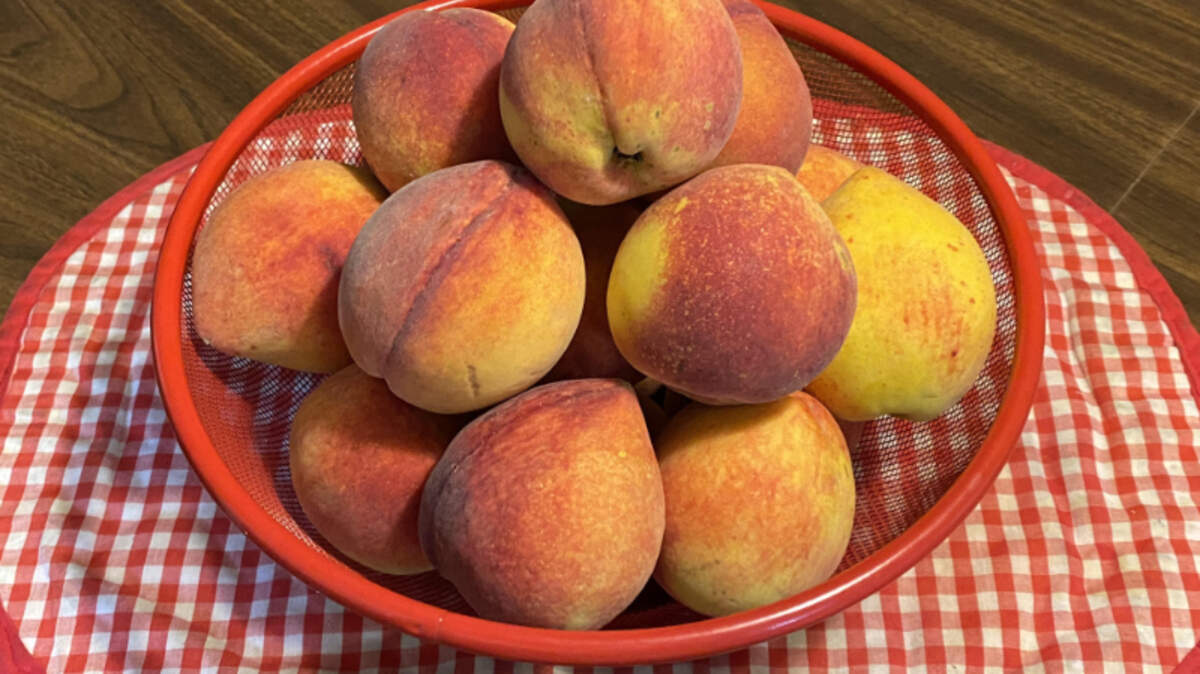
Another fruit that’s sure to satisfy the palette is a fuzzy, ripe and juicy peach. The peach probably ties with the watermelon for first place when the juice starts dripping down your chin.
“A peach with a leaf attached symbolizes the union of the heart and tongue, hence truth,” wrote author Karen Jean Matsko Hood.
Even though Georgia is known as the peach state, there are just as many peach farms in South Carolina. The S.C. Department of Agriculture says, “We know Georgia gets all the credit, but South Carolina is number two in the nation in peach production, second only to California and leading all the southern states.” The peach was designated South Carolina’s state fruit in 1984, whereas, Georgia didn’t name the peach as its state fruit until 1995.
There are several ‘U-pick’ peach farms in South Carolina, and we’ve picked from fields in Kline. Titan Farms in Ridge Springs was recently highlighted on “The Very Vera Show,” a local television program. Lori Anne Carr and her husband, Chalmers, who own Titan Farms, have been in the peach farming business since 1999, starting with 1,500 acres and now with over 6,000 acres of peach trees. The fruit reaches its peak in the summer months.
Titan Farms recently won a $10 million COVID-19 federal contract to send fruit and vegetable boxes to food banks and other aid organizations in the South, since they also farm a variety of vegetables. The grant, part of a coronavirus relief program, requires them by the end of August to provide 286,000 fruit and vegetable boxes to various groups, amounting to more than 5.2 million pounds of food. Their products can also be ordered online at: titanfarms.com.
Ode to the goober
Last but not least, a favorite of many, a fruit I grew up with and have consumed my fair share of: the peanut. That’s right, while it’s called a nut, it’s actually classified as a fruit. It’s a warm season annual plant, also known as goober, that is the fruit of a legume.
As American playwright and critic Channing Pollock wrote, “No man in the world has more courage than the man who can stop after eating one peanut.”
My daddy always had a field of peanuts planted. When the plants were ready to be harvested, they would be pulled up by hand and loaded on a flat-bed trailer and hauled to the house. There, after finding a shady spot under our giant Sycamore tree, all of us young’uns would have a peanut-pulling good time. The bushes would be strung out to dry on a wire fence and used as fodder for feeding cattle. There were always plenty of peanuts to eat year-round, either raw, boiled when green, or roasted when dried during the winter months.
The peanut has long been a staple of South Carolina farms and can be traced back to the Civil War, when Confederate soldiers used the legume as an important source of protein. It became designated as the official snack of South Carolina in 2006. They are available at roadside stands, festivals, produce stands and stores.
At least, while sheltered at home during this pandemic, we have these luscious fruits to enjoy!