
The easier side of life
We, as humans, sad to say, are almost predictable. We stroll through life, day by day, almost to the point of taking everything for granted and thinking we have all “our ducks in a row.” But do we?
Sure, we may be at a point and time in our life that’s good, but, when over the years, climbing the ladder to reach this point, we went through some rough times, securing a job, raising a family, having to scrape the bottom of the bucket sometimes to make ends meet, but we got over the hump, and we made it.
Then, whoa! Along comes a pandemic, something we’ve never experienced before that catches us with “our pants down.” Which gives us a thought: “Were we ever grateful, were we ever thankful, did we ever show appreciation when times were good, without a crisis?”
A crisis is an opportunity to experience God at a level you had not previously known. A time to not be pessimistic and let this gloom and doom drag us down, but instead, be optimistic with happy thoughts that can lift our spirits.
Maybe the old cliché’ “to be free as a bird” could be applied here, to lean toward an easier side of life and “let it all hang out”; not literally, but in a soul-searching way.
Noted writer and speaker William W. Purkey said: “You’ve gotta dance like there’s nobody watching, love like you’ll never be hurt, sing like there’s nobody listening, and live like it’s heaven on earth.”
Since staying at home and spending endless hours outdoors in our backyard, bird watching has become the natural thing to do. Having five birdfeeders, with an ample supply of fresh seed, one Hummingbird feeder, being constantly filled with my homemade brew, and three birdbaths filled to the brim with water, there are plenty of birds for entertainment.
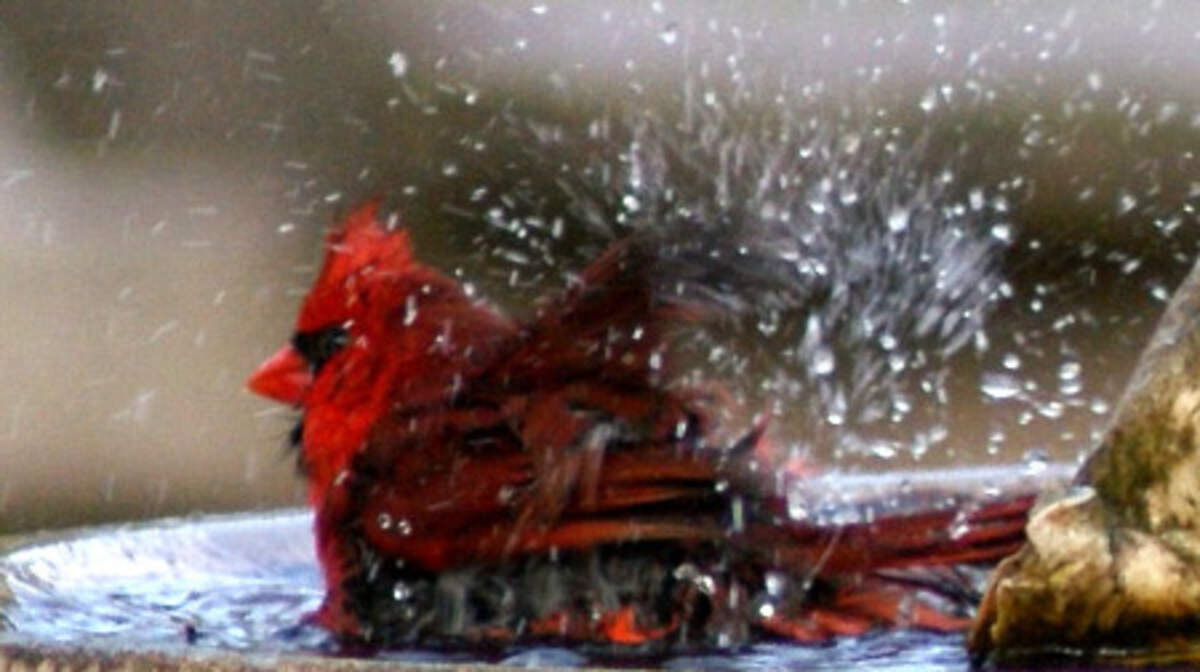
And I might say, they DO let it all hang out, literally, by multiple visits to the birdbaths, splashing and frolicking around to stay cool.
When through with their bath, they take a perch on a branch of our Bottle Brush tree, preen, pick and flutter till they’re all dried out. Then it’s back to a feeder for more seed, enjoying the easier side of life.
In between all these relaxed good times though, these birds, numerous varieties, have taken time to be responsible parents by finding a good site for a home, building a nest, incubating their eggs and finding food for their fledglings until old enough to make it on their own, without skipping a beat.
I’ve watched, to name a few, mourning doves, mocking birds, brown thrashers, nuthatch, Carolina wrens and Eastern bluebirds raise their families, with some doing repeats. But for the life of me, as closely as I have watched them, I cannot detect where our hummingbirds have nested. They spend quantity time darting to and fro from the feeder to the Bottle Brush tree with its millions of tiny leaves, but if their nest is there, it’s hidden in the shadows of the greenery.
Right now, we humans are kinda’ between a “rock and a hard place,” so to speak, with this pandemic, playing musical chairs with social distancing, wearing face masks everywhere we go, either to work, the grocery store or other necessary places, and dealing with this unrelenting heat.
So, back to the earlier statement of us lightening up and being “free as a bird,” maybe we need to energize our brains with a little more faith — faith that we will overcome this.
J.M. Barrie, Scottish novelist and creator of Peter Pan, said: “The reason birds can fly and we can’t, is, simply because they have perfect faith, for to have faith is to have wings.”
We need to start “thinking” like a bird and find a watering hole to cool off and relax. And don’t retort back with, “Birds don’t think,” because they do.
Birds lack a cerebral cortex, which allowed scientists for decades to assume they weren’t capable of any higher thinking, but, now, researchers have found a different part of the “bird brain,” the avian pallium, has evolved to do many of the same tasks as the cerebral cortex.
Jennifer Ackerman, veteran science writer, explores the different forms of avian intelligence in “The Genius of Birds.”
She points out their unique mental abilities, such as Mockingbirds being able to learn hundred languages in song, and their navigating skills, such as the White-crowned Sparrow when their flock was transported by jet 3,000 miles across the country, from the West Coast to New Jersey, and within hours the little birds were beelining it, solo, back to their wintering grounds in Southern California.
Which goes to show you, if you’re ever accused of being a “bird brain,” don’t put yourself down, thinking you have two left feet. You might be smarter than you think you are.
Romans 12:12: “Rejoice in hope, be patient in tribulation, be constant in prayer.”