
Sweet Vidalia onions: This sweet Southern success started by accident
What’s NOT to like of a fresh, sweet Vidalia onion that’s in season right now, and only a short distance away?
Some folk say the onion is the most favored of all foods. They’re good for your immune system, helping to fend off the common cold, and they add flavor to many a cook’s favorite dishes.
The sweet onion capital of the world, Vidalia, Georgia, is about hour and a half drive from Savannah, which makes it about a two-hour drive for us Blufftonians. After traveling past I-16 you go through some quaint small towns and scenic back roads that lead you straight to the onion fields and the office of the Vidalia Onion Committee that represents the onion farmers, with manager Bob Stafford.
Mr. Stafford says the Vidalia Onion is a special sweet onion sold all over the country, but can only be grown in 20 counties in a certain area of Georgia, designated by the Vidalia Onion Act of 1986.
They have certified varieties of onions in conjunction with the University of Georgia that go through three years of testing before they can be recognized as a certified Vidalia onion.
Growing certified Vidalia onions is a serious business for the area, dependent on the sandy soil with low sulphur that produces the best sweet onion in the world.
Some farmers were bringing in western onion varieties, trying to bag and pass them off as Vidalia, so the Vidalia Onion Committee had to get the territory and the name trademarked.
Being very fortunate to do that, they gave the state the trademark because they had the money and the lawyers to protect the deal.
The Vidalia onion was named the Georgia state vegetable in 1990 and there’s about 25 packing houses used by various farmers in the Vidalia area.
The onion business all began back in the 1930s during the Great Depression, when farmers had high hopes of onions being a cash crop. So imagine their surprise when what grew was not an instant moneymaker, but a strange new, sweet-tasting onion, instead of the ordinary pungent onion. It was accidentally discovered by farmer Mose Coleman of Toombs County in 1931.
Farmers found out people liked them and wanted more of them, so the state built a farmer’s market in the 1940s, central to Macon, Augusta and Savannah.
As word spread of these sweet onions from Vidalia, a name was born, and as folks from other areas got a taste of these sweet gems they’d tell their neighbors, “Hey, if you’re going through Vidalia bring me back a bag of those ‘sweet onions.’ ”
During the 1960s, the Piggly Wiggly grocery store, headquartered in Vidalia, saw the potential of this special produce and became the first retail store to sell them, helping farmers from all over the Vidalia area get their newfound onions on store shelves.
Then, a 50-pound bag of Vidalia “jumbos” could be bought for $15.95, whereas now, a 5-pound bag of medium Vidalia onions run $3.99, on sale!
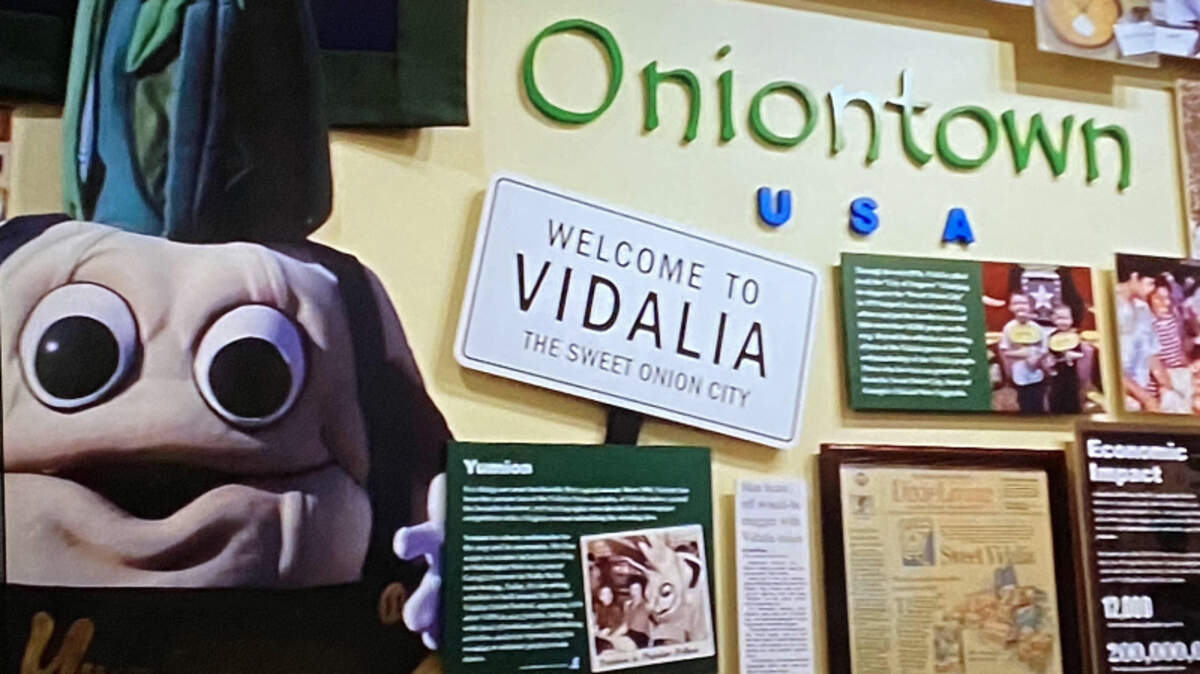
Vidalia has a Vidalia Onion Museum that houses 1,300 square feet of information and exhibits that highlight the sweet onions economic, cultural, and culinary significance.
There is also an annual Vidalia Onion Festival that had to be canceled this year because of COVID-19, but it is already scheduled on the calendar for next year, April 22-25, 2021.
Planting onions is a year-round job — planting seed beds in September, transplanting the plants in November and December to where they over-winter. Then the harvest begins the middle of April right on through June.
They put half the crop in storage and selling half of the crop fresh. Around 3 million to 3.5 million bushels are put in storage, which will be enough to sell through Labor Day.
Vidalia onions are planted on over 14,000 acres.
Alan Sikes, the “Vidalia Onion grower of the year,” when viewing a field of harvested onions ready for picking and packing, says it feels like home when walking out in the sandy, beach-like soil.
Mr. Sikes says the soil is not the only thing that makes the Vidalia onion special. It’s also how it’s grown, picked and packed, all by hand, making it a unique, hands-on crop. While some onion fields are done by the use of machinery, the Vidalia onion is mostly done by hand.
Even after a machine is used to lift them out of the soil come harvest time, skilled workers clip, cut and sort the produce, covering 20 acres a day.
From the fields they go to Alan Sikes’ packing house, loaded on conveyor belts, weighed, sorted, bagged and shipped to retail stores.
Vidalia onion sales total $90 million, 40% of the nation’s spring onion crop, with 5 million 40-pound boxes shipped out each season. A sweet success!
Carl Sandburg said, “Life is like an onion. You peel it off one layer at a time, and sometimes you weep.”
Jean Tanner may be reached at jstmeema@hargray.com.