
Who’s that rapping at my door? Could it be a woodpecker?
Wow! Sometimes when we’re really curious about something we can open a big can of worms, so to speak, which, in this case, since it involves birds, would make the birds happy. I’m not an ornithologist but I do, for sure, like birds of all kinds.
Woodpeckers have always intrigued me and since we have a large variety in our part of the South Carolina Lowcountry, and I have a good many photos taken of them, I decided to bone up on their lifestyle, nesting habits, favorite foods, etc., and that’s when the can of worms got opened.
To start with, just to get a quick, clear, professor-type description of a woodpecker for this article, I relied on my Webster’s New Collegiate Dictionary to spill the beans. In a nutshell, it read:
Woodpecker: “Any of numerous birds (family Picidae) with zygodactyl feet, stiff spring tail feathers used in climbing or resting on tree trunks, a usually extensible tongue, a very hard bill used to drill the bark or wood of tree for insect food or to excavate nesting cavities, and generally showy parti-colored plumage.”
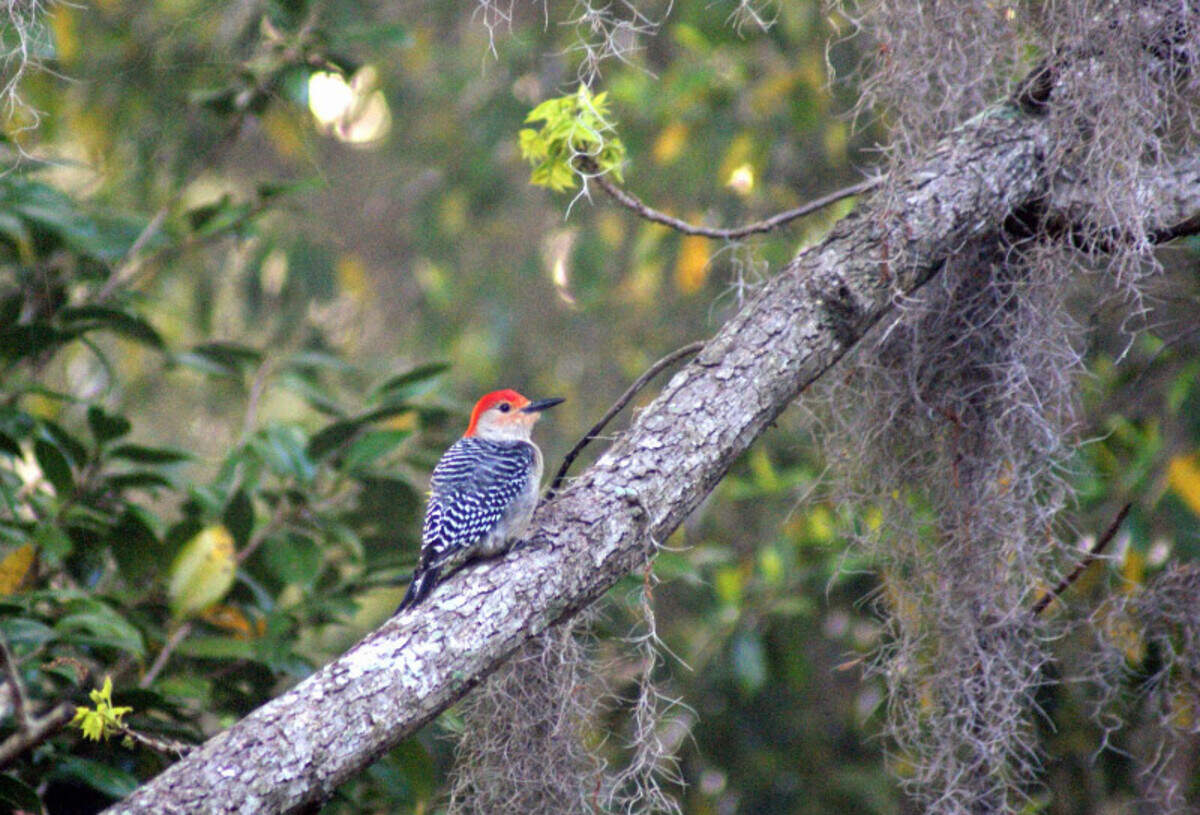
Now what in the Sam Hill does zygodactyl feet mean and what does “usually extensible” tongue mean? I declare, looking up one simple word turns into looking up more words to explain what the words in the original definition meant. Are you with me?
Turns out, zygodactyl feet means that the two inner toes point forward and the two outer backward. Aha! So that’s what allows the woodpecker to skitter around a tree trunk upside down and all around without falling off, because they have two toes pointing forward and two toes pointing backward on each foot. Cool!
And the “usually extensible tongue” means its capable of being extended. Of course! How else would these pile-driving birds be able to extract those insects out of those neatly drilled holes? The tongue is also pointed with barbs on the side and coated with thick saliva, enabling it to capture small insects and ants. They also eat berries, fruits and nuts.
To further my woodpecker education, I browsed through my Compton’s Pictured Encyclopedia so as not to leave out any important, pertinent information on this unique creature God created. Woodpeckers are built for powerful hammering, making you wonder if they ever end up with an Excedrin headache, especially when they spot an insect on the side of your home, making you think someone’s knocking at your front door.
Jerking its head up and down when rapping the bark of a tree with its hard chisel-like beak, the sound is like a riveter’s gun and wood chips go flying. Sometimes this drumming sound is a woodpecker in search of food or drilling out a hole for a nest, while other times they use this loud drumming in the spring as their mating call, while others, especially the Northern Flicker, adds a little pizzazz to attract a female by performing a comical courtship dance.
When digging their nest holes in trees they leave fine wood chips in the bottom of the nest to cushion the eggs. Of course, the female woodpecker, like any good mother or housewife, inspects the first drillings of the male woodpecker and if completely satisfied sets in to helping him complete the task. Most species lay four to six eggs, but the northern flicker sometimes lays as many as nine.
A short story in the Compton’s Encyclopedia of a baby flicker, “How Goldenwings Learned to Fly,” provides a whimsical, lighthearted read. In short, it reads: “Goldenwings, a little flicker, waked one morning in early spring and opened his mouth as wide as he could. ‘I’m hungry! I’m hungry!’ he called. He made so much noise that his five little brothers and sisters opened their eyes. Then they all began to call for food as loud as they could.
“Mother flicker put her head at the small round opening of the hole she and father flicker had made with their sharp bills, taking more than a week to hollow out, and said, ‘Oh, so you’re awake and hungry. Snuggle down a minute till father and I bring your breakfast.’
“But Goldenwings decided instead to go out on a branch and wait in the sunshine. Getting very hungry, he called out as loud as he could, ‘Mother, father, come feed me!’
“What is all this noise? Said a voice.” A screech owl poked his head out of a hole farther up the tree. ‘How do you suppose I can sleep?’ Goldenwings looked up and saw two large, fierce-looking eyes staring down at him and he became frightened, but was quickly put at ease when mother flicker came back with a fat caterpillar and dropped it in his opened wide mouth. When the screech owl learned from father flicker that they had drilled the hole in the tree that he was now using as his home, he said, ‘Well, I declare, had I known that, I wouldn’t have scolded Goldenwings for making so much noise. I’m obliged to you for my home.’
“Later, when Goldenwings decided to go out on his own to learn how to fly, he fell from the branch with a thud on the ground right beside a fat Robin looking for a worm in the grass. Having never been on the ground before Goldenwings hopped around and caught some insects crawling in the grass with his long sticky tongue.
“Mother flicker came to him and coaxed him into fluttering his wings and fly a little above the ground before the two of them, using their strong tail feathers and sharp claws, hitched themselves back up the tree to their nest. Goldenwings was so excited he called to his brothers and sisters, ‘I know how to fly! I know how to fly!’ “
Again, I end with a favorite Ralph Waldo Emerson quote: “Nothing great was ever achieved without enthusiasm!”
Jean Tanner may be reached at jstmeema@hargray.com.
This story was originally published February 25, 2020 at 3:24 PM.