
Lowcountry summer nights are filled with the songs of some very small singers
If you grew up in the years prior to early 1950s and lived in the country, you probably were lulled to sleep at night by the sounds of summer drifting through a raised bedroom window that allowed a gentle breeze in.
In the post-World War ll economic boom, residential air conditioning became just another way to keep up with the Joneses, but my families names weren’t on that list.
In our two-story house, my sister and I shared a bedroom that had four full length windows while our brothers shared the upstairs bedroom with four windows. Daddy had a giant attic fan that pulled in glorious cool air on sweltering summer nights in rural Bluffton. He also had cows that slept grouped together in the fenced field right outside our windows, so not only did we hear the orchestrated buzzing of cicadas, crickets, and katydids, we also heard the soft lowing of the cows and caught the whiffed’ mixture of dew-on-dry-grass odor with a little "cow" mixed in.
A majority of cicadas live in deciduous trees and pine trees and keep their musical talents revved up during hot summer months.
The 17-year periodical cicadas last emerged in South Carolina in the spring of 2007 and will next return in 2024. The 17-year cicada is often incorrectly called the 17-year locust, but true locusts are grasshoppers. Any short-horned grasshopper is a locust.
Seventeen years of slumber in the ground, five weeks of joyous life in the light of the sun, and then death, that is a cicadas’ life story.
It is one of the long-lived species of insects. No other insect is known to live longer, except perhaps the termite queen. This cycle creates a quandary. Why does it take so long for this little winged insect to develop when a full grown lion develops in three, a giraffe in four, and a rhinoceros’ in 15. No one can answer.
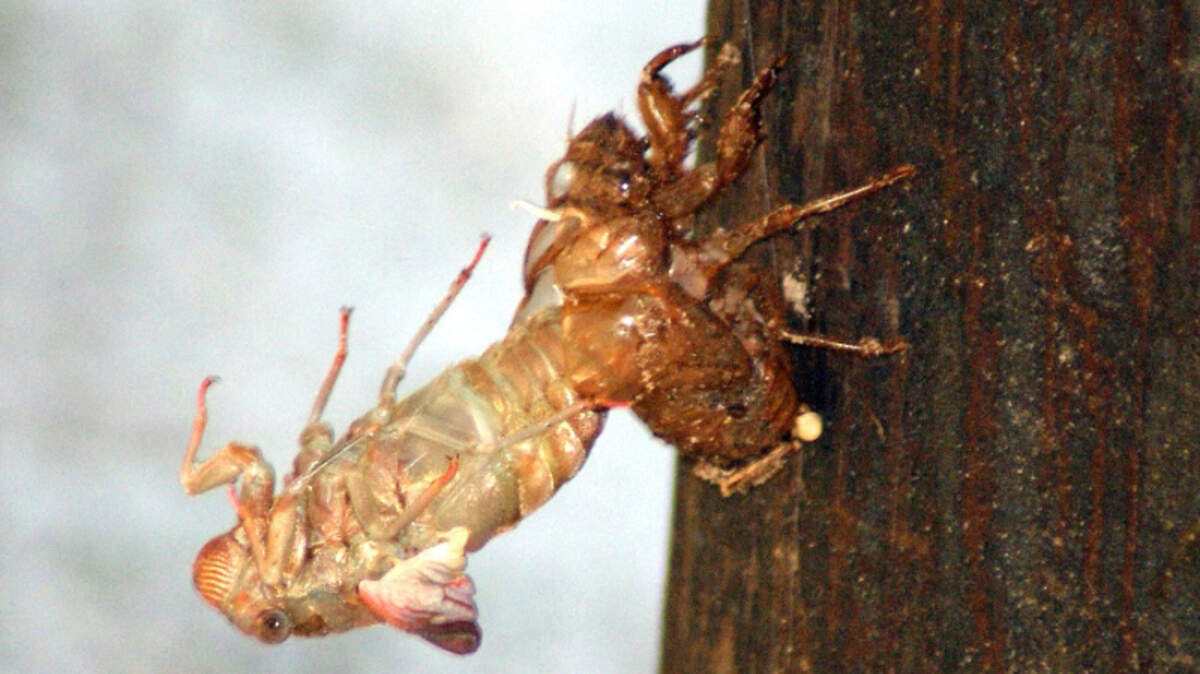
Newly hatched cicadas’ are active underground, tunneling and feeding. They do not sleep or hibernate and when soil temperatures eight inches below the surface warm to 64 degrees, they emerge from the ground as nymphs, climb the nearest tree and begin to shed their nymph exoskeleton. These empty shells we, as children, placed on our noses. We called them locust shells but should have called them cicada shells.
The cicadas’ claim-to-fame is its singing. The high-pitched song is actually a mating call belted out by the males. They are the only insects capable of producing such a unique and loud sound. Since only the males can make this noise, it led an ancient Greek to say, “Happy are the cicadas’ lives, for they have voiceless wives.”
Cicadas’ usually sing during the heat of the day. They sing so loudly their song is painful to birds’ ears and interferes with their communication. Even cicadas’ must protect themselves from the volume of their own singing. They have mirror-like membranes called the tympana which functions as ears connected to an auditory organ by a short tendon. When the male sings, the tendon retracts, creasing the tympana so it won’t be damaged by the sound.
Cicadas’ start their musical-insect-chorus in late afternoon with the ascending "zing-zing-zing" coming from the trees.
At dusk, the field crickets start their chorus by rubbing their wings together to produce a clicking sound, produced so fast you don’t hear the click but a trill. Here again we find that only the male crickets sing. The musical "chirrup, chirrup" of these little insects is such a pleasant sound that the phrase "as merry as a cricket" has become proverbial.
In his famous story, "The Cricket on the Hearth," novelist Charles Dickens has the plot center on the joyous chirp of a cricket, who sings when things are going smoothly but is silent in times of trouble.
Late at night, the last singers of the day take over and sing until the wee hours of the morning — the katydid.
Throughout the late summer nights, the katydid sings unceasingly in the tops of the tallest tree: "Katy did, Katy didn’t, she did, she didn’t."
It is one of the most musical of our insect songsters. Again, only the male katydids are the music makers, and the song they sing is the mating call.
On a very warm summer night, stepping outdoors around midnight, you will hear a cacophony of an insect orchestra that always fills me with a little nostalgia of childhood days. Their songs will grow slower and quieter as temperatures drop until they eventually fall silent by October.
But, for now, it’s their season; so lend an ear to be filled with nature’s insect music