Marines worry 115 wells near Beaufort base could be tainted with firefighting chemicals
Marine Corp Air Station Beaufort has 28 sites where potentially harmful chemicals known as PFAS have tainted the groundwater, including some areas with concentrations of 1 million parts per trillion — far above what’s considered safe for human consumption.
The main threat, according to Capt. Thomas Jones, a MCAS Beaufort spokesman, is whether the pollution has migrated off base and tainted private drinking water wells nearby.
“The big thing is identifying drinking water wells off base because that’s the chief concern, is that people are consuming things that include PFAs that are over that 70 parts per trillion (ppt) lifetime health advisory,” Jones said.
PFAS stands for per- and polyfluoroalkyls, a family of 5,000 “forever chemicals” widely used since the 1950s in firefighting foams, food packaging and non-stick cookware, that have been linked to health problems.
Most of the properties neighboring the base are hooked up to the public water system run by the Beaufort-Jasper Water and Sewer Authority (BJWSA), which draws its supply from the Savannah River. The air station also gets its water from BJWSA.
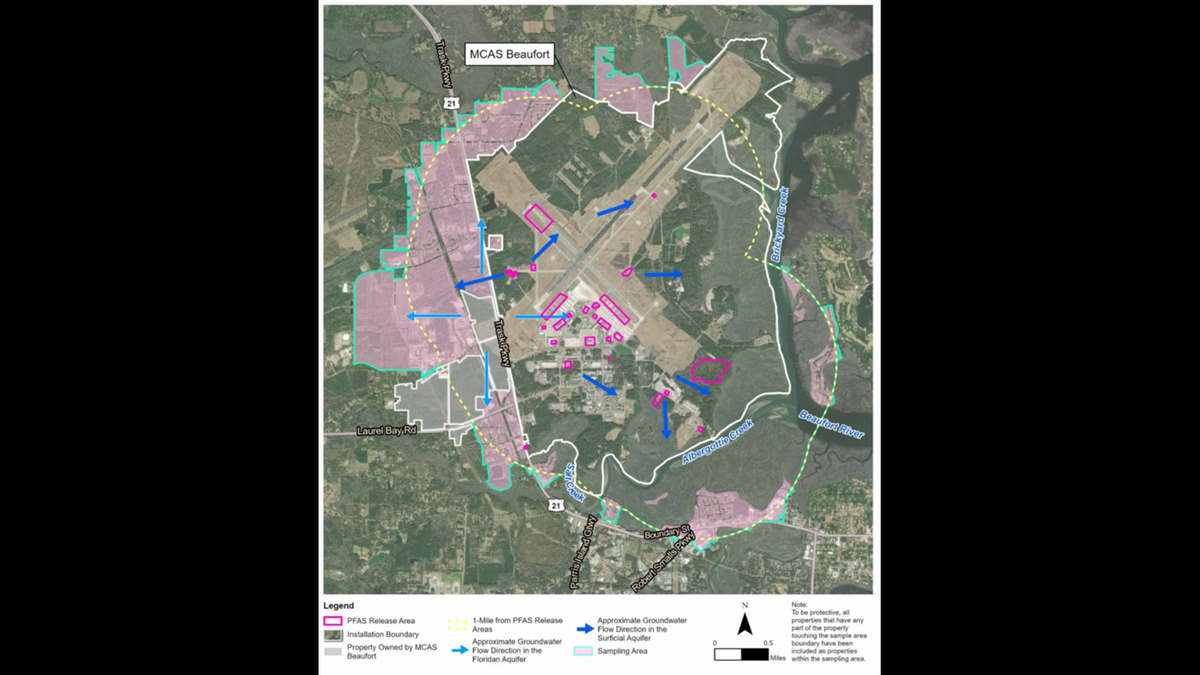
But 115 private drinking water wells, potentially, also are located within a mile of the base and should be tested, said Chris Vaigneur, MCAS Beaufort’s environmental director.
MCAS began reaching out to property owners and urging them to allow the base to test those wells. The sampling area surrounds the base. It includes properties to the west, across Highway 21; as far south as Boundary Street; across the Beaufort River to the east, and land north of MCAS Beaufort.
“We are not sure if those wells are impacted yet,” Vaigneur said. “Instead of waiting for the rest of the cleanup process to play out, we’re trying to be proactive.”
An open house on Thursday called by the military to explain the well testing procedure drew 36 people. Officials with the Navy, Marines, South Carolina Department of Health and Environmental Control and the Agency for Toxic Substances and Disease Registry (ATSDR) were on hand to answer questions.
PFAS found in shallow groundwater on base prompted the meeting and the effort to do more widespread testing. Concentrations of PFAS at the base locations ranged from 40 ppt to a million parts per trillion, Vaigneur said. The highest concentrations, he said, were found in firefighter training areas.
“The Navy has a responsibility to address these,” Vaigneur said, “so we will be doing cleanup actions.”
The cleanup process explained
Cleanup on the base will likely involve a pump and treat system, Vaigneur said, where groundwater is pumped through a treatment process.
If PFAS are found in wells off the base above 70 ppt, residents would be immediately provided with bottled water at no charge, Vaigneur said. The long-term solution, he said, could involve having them hook onto BJWSA’s public system or get a home filtration system.
PFAS exposure at higher levels over decades may cause health problems including increased cholesterol levels, decreased immune response, small decreases in infant birth weights and increased risk of kidney or testicular cancer, according to the toxic substances agency.
The 70 ppt health advisory means that “you could drink water that had that level of PFAS in it everyday of your life for 70 years and you wouldn’t see health effects,” said Sue Casteel with the ATSDR.
The EPA, however, is in the process of coming up with new standards because PFAS is a chemical class that, until fairly recently, Casteel said, “We didn’t know how harmful it was.”
The Department of the Navy began investigating PFAS releases nationwide that could impact drinking water in 2016.
There are now ongoing investigations at almost 150 installations and some $100 million in funding was earmarked for the ongoing work in 2022. To date, PFAS levels above the 70 ppt health advisory have been found in off-base drinking water near 16 bases. At another 39 sites, PFAS concentrations were below the health advisory threshold.
Most of the contamination at MCAS Beaufort is at sites where firefighting foam was used, said Jones, the MCAS Beaufort spokesman. The sites include locations where there were fires, hangars with fire suppression systems, firefighting training areas, fire stations, sewage treatment plants and landfills.
In the 1970s, the Department of Defense began using certain firefighting foams that often contained PFAS.
Using records and on-the-ground investigation, MCAS has identified properties with drinking water wells that are within the flow direction of the shallow aquifer, up to a mile from the release sites. Those property owners were then advised to attend Thursday’s meeting and to get their water tested, Jones said.
“And if they come in with a test that’s above the 70 ppt,” Jones said, “then we can immediately have the Navy start providing bottled drinking water to them as we look for a solution for how to give them a long-term fix.”
Property owners and tenants who drink water from a well on a property located within the sampling area may request sampling by calling 800-818-8455. Appointments will be scheduled from Dec. 9-21.
This story was originally published December 9, 2022 at 1:53 PM.