
Menu designs can tempt, entice -- subliminally
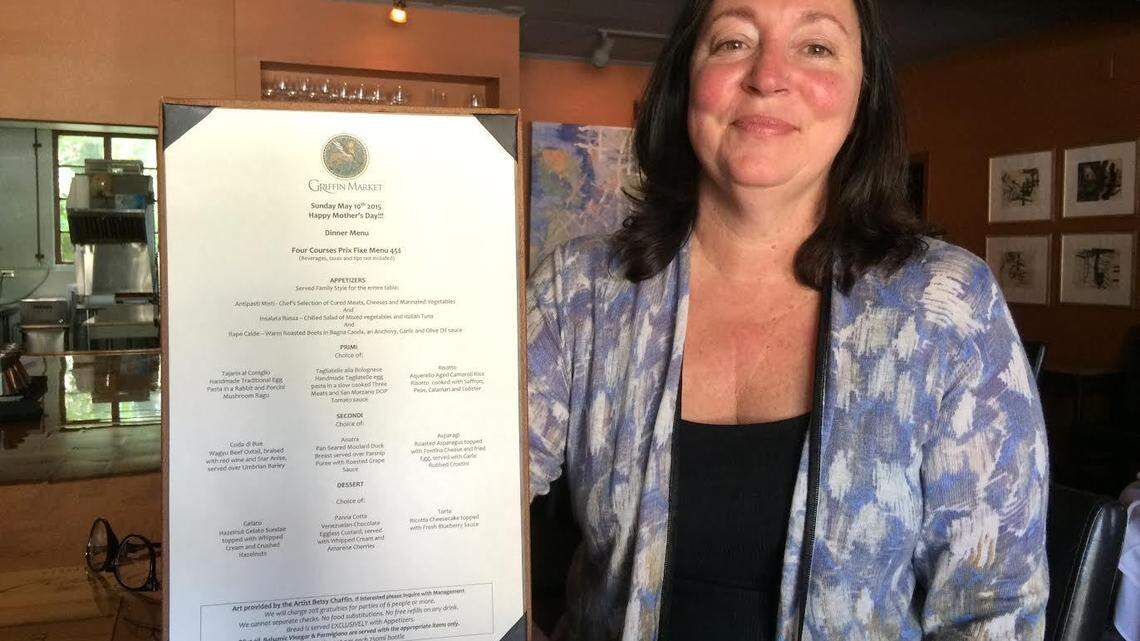
The menu posted outside Griffin Market in Beaufort seems simple.
Black ink on white paper with the names of Italian dishes followed by concise, English descriptions.
Chef and owner Laura Bonino likes it that way. She doesn't see her menu as art, or a place to experiment, because precision and simplicity are the best tools she has for getting people through the door of her Carteret Street restaurant.
But Bonino knows there's a science behind even the barest of menus.
Her white paper is actually pale gold, which she says is the best background for readability.
She keeps prices relatively similar because otherwise, the cheapest option far outsells the rest.
And the names of her courses -- Primi, Secondi -- encourage diners to partake in multiple small dishes, a concept so different from the overflowing portions and doggy bags they expect from Americanized restaurants.
"Dining in Italy is all about spending time with your friends or a loved one and having a whole meal," she said. "Don't come in and just jump to an entree. There isn't one on the menu. It's going to say Secondi and, you know, that means second."
"That's what we're trying to do," Bonino said, "is lead you into an Italian meal."
While each restaurant has a different feel, the goal of a menu is singular -- to convince diners they're in for a good meal at a good price in a good environment.
From there, chefs, owners and professional menu designers have some choices to make, and science suggests some psychological tricks are more successful than others.
From camouflaging prices to using different colors to stimulate the appetite, well-designed menus can steer diners' eyes wherever a restaurant wants them to go.
Claude Melchiorri, owner of Claude and Uli's Bistro in Bluffton, described it another way.
"When people are going to restaurants, it's like going to the theater," the French chef said. "Our job is to make them comfortable."
Melchiorri says diners expect a fine-dining, authentic experience at Claude and Uli's, and that begins with his menu -- tan and red, with French names and formal descriptions like snails served "piping hot" and housemade pasta with "a collage" of fresh shellfish.
At Pour Richard's, another upscale Bluffton restaurant, descriptions are also a key part of the menu.
Their high price tags, however, are softened by corny phrases and wordplay.
The wasabi edamame hummus is "Soy nice!," for example, while the black-eyed pea variety is the "Southern answer to chick peas."
And rather than label one of their oft-changing small plates "Tuna of the day," the restaurant offers, "Tuna Madness: A fish lover's drug of choice."
"We like a little tongue in cheek," owner Allyson Rogers said. "This is Bluffton. I know people want to eat foi gras in their flip flops and not be so pressured to have the white tablecloths."
The menu follows a few other best practices.
Each category has eight or fewer items per category, which follows the psychological theory of the "paradox of choice." Some menu engineers preach that the more options you give diners, the more anxious they'll feel about making the right choice.
Pour Richard's also tops its entree list with its most expensive dinner, a $38 bacon-wrapped prime filet. Some studies suggest subsequent items, like the $28 scored flounder, are a much better deal, or that the prime filet would be a much tastier option.
Rogers said both menu features are coincidence.
"It still takes a lot of money to retire around here," she said. "People who are ordering that flounder like that flounder."
And while she said her small kitchen couldn't accommodate a massive spread, customers' have more options than the menu suggests. Servers sometimes have to take a breather while listing the seven or eight daily specials Pour Richard's offers, many of which cost more than $40.
Pour Richard's also doesn't shy away from using dollar signs, though studies suggest they draw more attention to prices.
Other restaurants, like Ruby Lee's on Hilton Head Island, use the symbols out of tradition.
"I'm meat and potatoes," owner Tim Singleton says. "I know that's fazed out -- a lot of people don't write sentences anymore because we text. But I'm just about good ol' fashioned."
One local business, though, manages to highlight its prices without the symbol.
At Neo off U.S. 278 in Bluffton, shrimp and grits costs "25.19." The mahi-mahi is "26.47." Want gluten-free pizza crust? Add "2.51."
Chef Russell Keane wants people to know what they're paying, arguing his prices are competitive and low for the quality of his local, organic ingredients.
That, and his wife hates even numbers.
"And me, myself, I like to mess with people," Keanne said.
Another aspect of his menu is more traditional. The more words in a description, the more value customers perceive they're getting.
Keane frequently drops the name of the Georgia farm that supplies his beef and pork -- Hunter Cattle Co. -- so customers will recognize the brand at farmers' markets, Keane said.
He's also generous with the phrases "farm fresh" and "local," and plumps up descriptions with words like "creamy," "charred," and "tender."
"When people read one of my menus, I want them to start salivating," Keane said.
"I want them to say, 'Man, that looks good."
Follow reporter Rebecca Lurye on Twitter at twitter.com/IPBG_Rebecca.
This story was originally published May 17, 2015 at 7:15 PM with the headline "Menu designs can tempt, entice -- subliminally."