
Repairs finally underway on house at center of defective-construction Supreme Court case
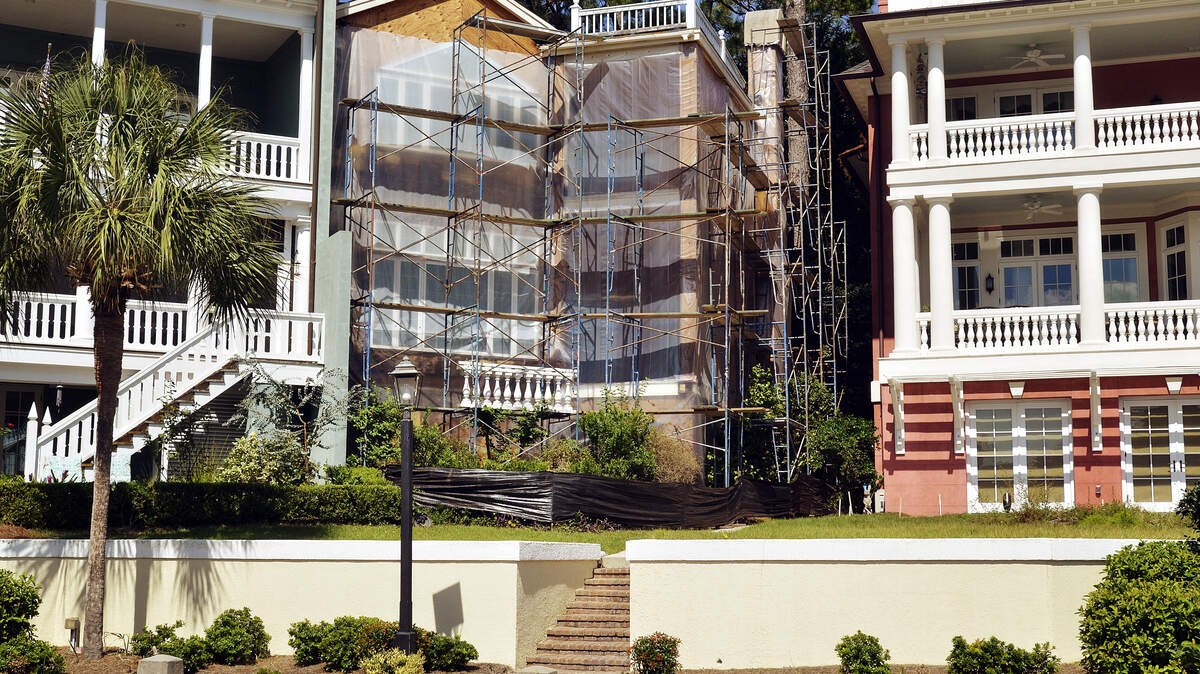
For 12 years, Danielle Smith has watched her Windmill Harbour home crumble around her.
Moisture damage has rotted the walls, dissolving them in some spots. With the siding removed, she can now see a nearby harbor through a floor-to-ceiling crack in her living room.
After years of spending almost $25,000 on unsuccessful legal battles and two years to secure a loan, she can finally make repairs.
Smith hopes her problems will serve as a cautionary tale for others buying a home built by someone who is not a licensed contractor.
The synthetic stucco used to build the house was faulty, causing water damage throughout that will cost $500,000 and six months to repair.
She filed a lawsuit against the former homeowner 12 years ago, seeking damages to be set by the courts for the faulty construction.
Her case went all the way to the state Supreme Court. The court ruled against her in 2008, stunning some in the home-building business.
The ruling said that the former owner, who had hired subcontractors to build the house, could not be held liable for the damage because he built it as a private home and had originally intended to never sell it. The ruling also indicated that those who buy such private homes can't expect the same legal protection as buyers of contractor-built structures, some home builders have said.
Legal action prevented Smith from making repairs to her home, as she was advised to leave the house in its deteriorating state to preserve evidence for her case. A forensic report completed before she filed the suit had already shown parts of her home were rotting from the inside out.
She had no idea how bad the damage was until the synthetic stucco that wrapped her home came down two weeks ago and repairs began.
'STRIP AND START OVER'
Nearly every plywood panel on Smith's home shows rot from moisture damage. A wall in the kitchen crumbled behind the stucco, leaving a gas line exposed. Through the crack in her living room, she can see the S.C. Yacht Club harbor.
The worst areas are around the windows. None had proper flashing, which prevents water from intruding into the walls, Smith's contractor, Daniel Hergenroeder, said.
He said Smith's home is an extreme example of moisture damage, a prevalent problem in the coastal Lowcountry. Hergenroeder said about 40 percent of the homes he's inspected or worked on over the years have had some such damage.
"In almost all cases, it happens because the system wasn't installed properly," he said. "It doesn't matter if you have HardiePlank or hard-coat stucco if it isn't installed right. It's not our first rodeo. We have to strip it and just start over again."
Those who have installed similar synthetic stucco have faced lawsuits around Beaufort County. The county received a $7 million settlement after faulty stucco was installed on the courthouse in Beaufort. Repairs to the exterior were part of a $13 million renovation of the county courthouse finished earlier this year.
And in Sun City Hilton Head, a class-action lawsuit over defective stucco is still pending.
Smith's home used an exterior insulated finish system, or EIFS, consisting of a foam-board insulate and a coating to give the home a stucco appearance.
The material was recalled after it was found to trap moisture in the walls, leading to severe rot, according to Ashley Feaster, executive director of the Hilton Head Area Home Builders Association.
Although a water barrier was placed around the outside of a carriage house above Smith's detached garage to protect the plywood walls beneath, it was not placed around the house. The foam insulation and synthetic stucco showed no hint of the rot beneath. Smith likened it to the chocolate topping shell that hardens as the ice cream melts underneath.
EIFS was the subject of several class-action lawsuits after the moisture problem was discovered, and commercial builders had to repair the damages from EIFS, Feaster said.
LOOPHOLE
Smith sued the home's original owner, Joseph Breedlove, in 2002. She had purchased the home from Breedlove in 1999 for $590,000, but didn't discover the problems until trying to sell it to a neighbor a few years later.
Breedlove had it built in 1993 for his wife and son, hiring subcontractors for different jobs. The Breedloves later moved to Atlanta and put the home up for sale, according to court records.
Attempts to reach Breedlove for comment last week were unsuccessful.
Smith did not hire a professional inspector when she purchased the home from Breedlove, instead relying on an inspection by her husband at the time, who worked in construction.
When she tried to sell the home three years later, a forensic report revealed the defects with the synthetic stucco. The house had a slight mold scent, and the report showed the stucco was rotting.
Smith's suit reached the S.C. Supreme Court in 2008. Justice Costa M. Pleicones wrote in his majority opinion that Breedlove, who had no professional experience as a contractor, had no obligation to honor a warranty on the home because when he set out to build the house, he had no intention of selling it.
Feaster and others are worried that the Supreme Court decision created a loophole for non-contractors, absolving them from being liable for faulty construction if they later sell the house. Commercial builders are liable for eight years after construction, under the state's statute of repose, said Mark Nix, executive director of the S.C. Home Builders Association.
So far, though, it appears no one has used that loophole, and Smith's case still appears to be unique. No one with the S.C. Residential Builders Commission could recall a similar case, said Lesia Kudelka, spokeswoman for the S.C. Department of Labor, Licensing and Relations, which oversees the commission.
Feaster said the house should never have been allowed to be put up for sale.
"It's beyond my understanding," she said.
COURT CITES LACK OF INSPECTION
The Supreme Court, however, didn't see it that way.
A professional inspection before the purchase would have revealed many of the home's defects, but Smith's failure to have one completed weighed in the Supreme Court decision, Pleicones wrote in his opinion.
"Smith had every chance to have the residence inspected before delivery of the deed, but she relied on her husband's cursory inspection," the opinion read. "Simply put, this was not a one-sided transaction where Smith had no choice but to rely on the construction skill and expertise of Breedlove."
Smith said she hopes her home becomes an example for needed changes. She wants to see clearer legislation that would make private builders face the same liabilities as commercial ones.
"I would question everything, had I known what they are uncovering and repairing for the next several months," she said.
"No one should have to go through what I've gone through."
Follow reporter Matt McNab at twitter.com/IPBG_Matt.
Related content:
Court ruling may create loophole in defective home construction cases, April 30, 2008
This story was originally published October 11, 2014 at 7:14 PM with the headline " Repairs finally underway on house at center of defective-construction Supreme Court case."