
Oceanfront building could produce a future burden for taxpayers, critics say
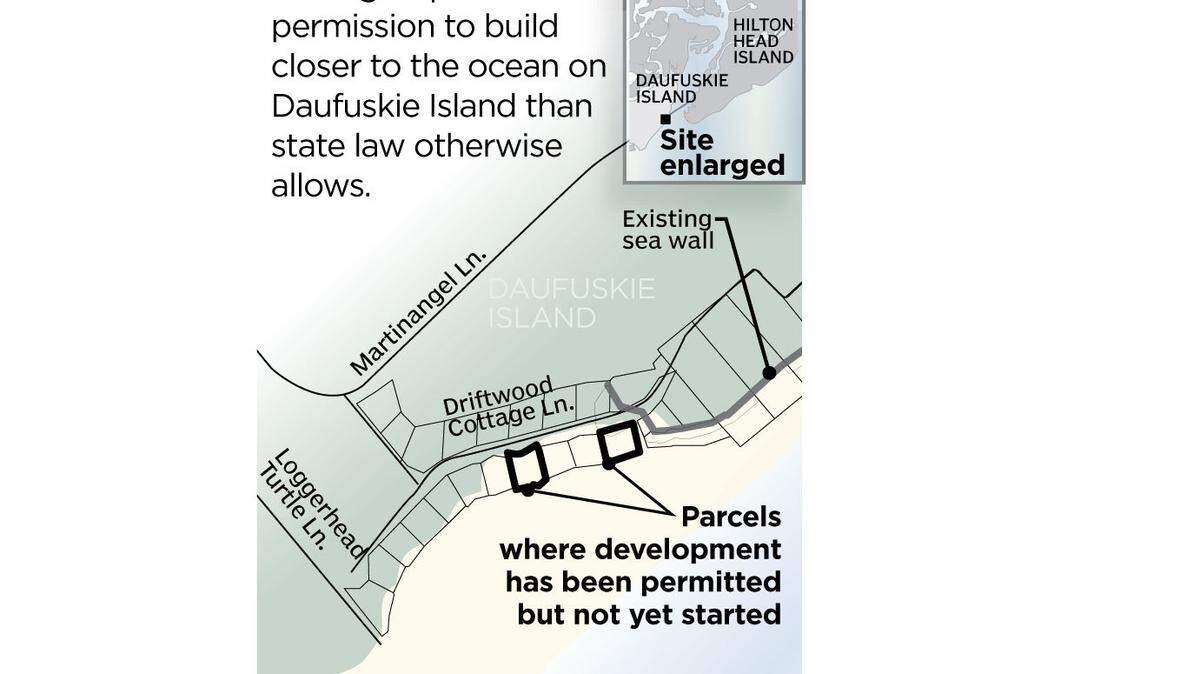
A little-known section of state law has allowed property owners to build large beach houses in storm-threatened areas near the ocean -- development that critics say could one day cost taxpayers a bundle.
About 60 seaside landowners -- including some in Beaufort County -- have persuaded state regulators to grant special permits so they can build closer to the beach, state records show.
In more than a few cases, houses approaching 5,000 square feet have been built legally or have been approved to be built along some of the most erosion-scarred sections. Records show some of the homes are at least 20 feet closer to the ocean than state law would have allowed without the special permits.
That increases the chances that taxpayers eventually will pay to help property owners protect their homes from erosion or rebuild them after a major storm, critics say.
Owners of homes threatened by the sea often seek government-funded beach renourishment projects. Taxpayers have spent more than $200 million on such projects in South Carolina since the 1980s -- including on beaches where homes have been built with special permits.
Oceanfront landowners also sometimes seek government approval to build seawalls or sand-trapping devices, such as groins that jut out into the ocean. Groins slow beach erosion where they're built, but they erode beaches and damage property down current. After big storms, the government sometimes has to bail out the federal flood insurance program to pay for damage to oceanfront homes.
"The problem is that our current policies and law let people move to high hazard areas, then ask for public relief,'' said John Mark Dean, a University of South Carolina marine scientist.
East Carolina University geologist Stan Riggs said approving special permits for building closer to the ocean is short-sighted. Not only is the sea level rising, but storms are an unavoidable reality, he said.
"These areas are going to be wiped out when the next storm comes through,'' Riggs said, and seaside landowners "are the first people crying at the door when they get wiped out.''
OWNERS: NO FAVORS GRANTED
Whether to continue issuing special permits to build near the beach is among the issues under increasing discussion these days.
The S.C. Department of Health and Environmental Control has scheduled a public hearing today to review plans for a new oceanfront building on Folly Beach that critics say would jut too far onto the shore. DHEC also is contemplating whether to issue permits to bolster seawalls that protect homes on Daufuskie Island.
Meanwhile, the state Blue Ribbon Committee on Shoreline Management is examining whether to tighten beach-management laws or give up on the 23-year-effort to move construction farther from the shore.
The law was supposed to push development back from the shore over time to minimize the hazard to coastal property and protect public beaches from erosion. But the called-for "retreat'' from the beach hasn't happened. And the 1988 law contains sections that, in many cases, have allowed development closer to the ocean -- including the provision for special permits.
Records obtained by The State newspaper indicate most of the special permits -- 27 -- have been granted for landowners in Charleston County, mostly at the Isle of Palms and Seabrook Island. The majority of the others were in Beaufort and Georgetown counties. But special permits have been issued in every oceanfront county since the legislature amended the 1988 law in 1990 to allow the exceptions, according to DHEC.
Among those who have received the permits are state policymakers, business people and a nationally known sports figure, according to public records reviewed by the newspaper.
People have built houses close to the ocean on more than 40 of 65 lots after receiving special permits, records show. Few requests for permits have been denied.
Property owners interviewed by The State said they received no special favors and were merely exercising their legal right to seek the exemptions.
Coastal regulators say they are required by law to grant permits if landowners follow the rules. The law says a special permit may be issued near the beach if homes aren't built atop "a primary oceanfront sand dune" or on the active beach. If erosion begins washing the ocean under a house, the permit recipient must move the home -- although DHEC has never required that.
"DHEC staff discretion is limited," agency spokesman Dan Burger said in an email.
Critics say the law needs strengthening, but they also question whether DHEC is influenced politically in making decisions.
HOW IT WORKS
Under the 1988 law, people are not supposed to build seaward of an oceanfront restriction line, called the baseline. To build farther seaward, property owners must persuade the state to move the baseline closer to the ocean or seek special permits.
In 2006, DC-CR Associates, a development group from Hilton Head and Daufuskie islands, received permission to build houses on two lots "entirely seaward'' of the baseline on Daufuskie.
DHEC records indicate the houses -- approved for 26 and 32 Driftwood Cottage Lane, part of the Driftwood Cottage community -- have not been built. An application filed with the agency by the owner of an adjacent property, who seeks improvements to a nearby seawall, indicates those lots have already eroded into the ocean. That document was dated May 19, 2011.
Attempts Wednesday to reach Susan Card, a Daufuskie resident and DC-CR partner, were unsuccessful.
In 2006, DHEC denied special permits for construction on the lots, saying building on a shoreline with an erosion rate of 10 feet per year was not advisable. But the DHEC board overruled the staff. The board said denying the permits would yield "no reasonable use" of the property. Agency maps did not clearly show how far past the baseline the homes would be.
An attorney with the McNair Law Firm's Hilton Head office, which represented DC-CR Associates, said the development company has sold most of the lots nearby but still owns the two that have eroded. Bret Pruehs added that the lots have been listed for sale periodically, but he does not know if DC-CR had any plans to build there.
"The active beach has moved landward, and things are way different than they were a few years ago," Pruehs said.
Others receiving special permits to build close to the ocean include:
A NEW DECISION AHEAD?
South Carolina allows special permits because legislators feared legal liability following Hurricane Hugo in 1989.
After the storm, landowner David Lucas sued the state because regulations prevented him from building as he wished at the Isle of Palms. The state was forced to pay Lucas more than $1 million for his oceanfront land.
Ann Timberlake, director of the Conservation Voters of South Carolina, said it may be time to crack down on special permits.
The Blue Ribbon panel is expected to make recommendations to the DHEC board next year.
This story was originally published July 6, 2011 at 7:24 PM.