‘Secret meetings’ by Beaufort council bothers residents. ‘I’m really tired of it’
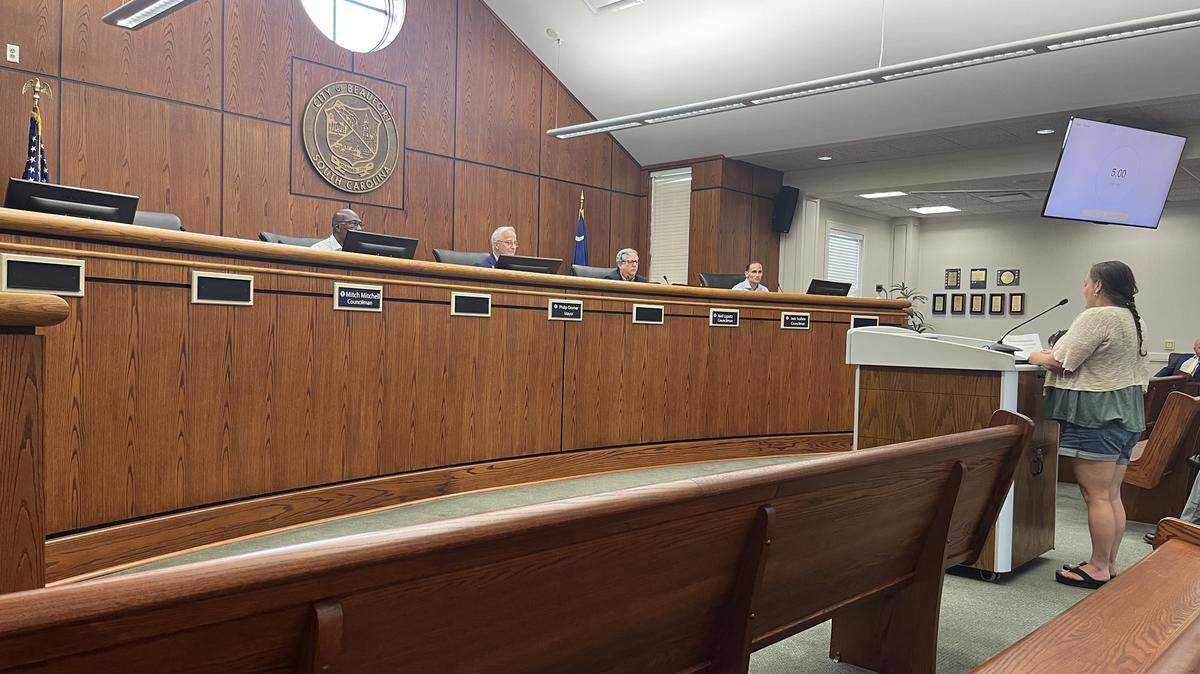
Private, closed-door discussions among Beaufort City Council members during public meetings have been the norm so far this year, not the exception to the rule of openness.
The lack of transparency is increasingly getting on the nerves of residents. Even the city’s mayor says he’s had enough.
“Executive sessions” have come at nearly every public meeting the city council has conducted in 2026. They routinely involve discussions of sensitive and sometimes politically charged legal, personnel and economic issues.
It’s not illegal to shut the public out of certain discussions, as long as the closures are properly announced with specific descriptions of the topic so the public knows what’s going on.
But distrust from residents is mounting over the number of these closed meetings and the lack of information on the agendas explaining the context, leaving residents in the dark.
“There’s just not enough of a description of what’s going to go on,” Paul Trask, a resident and developer, told council members Tuesday, looking at the agenda and the items listed under “executive session.”
Trask also pointed out that executive sessions are optional, not required.
“This material should be released by the city,” Trask argued. “It should be made public. It seems like when things go haywire for the city, it happens in executive session. A prime example would be the lease with Safe Harbor.”
The city discovered in 2019 that its lease with Safe Harbor to manage the city marina was improperly approved without the required two rounds of votes and public input. The mistake was fixed, but later led to a lawsuit.
Trask and others are saying enough is enough. They’re requesting the city stop discussing so much in private.
Their push for more disclosure comes as the city’s secret talks have ramped up because of an investigation into a city screw-up involving the release of sensitive documents that’s now almost a year-old.
Council members also meet in executive session to talk about economic development activities in Beaufort’s Commerce Park, another issue that’s of high interest in the city. Other times, they meet to talk about possible appointments to boards and committees.
Council members conducted their final regularly scheduled meeting Tuesday before a summer break that will see them reconvening for regular meetings in mid-August.
Once again, the council, citing the South Carolina Freedom of Information Act, closed the doors to the public to talk about several sensitive items near the end of the meeting, cryptically listing “FOIA Investigation” and “Parcel K in the Beaufort Commerce Park” under the heading “executive session.”
According to city records, the City Council has gone behind closed doors 17 times over the first 7 months of the year.
In fact, council members have gone into executive session to talk about public business in all but one meeting and their two-day retreat when the council meets to stake out the year’s priorities.
Later in Tuesday’s meeting, Council members ignored Trask’s advice and voted unanimously to convene into closed session.
Graham Trask, another local developer, took his criticism a step farther, calling council members “cowards” for not releasing information about the FOIA investigation and the Commerce Park. “Tell people what you are doing,” he said.
Technically, the meetings that City Council members are conducting behind closed doors are listed publicly on the council’s agenda as “executive sessions,” not as secret meetings, as some residents describe them.
What is said in the meetings, however, is only known to City Council members and their attorney, Ben Coppage, and City Manager Scott Marshall because the public isn’t allowed in to listen.
The state’s Freedom of Information Act allows local governments to close meetings but not before they publicly cite one of several exceptions and announce at the meeting a description of the specific topic to be discussed.
The reasons the city most often cites for closing its meetings are receiving legal advice, selling or buying property, appointing people to boards and committees and discussions about “personnel employed by the City Council,” which is City Manager Marshall.
FOIA investigation
In August, the City Council voted to hire a Charleston-based law firm to investigate how 9,000 pages of emails and attachments that were accidentally released. The document dump was part of a Freedom of Information Act request by Beaufort couple Autumn and Kiel Hollis, who were seeking information about how city police handled a missing persons case involving their daughter.
Among the trove information inadvertently released included sensitive information about their daughter and at least one other child, said Amanda Patel, a local educator and parent. Patel has questioned city officials for months about how the confidential records were released, and how the public still doesn’t have answers a year later.
She did so again Tuesday, right up to the point in the meeting where the City Council closed the meeting to receive another update on the FOIA investigation and other issues.
“Buried beneath the city’s mistakes are children who never asked to become a part of this story,” Patel said during the public part of the meeting.
Beaufort Commerce Park
The city’s relationship with the Beaufort County Economic Development Corp. in developing the Commerce Park has also come under criticism in recent months.
That’s why residents regularly object now when the City Council says it plans to talk about the park in closed session.
In April, the city of Beaufort agreed to sell 32 acres in the Commerce Park to Clarendon Farms for $2.3 million. But the council members rejected turning over $1.2 million of the proceeds to the BCEDC, which helped arrange the deal, as originally intended, after the public pushed back on that part of the deal.
“I’m tired of executive sessions,” said Felice LaMarca, a local realtor who monitors local government. She called them secret meetings. “I’m really tired of it. You do it entirely too much.”
Any meeting in which the Beaufort Commerce Park is discussed, LaMarca said, “I want to be there. You can swear me to secrecy and that’s what it is, a secret meeting. Secret talks. You gotta stop it. We’re noticing and we’re noticing a lot.”
What the law says
Before closing a meeting, the South Carolina Freedom of Information Act (FOIA) requires the governing body to approve a motion citing the exemption from the open requirement. The specific topic must also be cited at the meeting. A general reference such as “personnel matters” is not sufficient, according to the South Carolina Press Association, and just because the city attorney is present doesn’t allow for carte blanche secrecy.
Jay Bender, a South Carolina attorney and expert on the First Amendment and the South Carolina Freedom of Information Act, said the key to whether a meeting is legally closed is what the presiding officer announces at the time of the executive session.
On Tuesday, Councilman Neil Lipsitz moved that the council close the meeting. The motion, which was written on the agenda, included language from the law citing the two exemptions the city was using and gave the brief descriptions of the topics that would be discussed.
If the description listed on Beaufort’s Tuesday agenda was read aloud, Bender said, it likely met the minimum requirements of the law.
But in all likelihood, Bender added, the council had discussions in the closed session far broader than the announced description.
“I would guess that with respect to the receipt of legal advice, council had a discussion that ranged beyond the receipt of legal advice to consider specific actions to be taken,” Bender said. “Executive sessions are not mandatory, and each time a council goes behind closed doors it diminishes its credibility with the public.”
Mayor once called for fewer closed meetings
After he was sworn in to office following a special election in December 2023, Mayor Phil Cromer read a statement that said he wanted “accessible, responsive and open government that represents all of our citizens.”
Afterward, Cromer said his priorities would include trying to reduce the number of closed meetings by the council.
“Unfortunately, we have had some issues come up we didn’t expect, one being the FOIA thing,” Cromer said Wednesday.
The city isn’t trying to do business behind the backs of residents, Cromer said, and is following state law allowing discussions of legal and contractual issues in private. He understands, he says, why people are frustrated.
“I think we have way too many, and I’m hoping in the future, once we get past these immediate things, we can cut that back to only when absolutely necessary,” Cromer said.