Oak tree in Beaufort Burger King parking lot is a whopper. Can it survive?
Burger King is the home of The Whopper. But at one Burger King in Beaufort, the real whopper stands outside.
From the bed adjoining the fast-food restaurant’s parking lot, the giant, 175-year-old live oak extends its branches halfway across four-lane Ribaut Road. Its beefy trunk erupts a few feet from the noisy road as exhaust-spewing vehicles whiz by, while its limbs, draped with Spanish moss, cover the location’s busy drive-through.
By all outward appearances, the long-in-the-root tree with a mushroom-shaped top appears to be an over-matched bulwark against the relentless growth epitomizing modern Beaufort County. But year after year, this woody remnant in the concrete jungle lives on, its shade as constant as the traffic and Whopper orders.
Michael Murphy, a tree expert with Preservation Tree, LLC, looked it over the morning of Tuesday, April 22 as patrons in golf carts and cars ordered fully loaded biscuit breakfast sandwiches and french toast sticks.
“It’s funny,” said Murphy, marveling at the tree and its unusual surroundings. “You look at this tree and it’s huge and it has a big full canopy. You don’t see any die back. Nothing wrong with it. And then you look around, if you took an aerial shot, it’s a 100% asphalt. It’s like it was planted in the middle of a landing field or something. There’s hardly any soil at all.”
The attention-grabbing tree has likely been anchored to the spot for close to two centuries, remaining in place as development in the area has grown up around it. The sturdy fixture could survive another hundred years or more, but it faces challenges.
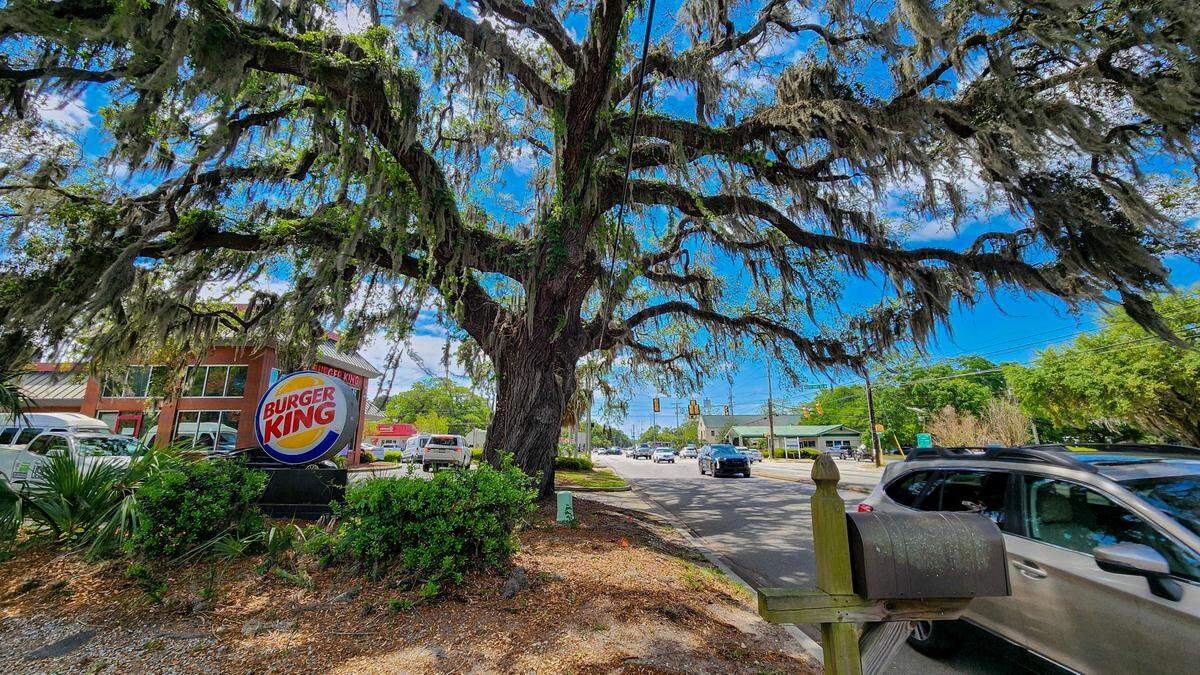
It’s a survivor
The tree is an example of the species’ resiliency and how, with a little effort, communities and builders can save trees that could one day become giants themselves, says Murphy, who often cites it when he speaks about the benefits of trees and how to preserve them.
After all, if a tree can make it to old age in the parking lot of a fast-food restaurant, Murphy says, it can make it almost anywhere.
“It’s not hard to preserve trees,” he said, “you just have to want to do it.”
Today, more stringent protections are in place to protect trees especially the big ones that are so beloved in the Lowcountry. The Burger King tree, Murphy says, got lucky.
“It’s a survivor,” he added.
How did it survive?
But given its location, Murphy can’t help but wonder how it managed to survive the expansion of Ribaut Road and the construction of commercial businesses that surround it.
The trunk of the tree is technically in the public right-of-way along state-owned Ribaut Road, not the restaurant parking lot, but its branches cover the restaurant’s property, including one of its signs. With thousands of customers driving directly past it when they exit the Burger King or drive north and south on Ribaut Road, it may be one of the most recognizable trees in Beaufort County.
“You wonder how a tree like this could get nutrients or water or even the air it needs for the roots to grow and sustain the tree,” he said.
But there’s more to the live oak tree than meets the eye.
An underground root system extends three to four times the area of the tree’s “drip line,” which is the farthest extent of the branches, Murphy notes. It’s those unseen roots that find the air and water the oak needs to maintain its brawn in a landscape without a blade of grass.
“These tree roots just mine this whole soil area,” Murphy said. “It just kind of shows the resilience of trees in general and the live oak specifically.”
How old is it?
One day earlier this week, Murphy produced a measuring tape and disappeared for a moment as he circled the girthy tree, which is about the size of a table top large enough to seat a dozen people.
It’s 72 inches in diameter — the distance through the center of the tree from one side to the other. That makes it a “future ancient” — a very old tree for the species. The Cherry Hill Oak in Port Royal, Beaufort County’s largest live oak, and Charleston’s famous Angel Oak are considered ancient oaks.
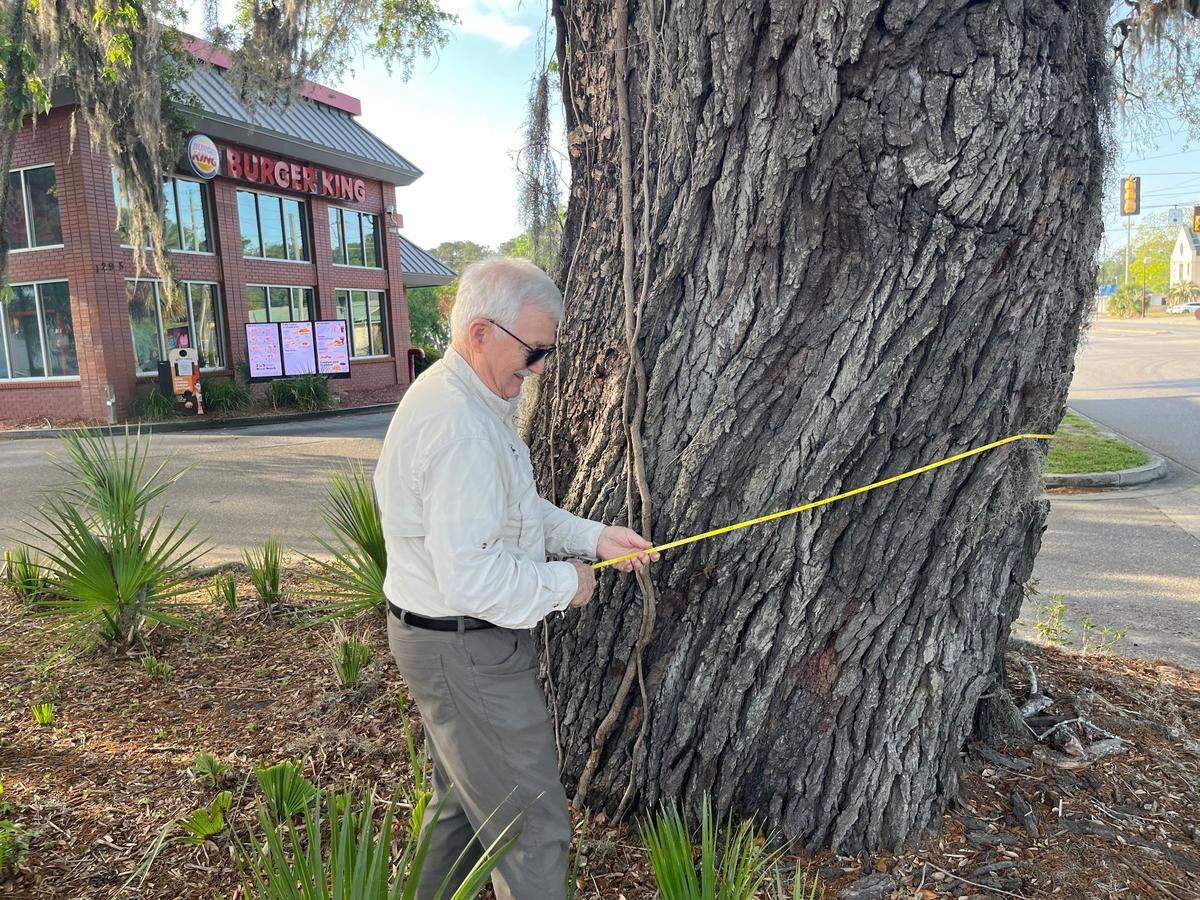
Without doing a core sample and checking the rings, an exact age of the BK tree can’t be calculated. But Murphy suspects it is 175 to 200 years, which means the tree could have been around when John Quincy Adams was sworn in as the sixth U.S. president in 1825.
By comparison, the Cherry Hill oak in Port Royal is 113 inches in diameter and 300 to 350 years old.
But to Murphy, the age and size of the whopper tree, while impressive, don’t stand out as much as the location where it has managed to grow old.
“You rarely see such a big tree in a developed area like this,” says Murphy, “and it’s so close to the road.”
Could the tree be removed?
The city of Beaufort is in the process of increasing regulation on tree removals, said Ashley Brandon, a spokeswoman for the city. But removal of the BK tree, which would be considered a “landmark tree,” could be denied under both the current and new code, she said. The caveat is that the tree is located in a state right-of-way and therefore exempt from city regulations.
Murphy says most communities have rules in place that protect trees designated as “specimen” or “landmark” trees. “It would be almost impossible to take it down,” he says, unless it became diseased making it a threat to the public in its high-trafficked location.
Hannah Robinson, a spokeswoman for the South Carolina Department of Transportation, said DOT does occasional limb pruning on the tree, with its last pruning coming in December.
Vents release damaging gases
The Burger King tree has been aided by the type and pace of development in its vicinity, at least up to this point, Murphy suspects. Ribaut Road, for example, didn’t start out as four lanes, lessening its impact, and the commercial development around it didn’t come all at once, either. That’s critical because trees adapt better to gradual impacts than jolts to the system like construction of new shopping centers or highways, Murphy says.
“Having all these root impacts over a sustained period of time, where the tree can kind of recover from the damage that has been done to the root system, it’s really a benefit to the tree itself,” he said.
Murphy points to a vent that’s been cored out of the asphalt parking lot near the tree. That vent, he says, is also helping the big oak survive in this unforgiving environment by releasing methane gas. Without the vent, the methane would force air out of the ground that aerates the tree roots, which would suffocate the big tree.
Even without vents, some trees can survive in asphalt in some conditions, Murphy notes. That’s because asphalt has porosity meaning air and water can seep through so methane gas doesn’t build up too much.
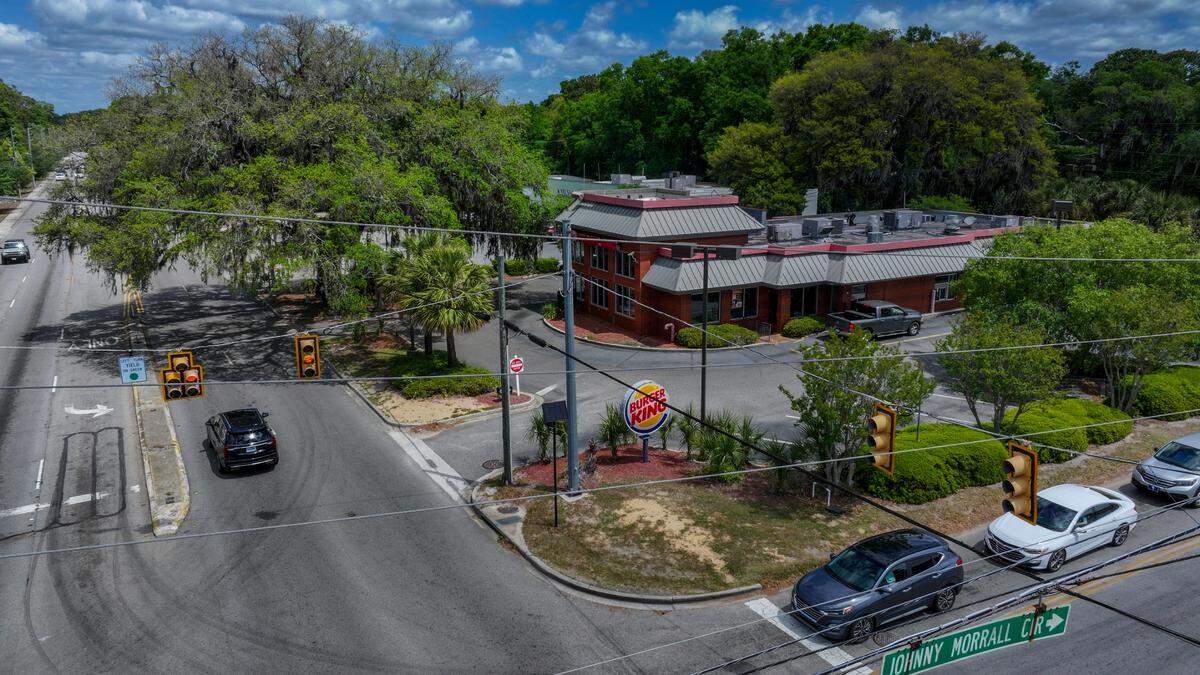
Whopper rules at BK
A sign underneath the BK tree reads, “You Rule Port Royal,” a reference to the restaurant’s latest marketing that includes employees offering customers a crown. It’s clear who the king is at the Ribaut Road restaurant.
While people wash clothes at a laundry next door and fill prescriptions at Walgreens across Ribaut Road, the tree’s leafy arms beat back the heat and extend horizontally over two north-bound lanes of Ribaut and part of the south-bound traffic.
Spindly hairs of Spanish moss dangle from the old timer’s canopy, which is thin on top but preparing to leaf out as spring advances.
“We’re so lucky to have that tree here and live underneath it,” Murphy says.
Besides their beauty, trees like the BK giant purify the air, cool the temperature and provide habitat for birds and animals, he notes.
Can it live another 100 years? “Absolutely,” says Murphy.
It’s already survived droughts and rainy seasons and hurricanes. Because of its size, it can be assumed the soil has “some type of fertility to it” that has allowed it to grow, he says.
But challenges still await the whopper.
Many of its initial years were lived before intense development arrived, Murphy says. But with growth ramping up, older trees are increasingly in jeopardy and particularly susceptible to major construction, Murphy adds.
“It’s kind of our duty to take those trees and help them withstand their next couple hundred years,” Murphy says.
This story was originally published April 28, 2025 at 5:00 AM.