With killer cold threatening its St. Helena blueberry crop, Coosaw Farms fought ice with ice
Biting wind and freezing temperatures greeted Cal Hucks and his Coosaw Farms crew at the blueberry grower’s St. Helena Island fields Tuesday.
A rare snowstorm was bearing down on the Lowcountry and threatening to wipe out more than 100,000 of Coosaw’s valuable blueberry crop 2 1/2 months before the harvest, when the berries are sold at grocery stores up and down the East Coast, including locally.
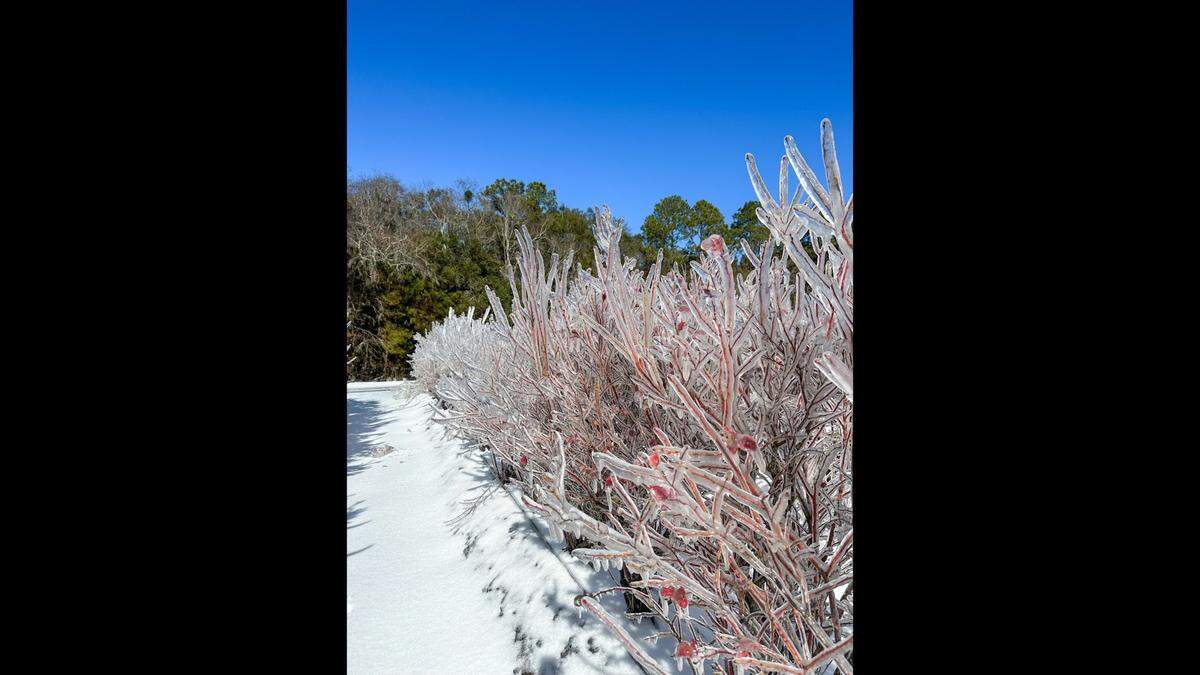
Dressed in full snow gear, the crew, prepared to work all night, got down to business. But covering the delicate plants was not part of this mission. Ironically, the Coosaw Farm workers began making ice to counter the killer cold, spraying over 80 acres of land with water that froze and entombed the berries and their white and pink flowers.
“It sounds backward, but we ice the plants on purpose,” Hucks told the Beaufort Gazette and Island Packet Thursday, after the massive job was done. “As we’re constantly running those sprinklers, the ice is constantly forming on the outside of the berry. That insulates it and it’s providing just a little bit of heat as it’s changing form.”
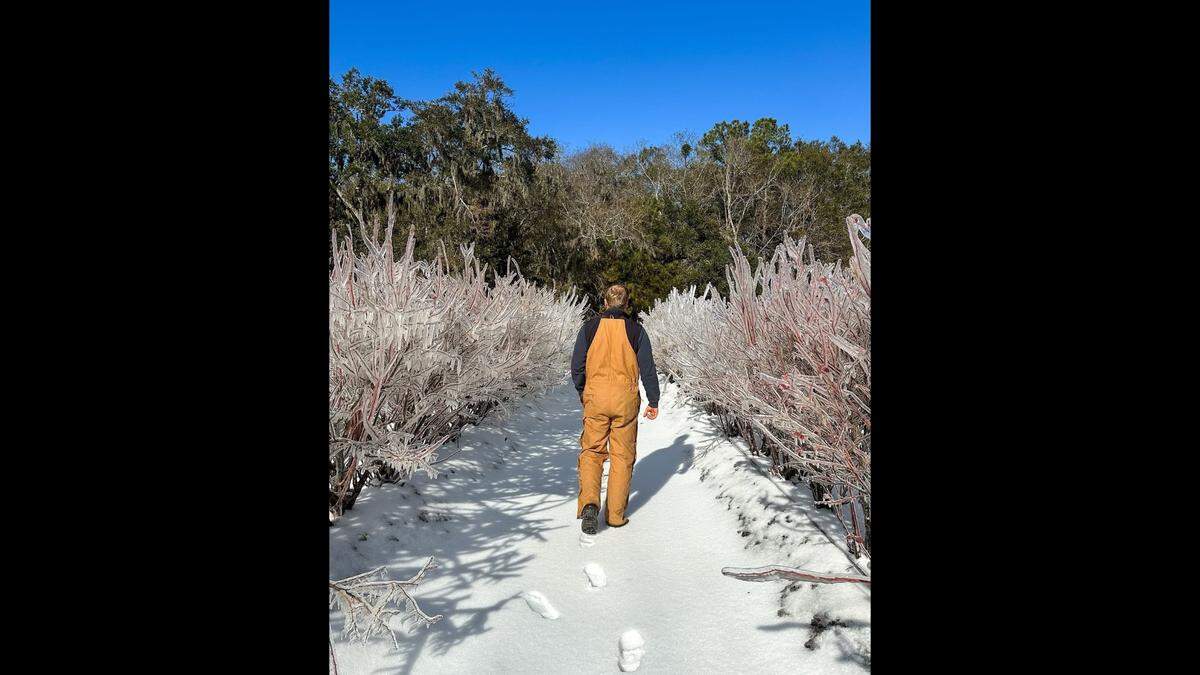
Hucks considers the 11th-hour effort to reduce the damage to the company’s blueberry crop — known as “frost protection” in the business — a success. To be sure, he’s still expecting some losses. However, without the seemingly anti-intuitive anti-freeze method of shielding the blueberries many would have succumbed, he says.
Coosaw Farms is South Carolina’s largest blueberry producer with its main fields located on St. Helena Island and in Fairfax, where its office and packing house is located.
Farmers, said Hucks, are constantly “fighting something,” but a snowstorm was unique. “I can’t think of the last time this situation would have happened,” he said.
Up to 4 inches of sugary snow sprinkled the salt marshes and palmetto trees and beaches before temperatures dropped into the 20s, creating a winter wonderland in the heart of coastal South Carolina overnight Tuesday into Wednesday.
But the rare sight wasn’t pretty for St. Helena Island farmers who remain concerned about the cold taking a bite out of their harvests or delaying them. Many big St. Helena crops, like watermelons and tomatoes, were spared because they’ve yet to be planted but others, like strawberries and blueberries, are in the ground and vulnerable.
135,000 plants at risk
Blueberry fields are planted with different varieties, which bloom at different times. And at each stage of growth, the berries have specific temperatures that will kill them.
So on Tuesday, Hucks knew what fields he needed to worry about: Roughly 80 acres with an estimated 135,000 flowering plants. Temperatures of 26 degrees or 27 degrees, which were in the forecast, would kill those plants, prompting the all-out frost protection effort.
Now it’s a waiting game.
“We really won’t know how much we protected until we start harvesting in mid-April,” Hucks said. “When you get a lot of cold nights back to back to back, your chances of saving everything dwindle.”
Frost protection is a common practice by blueberry growers. It relies on a well-known law of physics that a chemical reaction, like water changing from a liquid to a solid, produces energy, and energy produces heat.
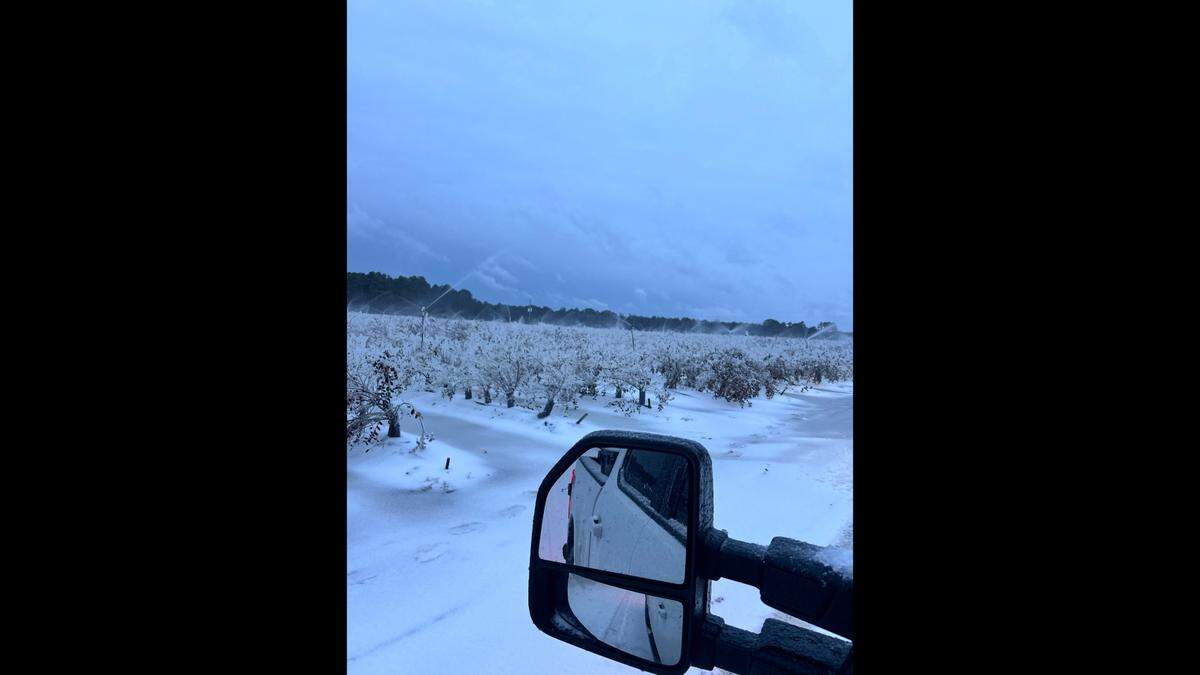
The all-night rescue involved positioning large sprinkler systems and spraying water drawn from canals on the 135,000 blueberry plants as the area’s first snowstorm in seven years raged around the Coosaw Farms workers, who donned stocking caps, winter boots, overalls and face coverings.
Workers pull an all-nighter
Work began at 4:30 p.m. Tuesday. It continued until mid-day Wednesday. Coosaw Farms workers remained on site throughout the night to ensure pumps kept working, sometimes knocking ice off the sprinklers so they continued to distribute the water evenly. One pipe burst or pump break would be catastrophic.
“Makes for a long night,” said Hucks, “but if everything goes well, we’re able to save the berries.”
On Wednesday morning, blueberry plants in fields off of Lands End Road were encased in ice. Icicles formed on some. But that ice came from water sprayed by sprinklers, not Mother Nature. In fact, the sleet and the snow raining from the sky was helpful because it brought moisture that provided added protection for the plants from the bitter cold. “As opposed to a dry night when frost is likely to form,” Hucks said.
.jpg "IMG_4037 (1).jpg")
Frost protection is not full-proof. But in this situation, it was a “no-brainer,” Hucks said. Even if it saves 10% of the crop, it’s worth it, he said.
“It gives us better odds to pick a good crop,” he said.
How will strawberries hold up?
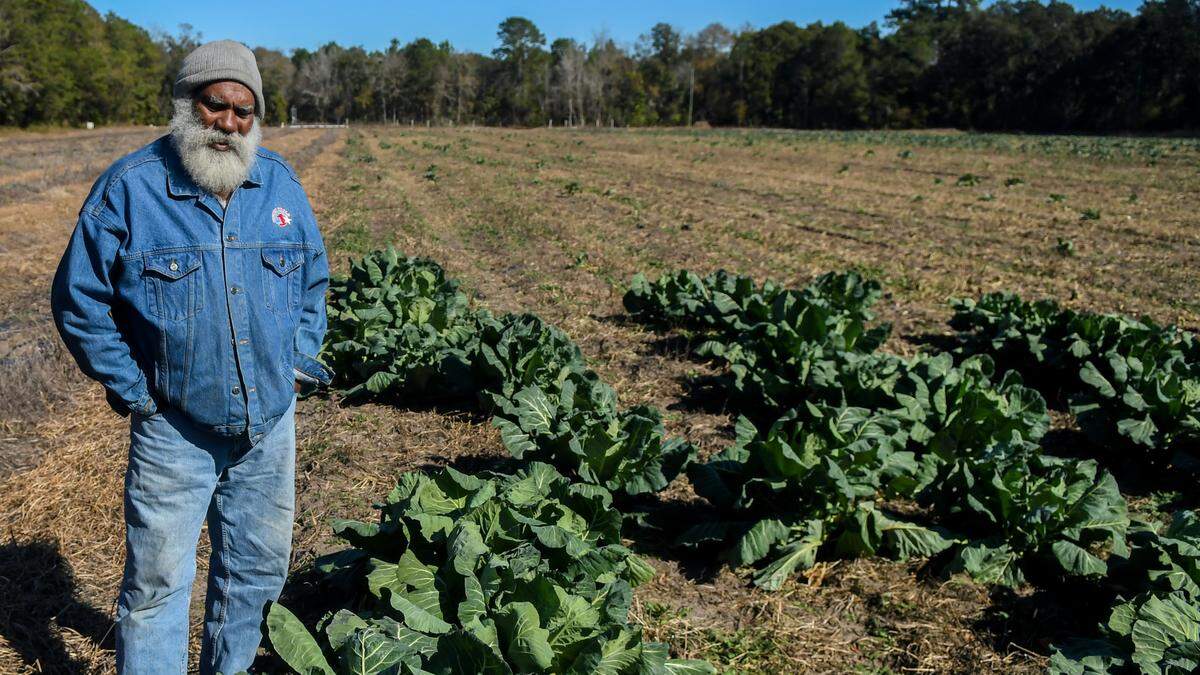
Jacky Frazier, the owner of Barefoot Farms on St. Helena Island’s Sea Island Parkway, said he’ll have to wait until the snow melts to see how his famous strawberries held up. “I’m not a fortune teller,” he said.
At the very least, he adds, the strawberry harvest could be delayed a few weeks from the usual start in late February and early March.
Barefoot Farms grows a number of crops, including collared greens, but its big crop is strawberries, which are planted in November. Many residents pick their own.
More sleet than snow fell during the storm, and it turned to hard ice, Frazier noted.
“I’m a little concerned,” said Frazier, “but I don’t want to start worrying until I see I have something to worry about.”