Gullah artist memorializes Black church in Beaufort. His canvas? A bench
Thin panels of wood are stacked upright like books on a shelf. Others rest on the floor, leaning against a wall. Still more are hidden away in a closet.
Each panel is a piece of art depicting aspects of Gullah life in the Lowcountry, from attending church to fishing to farming.
And each one is a page from the imagination and life of the Rev. Johnnie F. Simmons, the Gullah folk artist who made them using heat and heart.
“This is my stash,” Simmons says of his library of art, which also serves as his studio in his rural Jasper County home.
Simmons’ latest artwork isn’t on a flat piece of wood, and it won’t be stashed away.
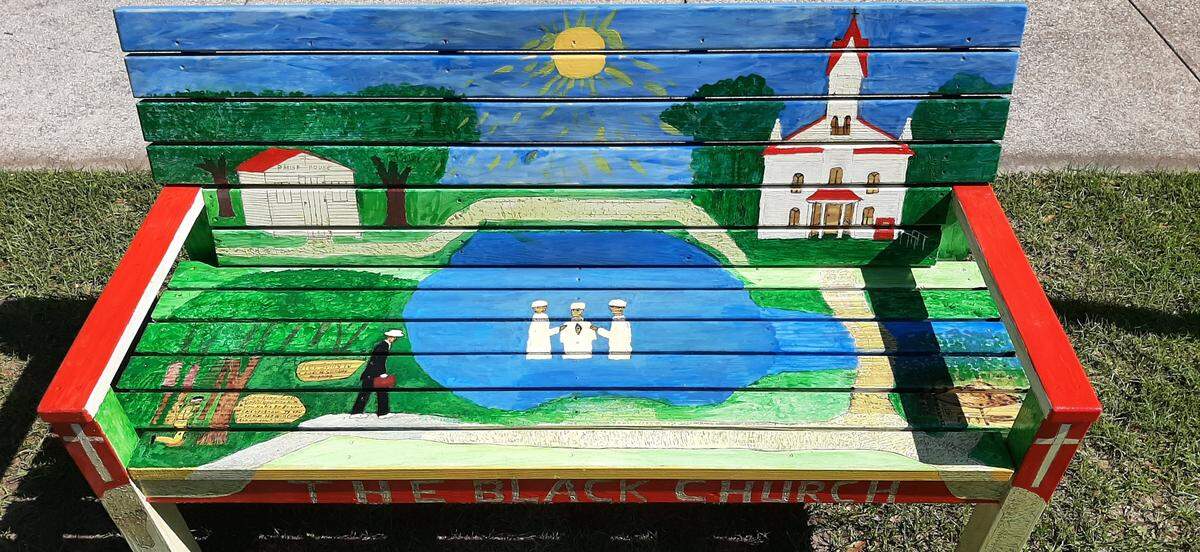
His canvas was a bench, and that bench, which will be placed in downtown Beaufort, will memorialize a prominent Black church in the city.
“I hope a lot of people see it,” Simmons says.
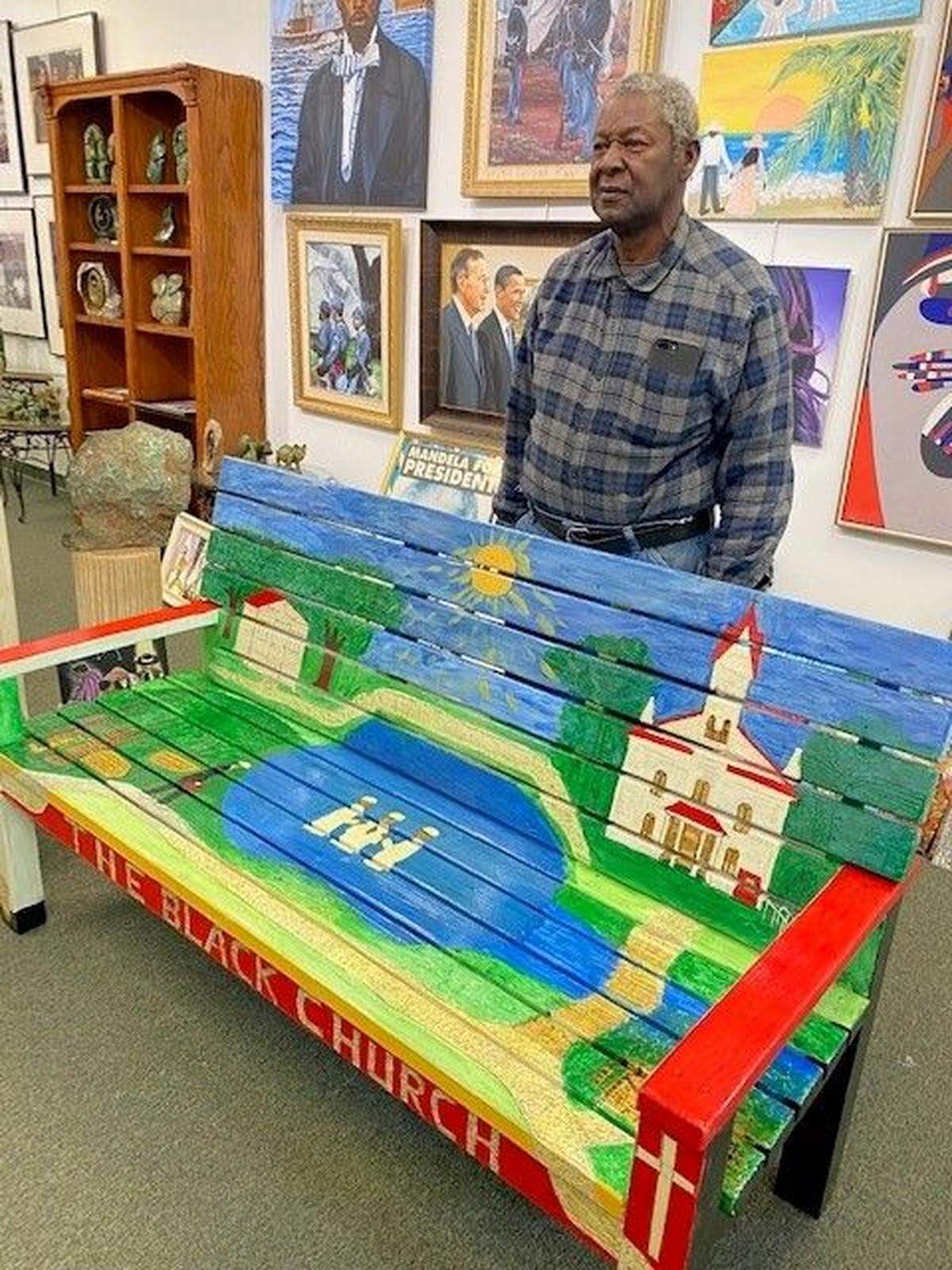
The City of Beaufort and the Beaufort Cultural District will unveil six new benches at the USCB’s Center for the Arts, including “The Black Church,” designed by Simmons, at 5 p.m. Thursday. The public is invited.
Through the city’s bench program, launched in 2019, artists, sponsored by organizations, design benches that celebrate the art, history and culture of the Beaufort region.
Then the benches are placed downtown, fulfilling practical and aesthetic needs.
Simmons’ “The Black Church” celebrates Tabernacle Baptist Church on Craven Street, which was founded in 1811. In 1863, it became the first Baptist church for African-Americans in the city.
“I went from where it began, as far as I know it, to where it is now,” Simmons said of the history of the Black church, which he traced on the front and back sides of a bench.
The bench depicts a secluded structure called a hush harbor, also known as brush harbor, where slaves worshiped in private. Also featured: a prayer house and the main church building.
“I like the idea they let certain artists put their art on the benches,” Simmons says.
Uses wood burning to create art
Simmons uses a technique called wood burning to create art that celebrates the way of life of the Gullah people.
And at 72, he’s still at it, often rising between 1 and 2 a.m. to burn his ideas into wood, using a tool with a brass tip that he holds like a pencil. He sits at a small table illuminated by a lamp, or works at a pool table for larger pieces.
“If I get tired, I quit and go to sleep,” he says.
He pulls out a large sheet of wood. In pencil, he has etched out a preliminary design and a verse from the 23rd Psalm, which includes the line, “Yea, though I walk through the valley of the shadow of death.” Written on the bottom is, “6-2019, 2:30 a.m.,” the time and date when he began that project.
“Man, I got all kinds of things in my head,” says Simmons of the ideas that make it onto his wooden canvases.
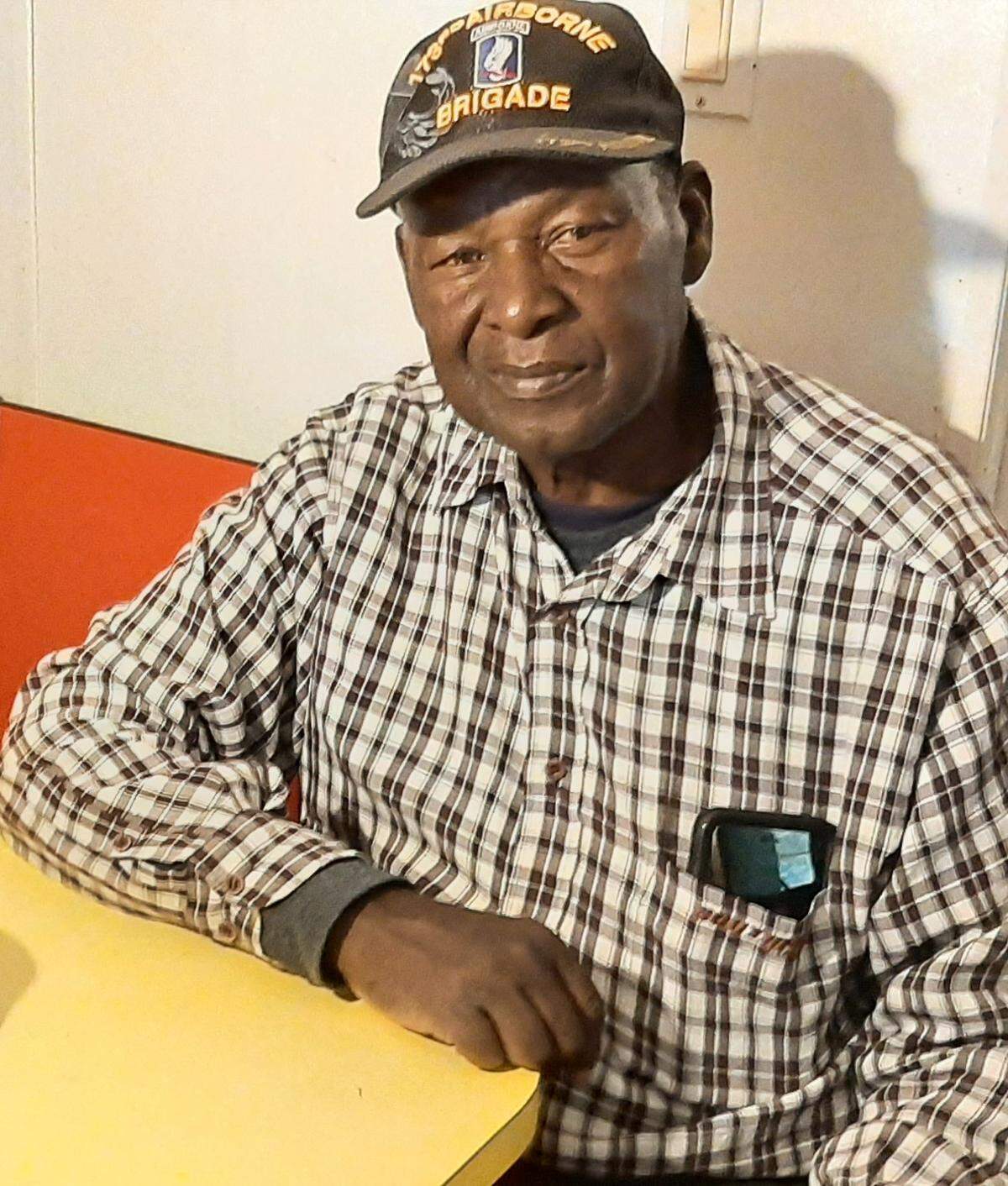
Simmons grew up in Frogmore, Pine Grove Plantation on St. Helena Island. He served in Vietnam and as a Baptist minister of a church for five years.
Spiritual themes, service and his life on the island figure prominently in his art, which Simmons says simply reflects what he knows.
“We went to school, but, time to fish, we fished,” Simmons said. “Time to farm, we farmed.”
One of his pieces shows a Marsh Tacky, the distinctive South Carolina breed of horse used for farm work and transportation.
Simmons also incorporates the Gullah language.
For example, one work that shows a boy playing basketball has this caption: “Gullah Baskit Ball. If you fine a ball or someone gee you one play ball.”
Pinched between his thumb and forefinger is the tool Simmons uses to burn his images into the wood.
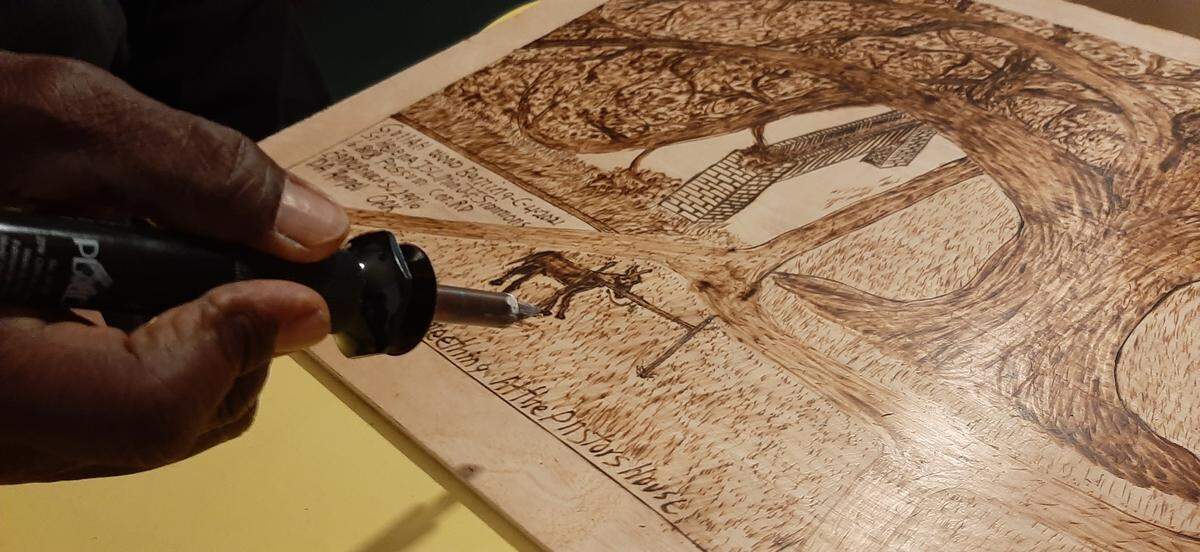
“You use it just like you do a pen or a pencil,” he says.
He presses the tip on wood, which burns the surface, leaving behind a brownish color.
“From that you can apply your skill to it,” he says.
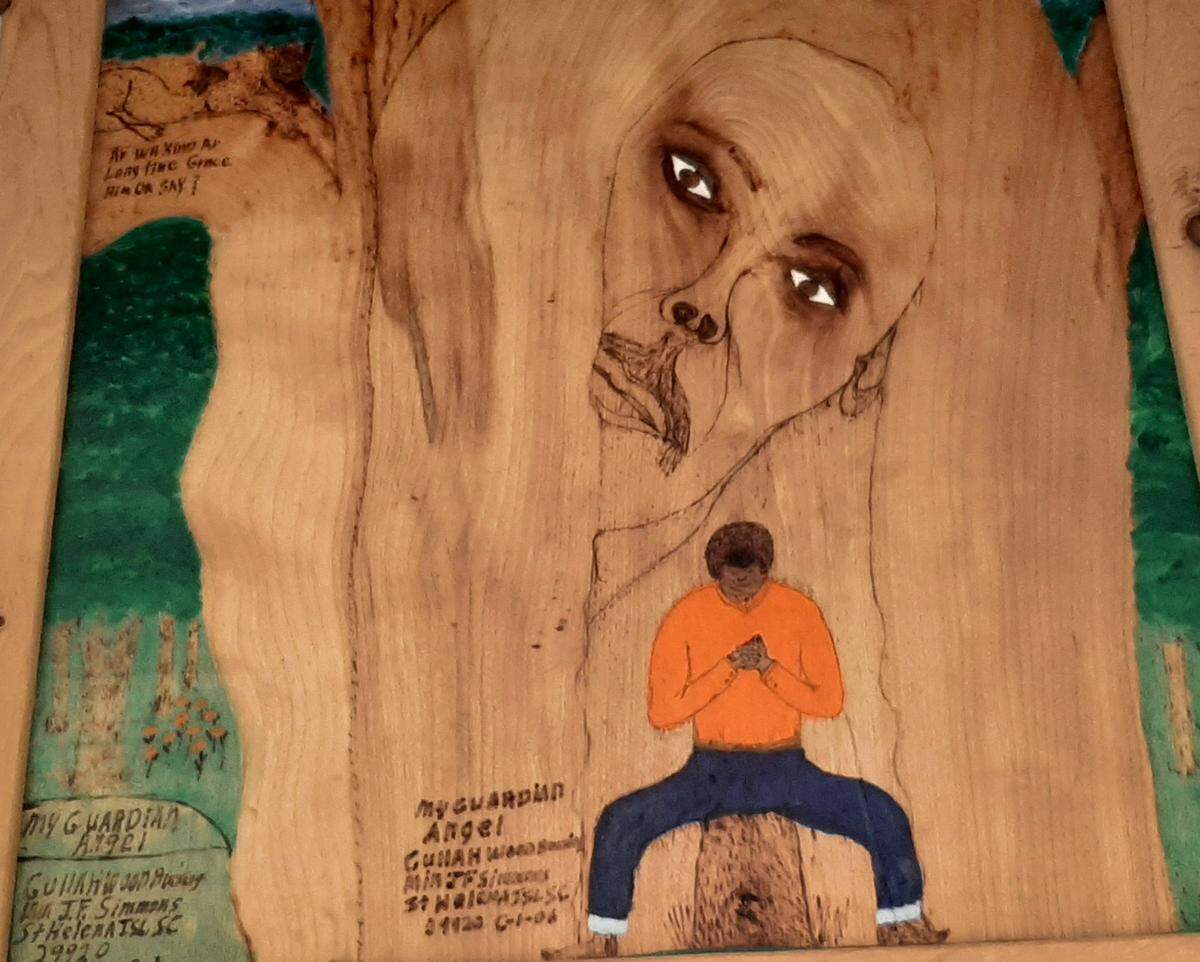
He uses acrylic paint to add color.
Simmons works with the grain in the wood.
“The dark part of the eye was already in the wood,” he says, pointing to “My Guardian Angel,” noting the grain also flows with the hair and face of the subject.
Simmons began his art career after he retired, in 2003. He played around with the wood-burning tool until he got good using it and began turning out “some pretty pieces.”
“I just kept goin’,” he says.
Simmons and his wife, Cynthia, own Gullah Woodburning Folk Art.
The other artists and sponsors of the new benches are:
▪ Diane Britton Dunham (Beaufort Arts Council): Her bench celebrates The Mather School, founded in 1868 as a boarding school for black girls in the aftermath of Emancipation. Its legacy lives on in the Technical College of the Lowcountry.
▪ Shawn Hill (City of Beaufort), a graphic designer and photographer: He made photographs from around Beaufort that illustrate the city’s commitment to ensure that Beaufort is a place where “history, charm and business thrive!”
▪ Linda Silk Sviland (Fripp Island Golf & Beach Resort): Sviland, a graphic artist who retired to Beaufort a couple of years ago, worked in acrylic latex to create a bench that has iconic scenes from the movie “Forrest Gump,” much of which was filmed in and around Beaufort.
▪ Aki Kato (Pat Conroy Literary Center): Kato, a native of Yokohama, Japan, has lived in Beaufort since 2003. His bench evokes Conroy’s first book, “The Water is Wide,” a novel based on Conroy’s year as a teacher on Daufuskie Island.
▪ Lisa Gilyard-Rivers (private donors): Gilyard-Rivers is known for her Gullah and heritage-themed works. Her bench captures the tranquil view of the downtown Waterfront Marina. On the back of the bench, a Gullah couple can be seen enjoying the view of the water near the oak tree-lined road.
This story was originally published May 5, 2021 at 12:00 AM.