
Beaufort News

Beaufort Co. residents will now hear fewer fighter jets overhead. Here’s why

Good news to anyone in the Beaufort area who has noticed more jet noise since last November: The Marine Corps Air Station primary runway construction project is complete.

That means normal aircraft flight patterns will resume, and there will likely be less jet noise overhead.

Last year, the Beaufort Regional Chamber of Commerce said the construction project caused more aircraft than usual to be stationed at the Marine Corps air base.

The change in flight patterns meant more planes were in the sky, and residents noticed more air traffic noise.

Now, the construction project is complete and has “improved the proficiency, safety and readiness of our pilots and airfield operations,” according to a news release from the air station.

Vice President Mike Pence and Second Lady Karen Pence serve Marines, Sailors and civilians a Thanksgiving meal aboard Marine Corps Air Station Beaufort, Nov. 28. After serving, they gave the service men and women the opportunity to take a photo. (U.S. Marine Corps photo by Sgt. Brittney Vella)
Vice President Mike Pence and Second Lady Karen Pence serve Marines, Sailors and civilians a Thanksgiving meal aboard Marine Corps Air Station Beaufort, Nov. 28. After serving, they gave the service men and women the opportunity to take a photo. (U.S. Marine Corps photo by Sgt. Brittney Vella) Brittney Vella

Jet noise has long been an issue among area residents.

Runway repairs in 2016 caused more air traffic over the city of Beaufort and led to calls for an alternate runway to move flights away from populated areas.

A woman threatened to shoot down MCAS Beaufort jets in 2018 because the noise was scaring her horses, authorities said at the time.

Airfield hours are typically from 7 a.m. until 11 p.m. Monday through Thursday, 7 a.m. to 6 p.m. Friday and from 4 p.m. until 6 p.m. on Sunday, according to the air station website.

Information on flight patterns and jet noise is available through Beaufort County’s website at www.bcgov.net and on the MCAS Beaufort site, www.beaufort.marines.mil. The site includes a map of Air Installations Compatible Use Zones.

According to a news release on aircraft noise, decibel levels on the Air Installations Compatible Use Zones map are the day-night average sound level, not single event noise.

Single event noise can be higher than the average. For example, if you live in the 60 to 65 decibel day-night sound level zone, you may experience single event noises greater than 65 decibels.

If you have questions or concerns about aircraft noise, you can send an email to BFRT_JPAO@usmc.mil or leave a voicemail at 843-228-6229.
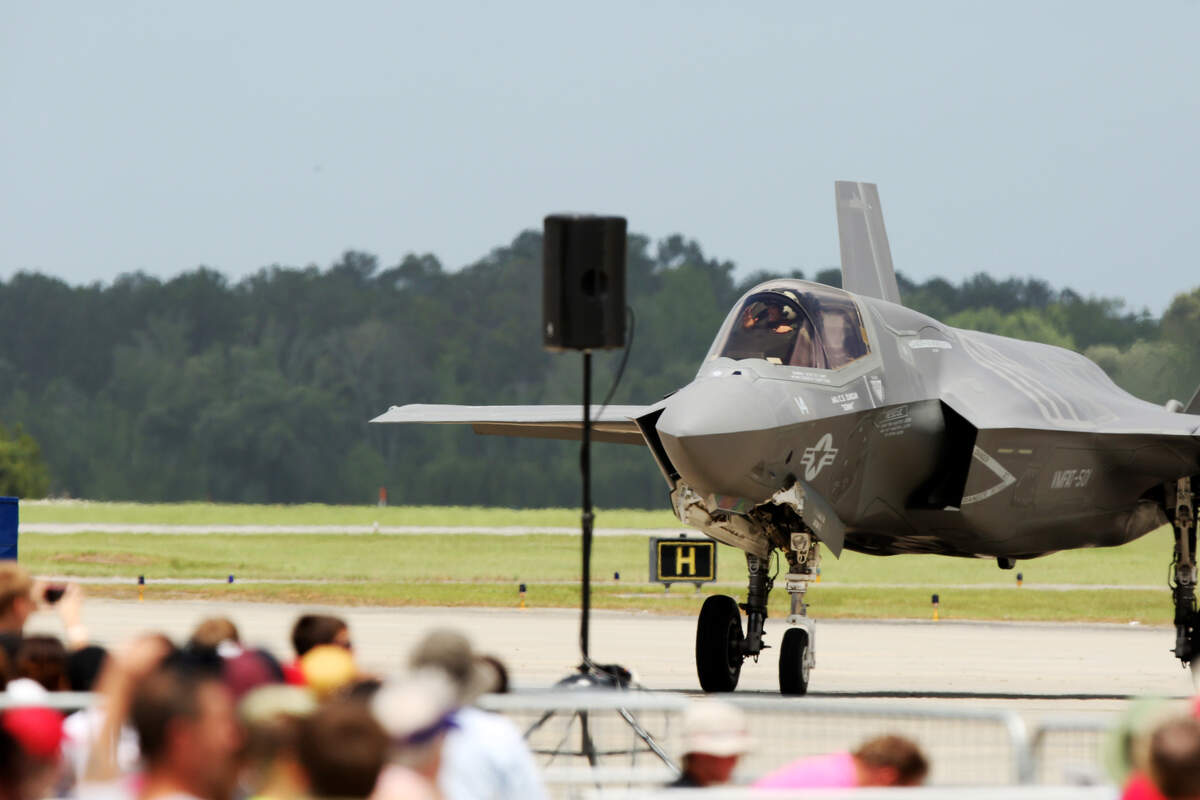

An F-35B Lighting II lands during the 2017 Air Show aboard Marine Corps Air Station Beaufort, April 30. The F-35 is the most flexible, technologically sophisticated, multi-role fighter ever built. It combines the most lethal fighter characteristics – supersonic speed, radar-evading stealth, extreme agility and short takeoff/vertical landing capability. Marine Fighter Attack Training Squadron 501 showcased the F-35’s capabilities during the air show, showing attendees how the aircraft gives the warfighter the ability to accomplish their mission anywhere at any time. The F-35 is with VMFAT-501, Marine Aircraft Group 31.
An F-35B Lighting II lands during the 2017 Air Show aboard Marine Corps Air Station Beaufort, April 30. The F-35 is the most flexible, technologically sophisticated, multi-role fighter ever built. It combines the most lethal fighter characteristics – supersonic speed, radar-evading stealth, extreme agility and short takeoff/vertical landing capability. Marine Fighter Attack Training Squadron 501 showcased the F-35’s capabilities during the air show, showing attendees how the aircraft gives the warfighter the ability to accomplish their mission anywhere at any time. The F-35 is with VMFAT-501, Marine Aircraft Group 31. Benjamin McDonald U.S. Marine Corps
Katherine Kokal
The Island Packet
Katherine Kokal graduated from the University of Missouri School of Journalism and joined The Island Packet newsroom in 2018. Before moving to the Lowcountry, she worked as an interviewer and translator at a nonprofit in Barcelona and at two NPR member stations. At The Island Packet, Katherine covers Hilton Head Island’s government, environment, development, beaches and the all-important Loggerhead Sea Turtle. She has earned South Carolina Press Association Awards for in-depth reporting, government beat reporting, business beat reporting, growth and development reporting, food writing and for her use of social media.
Get unlimited digital access
#ReadLocal

Try 1 month for $1

CLAIM OFFER