
Got a mystery political mailer? Here’s what to know before June 9
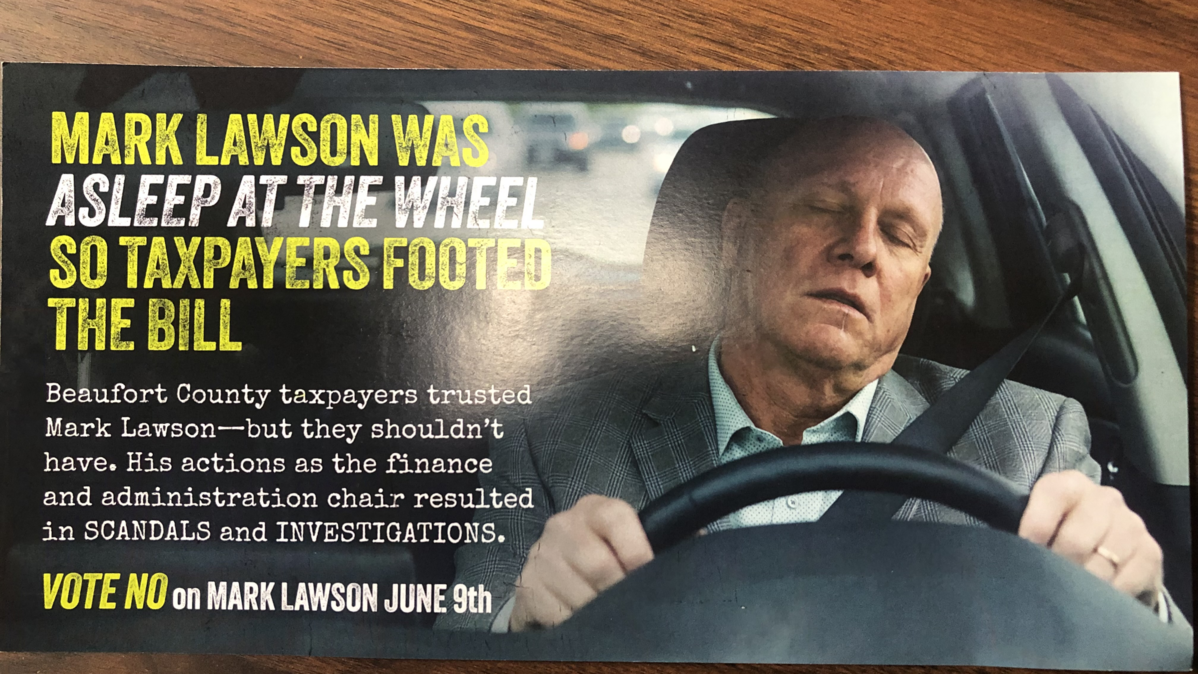
If a political attack ad showed up in your mailbox or Facebook feed in recent weeks — one targeting a Beaufort County Council candidate but listing only a vague group name and a Charleston return address — you are not alone, and your confusion is warranted.
The ads are paid for by a group calling itself Alliance for Lowcountry Balance, a Super PAC that registered with the Federal Election Commission on April 22, 2026. With the statewide primary set for June 9, local party leaders and residents are raising alarms about what they describe as “dark money” flowing into races for county council.
FULL STORY: What’s going on with ‘dark money’ in Beaufort Co. elections? What we know
What we know about the group
Very little information is publicly available about the group. The PAC’s address — 78 Folly Road Ste B9 #1263 — matches a Staples store in Charleston. Its website domain was registered through Domains By Proxy, a service that hides the owner’s identity. Requests for comment sent to the phone number and email on its FEC filing were not returned.
The only name on the group’s organizing document is treasurer Dustin McIntyre, who serves as treasurer for 74 federal political action committees nationwide, according to the FEC database. Two other PACs formed by McIntyre include “Lowcountry” in the title, including one that previously spent $179,500 in support of U.S. Rep. Nancy Mace.
The group has not yet filed any campaign finance reports. Under FEC rules, the filing deadline for spending between April 1 and June 30 is July 15 — more than a month after the primary. That means voters will head to the polls on June 9 without knowing who funded the ads.
Who’s being attacked, who’s being supported
The PAC has bankrolled mailers and social media ads supporting five council candidates and attacking their opponents:
- District 4: supporting Thomas Grygowski
- District 5: supporting Joshua Hower, attacking Mary Jeans Otto
- District 8: supporting incumbent Paula Brown, attacking Kraig Gordon
- District 9: supporting Beth Gillespie, attacking incumbent Mark Lawson
- District 11: supporting incumbent Tom Reitz, attacking Elizabeth Galloway
All five supported candidates have distanced themselves from the group. Gillespie told the Post and Courier she “would never approve of such an ad.” Reitz said he had “no knowledge” of the PAC. Grygowski said he has “no affiliation with this group.” Brown told The Island Packet “the bottom line is, I have no idea who this is.” Hower said he has not “solicited, coordinated with or asked for support from any outside political action committee.”
Lawson, one of the targets, wrote on social media: “Anyone who knows me and my record knows I will not stoop to that level. I have always vowed to run a clean campaign focused on real issues and real results.”
Otto, who is being attacked in District 5, told The Packet: “I spent the past year fighting an increase in density and commercialization in District 5 and 1. ... I believe that they’re attacking me and spending thousands of dollars because they’re afraid I’m going to get ‘em.”
What local party leaders are saying
Kevin Hennelly, chair of the Beaufort County Republican Party, is sounding the alarm.
“I’ve been in this business 50 years, and I’ve never seen anything like this,” Hennelly told The Island Packet.
In a statement on the county GOP’s social media page, he urged voters to ask hard questions: “Who are the donors behind this dark money? Why is outside money trying to buy influence in our local races?”
Robert New, a Charleston resident who owns land on St. Helena Island, echoed those concerns. “This is a dangerous challenge to local democracy,” he said. “The thought that a secretive dark money super PAC can come in and influence our elections is scary beyond belief.”
Hennelly noted that full-color mailers are typically out of reach for county council candidates, whose campaign budgets generally run between $5,000 and $10,000.
What ‘dark money’ actually means
The term “dark money’ refers to political spending where the original source of the funds is hidden. According to the Campaign Legal Center, a nonpartisan group that advocates for campaign finance reform, dark money typically flows through tax-exempt nonprofits — 501(c)(4) social welfare organizations or 501(c)(6) trade associations — that are not required to disclose their donors.
Those nonprofits can then donate unlimited amounts to Super PACs. Super PACs, in turn, must disclose their donors — but only the nonprofit’s name appears, not the individuals behind it. The Campaign Legal Center argues this allows “wealthy special interests” to “easily hide their political spending.”
Super PACs themselves can raise and spend unlimited sums to influence elections, so long as they do not coordinate with any candidate or party.
How to evaluate a political mailer
A few practical tips for the next ad that lands in your mailbox or feed:
- Check the “paid for by” line. Every legitimate political ad must disclose who paid for it. If the name is unfamiliar, search it on the FEC’s website at fec.gov.
- Look up the address. A return address pointing to a UPS Store, Staples or mail drop is a sign the group may not have a real office.
- Check Meta’s Ad Library. Facebook and Instagram parent company Meta maintains a searchable database showing who is running political ads and roughly how much they spend. Based on that data, Alliance for Lowcountry Balance has spent between $15,000 and $19,990 on 10 ad campaigns, reaching between 1,165,000 and 1,399,990 impressions.
Voting on June 9
The statewide primary is Tuesday, June 9. Polls are open on Election Day at your assigned precinct. Voters who are unsure of their polling place or registration status can check with the Beaufort County Board of Voter Registration and Elections.
For voters heading to the polls this week, read up on how candidates responded to questions about key Beaufort County issues in our published questionnaires:
- District 11 - Reitz/Galloway
- District 5 - Hower/Otto/Maiorano
- District 9 - Gillespie/Lawson
- District 8 - Gordon/Brown
- District 4 - Grygowski/Anderson
The story above was compiled with the help of AI tools and edited by journalists. The full story in the link at top was reported, written and edited entirely by journalists.