In change, Hilton Head’s chamber deal done mostly in private. Now, few are talking
More than eight weeks after the Town of Hilton Head and the local Chamber of Commerce agreed to a contract with transparency clauses the chamber had successfully fought off for years, few of the main players are willing to talk about how it happened.
Key questions, such as what changed, why now, and what it means for the Hilton Head Island-Bluffton Chamber of Commerce, which for years argued that public scrutiny of its spending would ruin the “secret sauce” it used to market the town, remain unknown to the public.
At the heart of the matter is nearly $4 million in lodging taxes the chamber receives through the town annually as its designated destination marketing organization.
The chamber has served as the town’s DMO for decades, but didn’t have a formal contract until 2015, and did not need to compete for the title before 2020.
Contract renewals have been a flashpoint over the years. Former Beaufort County and Hilton Head leaders have attacked the chamber for denying requests for quarterly reports. The town itself has fielded criticism for what was seen as a failure to oversee how public money was spent, creating the potential for unchecked abuse, conflicts of interest and lavish spending.
It was, in the eyes of critics, seen as a small group of power players protecting each other. The chamber is a private organization not subject to Freedom of Information requests. Whatever the chamber gives the town, however, becomes a public document. By not asking for and receiving a full accounting of how the money was spent, the town was in essence helping the chamber keep the information from public scrutiny.
That all has seemed to change this year, though, as the most recent contract signed Jan. 6 requires the chamber to turn over all receipts and invoices related to the money it receives from Hilton Head as part of an annual report. (The chamber’s overall revenue was about $12.3 million in 2025, and how that additional money is used will remain out of the public eye.)
For years, the chamber has insisted that it has adhered to an acceptable amount of auditing and transparency. The organization publishes yearly financial audits on its website, breaking down how much it spends on things like public relations, administrative expenses and sales and marketing. Asking any more of it, the chamber argued, would put it at a strategic disadvantage with other resort communities.
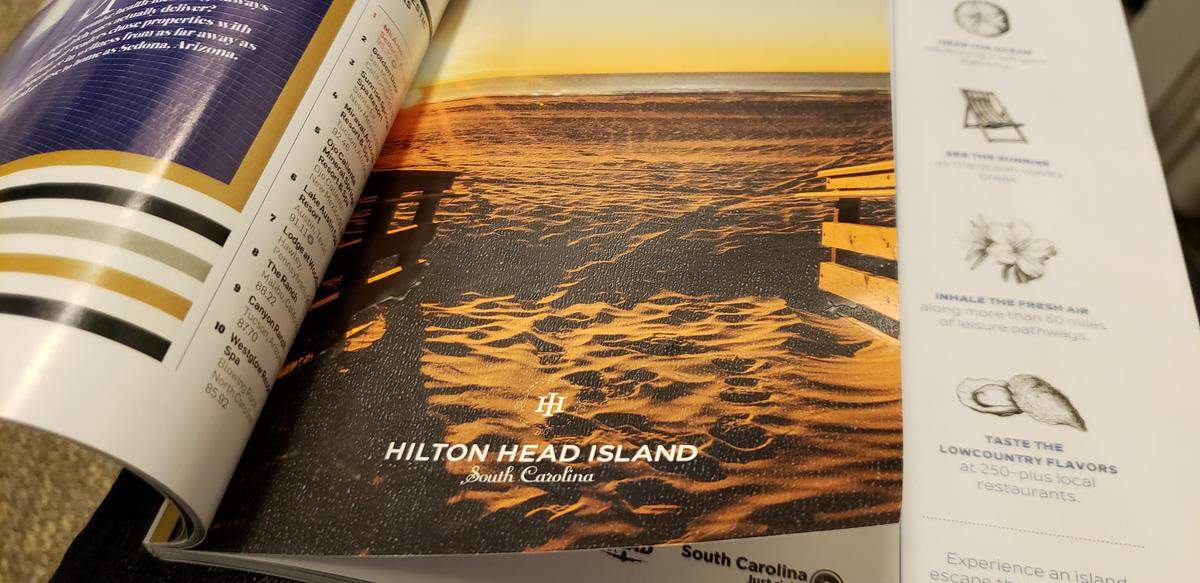
The chamber’s president, Bill Miles, exemplified this viewpoint during a 2018 exchange with the town council, when he held up an ad for Hilton Head Island in an issue of Travel + Leisure and defended the chamber’s desire to keep the cost of the ad private.
The ad contained a beach scene and used textured stock for the sandy parts of the photo.
“Why do we want to share with Charleston, or Destin, or any other areas, how much we paid for this ad?” Miles said to the council during the exchange.
Now that the chamber has agreed to reveal its spending in detail, no one is saying whether the chamber now must do business differently or if it’s unhappy with the new contract.
Contacted multiple times by The Packet, Charlie Clark, the chamber’s vice president of communications, declined to speak to a reporter or to set up an interview with its president, Miles, and told one of the paper’s editors that she believes the paper has been unfair in its coverage over the years. The Packet declined an offer to email its questions.
The paper has written extensively on the issue for years, including, in 2018, pointing out that the director of the DMO for Destin, Florida, noted her organization’s spending, budget and marketing plan were public and saw no business disadvantage to it. And the paper’s editorial page repeatedly advocated for change, stressing that the old arrangements were eroding public trust in both entities.
The town’s perspective
If anyone in the town is taking a victory lap over the new contract, they’re doing it quietly.
Town Manager Marc Orlando, one of the main players in the contract negotiations, has not spoken publicly on the matter. Orlando told the paper he would sit down for an interview in March but when asked specifically to answer a couple of questions about the chamber contract, the town instead sent a two-sentence statement that said the new contract reflects the town’s “priorities to promote transparency, invite public understanding and ensure tourism marketing decisions are informed by our community’s values.”
Another member of the negotiating team, Ward 1 Council Member Alex Brown, declined to talk about the chamber deal. Only Ward 6 Council Member Melinda Tunner agreed to provide some insight into the town’s thinking.
Tunner said town council members were “aligned” in wanting transparency and called the move a “reflection of what’s happening across the country.”
“People are looking for transparency,” Tunner said.
Another change council members all agreed on is a shorter term than normal. The new contract is for a three-year term, with an option to extend by two years at the end of that term. Past contracts have been for five-year terms.
According to Tunner, changing consumer behavior and travel trends have made a shorter contract necessary. Social media, influencer marketing and artificial intelligence have challenged the “tried and true” methods of marketing, she said.
“AI has really impacted how we get information online,” Tunner said. “[If] I’m planning a trip, I’m using ChatGPT to plan my itinerary.” A key goal for the council, she said, was to create more public dialogue between the town council and the chamber. In previous years, the chamber presented its budget and marketing plan before the council during regular meetings. In the future, these discussions will be held in a workshop, providing more opportunity for input from the town.
Closed-door discussions
In the past, many debates over the chamber’s transparency have been held in the public eye, often revealing a divide between members of the council who strongly believed in greater oversight and those that were fine with the ways things had always been.
Over the past year, discussions about the DMO contract were held largely behind closed doors. The town released a formal bid for the contract in February 2025, and met during executive session five times last year to discuss bids and negotiate contracts. The council did not publicly discuss the contract until it was ready for formal approval.
Under South Carolina law, public bodies are allowed to, but not required to, hold meetings closed to the public for discussions related to contract negotiations.
It’s unclear why the town chose to build consensus for new transparency standards behind closed doors.
Tunner admitted the council could have done more to keep the public in the know.
“I believe there were opportunities to be more transparent about what was happening in the process,” she said. “... I call it lessons learned.”
Still, she maintained that there was “no pushback” from anyone within the council about the transparency clauses and the three-year term, but declined to speak to whether there was any pushback from the chamber, saying she wanted to be “respectful” of the negotiation process.
“A negotiation is a negotiation, and there’s a lot of give and take,” Tunner said. “I don’t think it’s important what happened specifically during the discussion but more importantly what the outcome is.”
Tunner provided a general outline of the negotiation process without naming anyone’s positions or criticizing anyone.
An initial proposal was sent to the chamber, which marked up changes it wanted and sent it back to the town. The parties then met for a three-and-a-half-hour face-to-face negotiation that sealed the deal that the town council would later formally approve.
At that meeting representing the town were Tunner, Brown, Orlando and Brittany Ward, an attorney for Finger, Melnick, Brooks & LaBruce, P.A., which has a contract with the town of Hilton Head to provide a variety of legal services. Miles represented the chamber as well as an attorney and finance person, Tunner said.
The Packet submitted a Freedom of Information request for any marked up copies of the contract, showing what changes the chamber wanted to make, but had not received a response by time of publication.
While everyone The Packet reached out to has either deferred comment or played down the importance of the contract changes, the town’s own website strikes a proud tone.
In a post dated Jan. 9, the town’s press release announcing the signing of the contract uses the words “trust” and “transparency” 10 times.
What changed for the town?
Without any public debate or more transparency on exactly when and why the town toughened its stance on the chamber, clues may lie in changes to the town’s administrative and council makeups since 2020, the last time the town approved the DMO contract.
In 2020, council members were David Ames, Bill Harkins, Tamara Becker, Marc Grant, Thomas Lennox and Glenn Stanford. The town manager was Steve Riley, and the mayor was John McCann. Becker is the only member from that period who is still serving on the council. Alex Brown, Steve Alfred, Patsy Brison, Steve DeSimone, and Melinda Tunner have replaced the others.
Orlando joined the town as town manager in 2021, and Alan Perry became mayor in 2022.

While Orlando has not stated his position in public, Perry has historically sided with the chamber.
A month before the 2022 mayoral election, Perry told The Packet that he was content with the chamber’s current level of reporting and would not press for more transparency in future contracts.
Perry did not return calls seeking comment on whether his position has changed or whether he pushed for the contract’s changes. In a press release following the Dec. 18 vote, Perry is quoted on the town’s website as saying the new contract is about “trust, clarity and community understanding.”
Understanding the money
As the town’s destination marketing organization, the chamber is responsible for marketing Hilton Head as an attractive place to visit.
Hilton Head’s economy is dependent on a steady influx of tourists that pay taxes every time they stay, eat and shop on Hilton Head.
Anyone that stays at a hotel or short-term rental pays both a 1% accommodations tax (ATAX), which is then used to further promote tourism, and a 2% beach preservation fee, which goes towards beach renourishment. When people dine at restaurants and sip on cocktails, they pay a 2% tax that helps the town pay for roads, parks and public safety.
The town is only allowed to keep five percent of that tax revenue and the rest must go towards promoting tourism. State law requires municipalities that receive tourism tax funds to give 30 percent of the funds to a designated nonprofit organization that promotes tourism; remaining funds are awarded out via grants to other nonprofit organizations that promote tourism.
In recent years, the amount the chamber has received has ranged from $3.5 million to close to $4 million.
Under the new contract, the chamber must provide the town with an audit and a “comprehensive accounting report” of how the public money was spent, including all invoices and receipts, by Sept. 30 each year.