New SC preserve in Beaufort County protects cotton fields created by slaves
Tucked off a dirt road on the edge of Coosaw Island, the stretch of salt marsh looks unassuming at first glance. But upon closer inspection, visitors can see a well ordered grid dug into the earth. These structures make up the remains of a sea island cotton field, worked and created by enslaved labor from the late 1700s until the Civil War.
The 123-acre site is now permanently protected. Through a collaboration between The Open Land Trust and the South Carolina Department of Natural Resources, the property, now known as the Coosaw Sea Island Cotton Heritage Preserve, is one of few sites in the Southeast that contains visible markers of sea island cotton production. In addition to preserving open space and habitat, the preserve also holds great significance for the Gullah community.
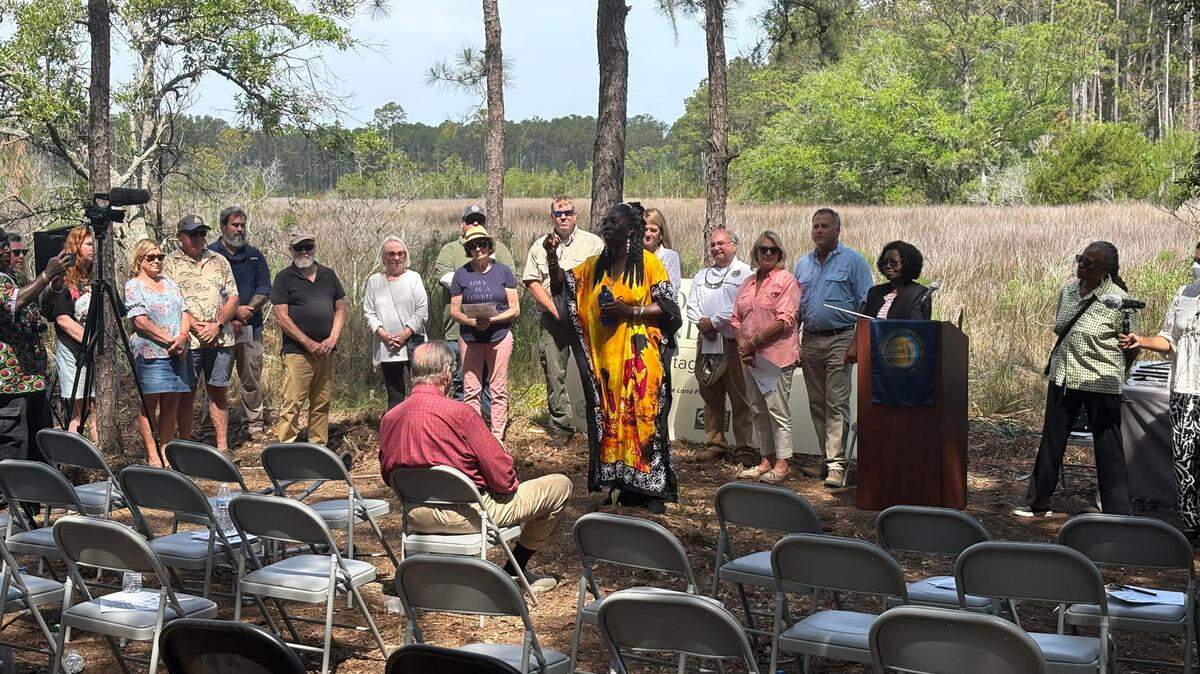
“It was a good thing to stand where my ancestors’ blood, sweat and tears, literally, is in the sand,” Queen Quet, chiefess of the Gullah/Geechee Nation, said during the dedication ceremony Tuesday.
The former cotton fields were first noticed by Beekman Webb, a local naturalist and musician, and his wife Kathy they explored the islands during the early months of the pandemic. Understanding that the structure was not of natural origin, Webb enlisted researchers to take a closer look at the property and they confirmed his suspicions.
The remaining beds and rows of drainage ditches on the property were created and maintained by enslaved people who cultivated sea island cotton, a strain with extra-long fibers that made it particularly valuable. Enslaved people created similar structures across the Lowcountry, though few remain visible today.
“It’s an engineering masterpiece,” Queen Quet said. “African people don’t often get credit for their intellectual prowess that was brought here and planted in Sea Island soil.”
The Open Land Trust initially acquired the land for the preserve from three separate families. The land trust had the right of first refusal should one of those families ever get an offer, said Kate Schaefer, director of land protection at The Open Land Trust. They decided to purchase the parcels, along with two other pieces of land from separate families.
A local land trust is able to move faster to purchase these properties than a state agency, Schaefer said. So they held onto the land for a while, but ultimately the goal was always to hand it over to the DNR Heritage Trust Program, which purchased the land for a little more than $500,000.
“But that was the whole point, from the beginning, to make sure this resource could be enjoyed by the public, “ Schaefer said. “A DNR Heritage Trust Preserve was the best way to make sure that could happen in a respectful way.”
More to learn
At the moment, there are no amenities on the site beyond two benches. Before any other infrastructure can be added, DNR needs to conduct an archaeological survey and create a management plan. Going forward, the site could also be a good candidate for prescribed burns, Brain Long, cultural heritage preserves manager with the department, said.
Jodi Barnes, the DNR heritage preserves archaeologist, said that it’s possible to find remnants of early Native American presence in the area, along with signs of early colonial trade and the Civil War and plantation era.
When plantation owners fled the region following the Civil War, Gullah/Geechee families cultivated the land, earning a living from truck farms and other businesses. Records show that on Coosaw Island, four of those landowners fought during the war in the United States Colored Troops, regiments composed largely of African Americans.
A number Gullah/Geechee farmers owned portions of the preserve up through the beginning of the 20th century as well. Barnes said they hope to learn about their lives across time.
Beyond the historical significance, the preserve is also near Morgan Island and other protected lands, so it helps to create a habitat corridor across the area.
“Now that they are protected forever, they provide a really special, rural place for all of us to come and enjoy the solace of nature on the edge of a growing community,” Schaefer said.