What to do when mobility becomes a challenge: Essential tools and tips for SC residents

As you, a parent or a loved one age, mobility can become more challenging.
Daily tasks like balancing, sitting down or even a short walk might leave you a bit winded. If this sounds familiar, an assistive walking device may be the answer to ensure you stay mobile and prevent falls.
Falls are a leading cause of hospitalization for older adults, often leading to a loss of independence.
If your loved one is struggling to move around their environment, it might be time to consider a walker, cane or even a wheelchair. Here are some ways to decide which device is right for you and how to obtain one.
Signs you or a loved one needs an assistive walking device
Look out for these warning signs that may indicate the need for an assistive device:
Needing to hold onto a wall or furniture to keep balance while standing or walking.
You or a loved one had a recent fall incident.
Pain in your back or legs, either developed over time or due to an injury.
Shuffling, limping or not picking up one or both of your feet when you walk.
Unexplained bruising, possibly from bumping into furniture or other items.
Increased anxiety or fear of falling.
Numb feet or other extremities, a sign of neuropathy.
If these signs apply to you or someone you know, a walking device can help with balance, mobility and safety, which ultimately improves confidence and quality of life.
If you find yourself or a loved one hesitant to use a walking device, keep in mind the risks of not using one. Aging is a natural process.
While it is an adjustment, common risks such as falls can drastically reduce independence. It is recommended to view these devices as a tool, not as a hindrance to your mobility.
Types of assistive devices
There are various types of assistive devices to help with mobility.
Here are some of the most common ones and how to determine which one may be best for you:
Canes
Canes are the least restrictive and simplest option, but they offer the least stability.
They can improve balance by partially off-loading weight from a painful or weak limb, enhancing the base of support, and providing sensory feedback from the ground.
Standard Cane: Lightweight and inexpensive, but less supportive.
Offset Cane: Offers better support due to its angled grip and is generally more comfortable.
Quadripod Cane: Offers better stability with four points of contact, standing independently.
Crutches
Crutches are typically used when more weight needs to be offloaded than a cane can provide. They do require upper body strength and stability to be properly used.
Axillary Crutches: Standard crutches that require caution to avoid nerve compression in the armpits.
Platform Crutches: Similar to axillary crutches but with a forearm support pad, offering more stability.
Forearm Crutches: Lighter and allow for better freedom of movement but require higher strength and balance.
Walkers
Walkers offer significant support for individuals with balance issues or leg weakness, making them ideal for patients who need help bearing weight.
Standard Walker: The most stable but requires the user to lift it, slowing their gait.
Rolling Walker (Two Wheels): Easier to maneuver with wheels on the front, making it suitable for those with less upper body strength.
Rolling Walker (Four Wheels/ Rollator): Has four wheels and is suitable for higher-functioning individuals who need rest breaks or carry items.
Wheelchairs
For those unable to walk or only able to walk short distances, wheelchairs are a great option.
Manual Wheelchairs: Require upper body strength to self-propel but are lightweight and foldable.
Power Wheelchairs: Suitable for those without the strength to manually propel a chair; powered by batteries and often customizable for individual needs.
Transport Wheelchairs: Lightweight and designed for a caregiver to push, ideal for short distances.
If you’re still unsure about what device is best for you, this chart from the American Academy of Family Physicians may be able to help:
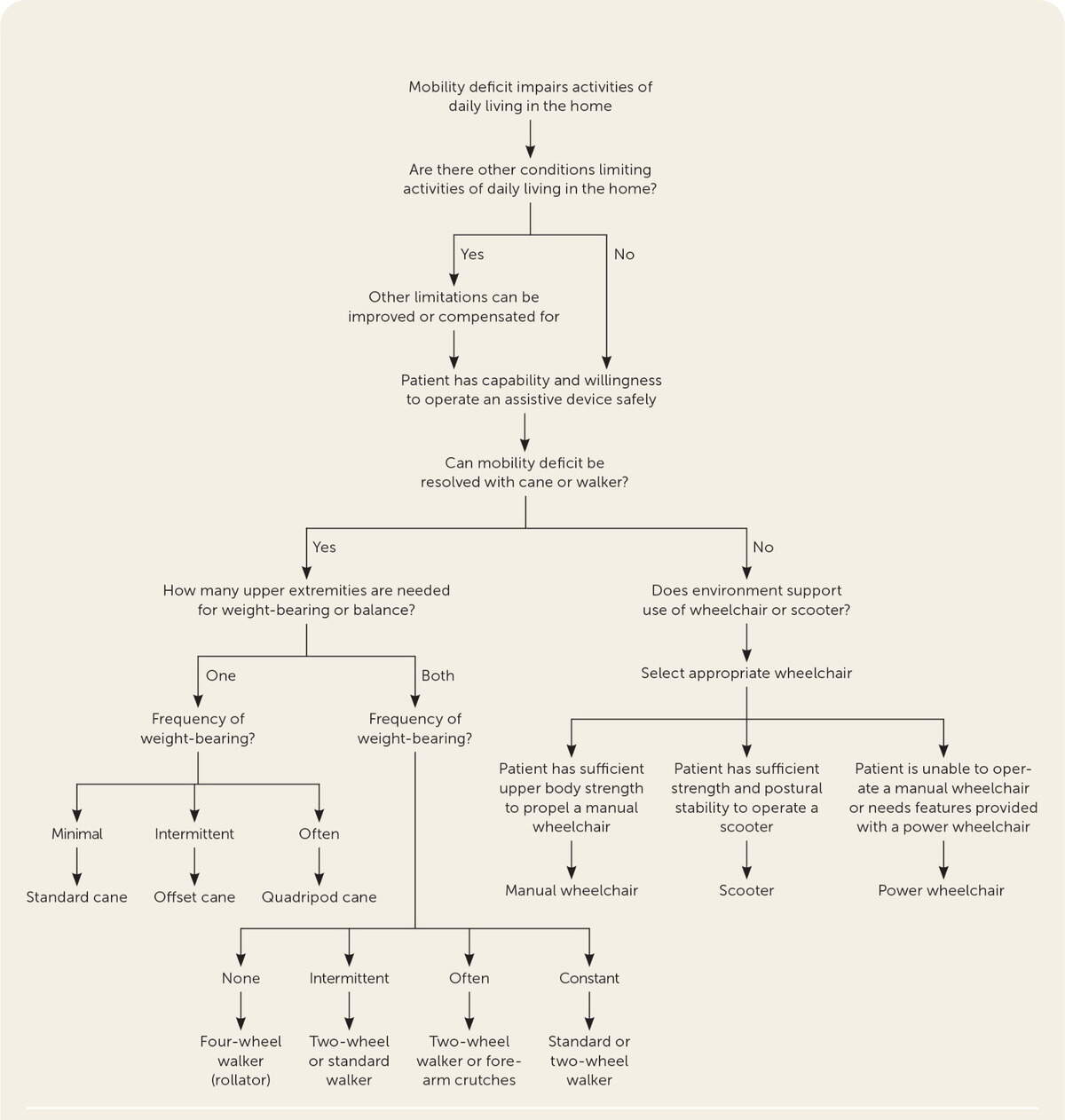
Determining the best device
When looking for the right device, physical limitations are a top contender when finding the best fit, but living environments can add another barrier.
Choosing the most appropriate device is often situational. Many people choose to have a cane for the house and a rollator to walk outside. Other people have a rolling walker at home but have a transport wheelchair for long distances.
Here are some factors to consider in and outside of the home when selecting the right mobility device.
Surface Types: A rollator works best on smooth surfaces like sidewalks, while a straight cane may be more suitable for uneven ground like cobblestones.
Space: Ensure the device fits through doorways and in narrow spaces.
User’s Strength & Needs: A cane may be suitable for those with minor balance issues, while a rolling walker or wheelchair may be more appropriate for individuals with greater mobility limitations.
Indoor and outdoor situations can also impact the device you pick:
Home use: Indoors, a cane or standard walker may be sufficient, dependent on floor surfaces.
Outdoors: A rollator or wheelchair may be better for longer distances.
Occupational therapy and mobility devices
The primary goal of occupational therapists is to foster the greatest level of independence by helping people make their day-to-day lives more efficient and convenient. So if you are unsure about what device may be best for you, you can consult these professionals.
When visiting an occupational therapist, there are options for care coverage cost:
Medicare Coverage: Medicare may cover part or all of the cost if medically necessary, and a referral from your regular physician is often required.
Private Payment: If insurance doesn’t cover, paying privately may be worthwhile for the benefits of expert advice.
Fitting and maintaining mobility devices
Fit: Proper fit and use of mobility devices are essential to get the benefits. It is also important that the patient knows how to use the mobility device correctly. An occupational therapist can help determine the right fit, size and use of a device based on your needs.
Maintenance: Other than finding the right fit, maintaining your device is critical to ensure it performs correctly. Make sure to keep track of the maintenance required for each device to ensure it remains in good working condition.
Insurance and Medicare coverage
Medicare Medical Insurance will cover medically necessary Durable Medical Equipment if your Medicare-enrolled doctor or other health care provider prescribes it.
Always make sure before purchasing a mobility device to investigate your insurance coverage, as they may cover only certain types of equipment and only certain suppliers.
Here are some notes about Medicare coverage for mobility devices:
Medicare coverage requires a written doctor’s order showing that the device is medically necessary.
Medicare will often only pay for one mobility device.
If your doctors or suppliers aren’t enrolled in Medicare, Medicare won’t pay the claims submitted by them.
You may have to pay deductibles and copays depending on your insurance plan.
You may have to get prior approval (known as “prior authorization”) for Medicare coverage of certain types of power wheelchairs.
Medicare won’t cover a power wheelchair or scooter that’s only needed and used outside of the home.
For more information about Medicare coverage of durable medical equipment visit their durable medical equipment web page.