Chair of Greater Island Council rebuffs ‘erroneous statements’ by Hilton Head politician
Emotions ran high early this summer when the Lowcountry nonprofit, the Greater Island Council, passed an internal resolution urging Hilton Head Town Council to surrender its municipal consent in the ongoing U.S. 278 project, a long-contentious undertaking that has resulted in friction between town, county and public alike.
The group came under fire from some members of the public for bringing its resolution to town council. It was Ward 4 Councilwoman Tamara Becker who took the most direct approach to rebuffing the GIC from the dais, publicly questioning whether the nonprofit was making attempts to sway public policy that could be illegal for a 501(c)(3) organization.
“I would like to ask the Greater Island Council this question,” Becker said at that June meeting. “As a 501(c)(3) organization, do you comply with the Internal Revenue Service? Have you met the ‘insubstantial amount’ (of lobbying) test that is in Section 4911 C2 of the code?”
There was some confusion at the time among GIC members present, including Peter Kristian and GIC treasurer Ray Warco, on the group’s classification.
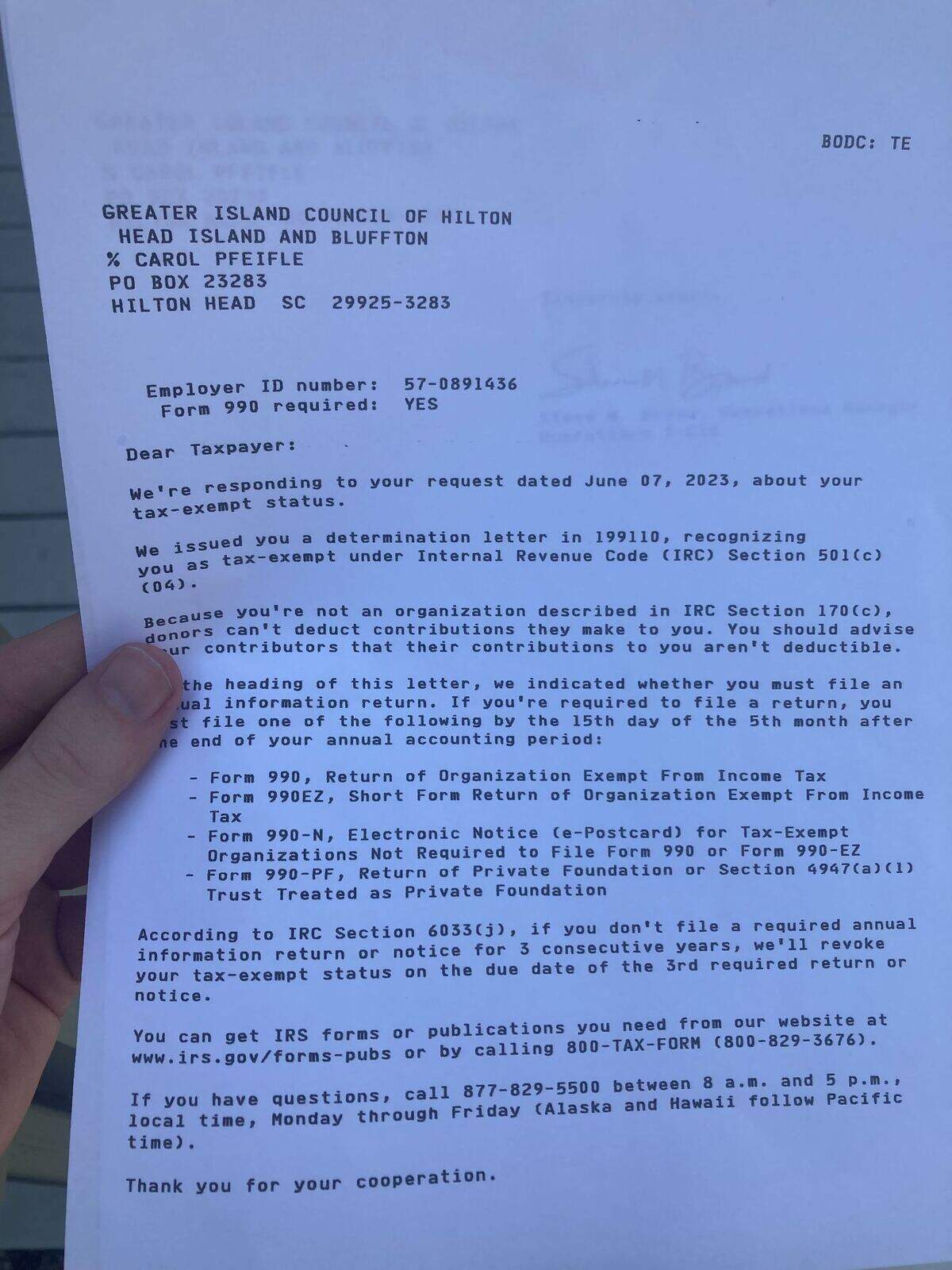
The GIC is not listed as a 501(c)(3), however, the group’s chair confirmed at town council’s most recent meeting — it is a 501(c)(4), giving it freedom to engage in an “unlimited amount of lobbying,” per IRS guidelines.
GIC Chair Lee Wilwerding addressed town council, correcting previous “erroneous statements” from the dais and public comment, and producing documents to show the GIC is instead registered as a 501(c)(4). The documents are consistent with other IRS communications clarifying tax-exempt statuses.
“The Greater Island Council is not now, and never has been, a 501(c)(3),” Wilwerding said.
Wilwerding told The Island Packet Becker has not contacted the group since the June meeting. Becker did not respond to requests for comment prior to publication.
When town officials narrowly passed an agreement with the county to progress plans for the 278 corridor — a project all agree is desperately needed to alleviate traffic, but on in which the details are still debated — not giving away Hilton Head’s municipal consent was, for the four councilmembers who approved the plan, a safety rail against construction that might overly stress the island’s historic Stoney community, residents’ quality of life, the environment, or otherwise not serve Hilton Head’s interests.
It was also a measure of guaranteed independence from SCDOT and county-level impact studies some on town council have been skeptical of for years, leading to today’s independent and ongoing town review of potential solutions and impacts along the 278 corridor.
The slow-rolling approach to the corridor plan was applauded by some residents, cautious of rushing into a potentially flawed project. Yet others, including members of the GIC, grew frustrated with what they characterized as Hilton Head’s wait-and-see philosophy. The GIC decided to draft its resolution in May, asking the town to give municipal consent, which they said would move the project along and display a “sense of urgency.”
Town, county, and state-level officials including Sen. Tom Davis (R-Beaufort) and Mayor Alan Perry clarified at the time that Hilton Head’s municipal consent is not a factor in the project’s current stage, and isn’t holding up progress.
What’s the law?
Under a 501(c)(3) designation, nonprofits toe a thinner line when advocating for public policy positions.
The IRS guidelines indicate a 501(c)(3) organization “may engage in some lobbying, but too much lobbying activity risks loss of tax-exempt status.”
“An organization will be regarded as attempting to influence legislation if it contacts, or urges the public to contact, members or employees of a legislative body for the purpose of proposing, supporting, or opposing legislation, or if the organization advocates the adoption or rejection of legislation,” the agency’s website states.
A 501(c)(4) group may engage in “an unlimited amount of lobbying,” according to the IRS, “provided that lobbying is related to the organization’s exempt purpose.”
Such organizations can also take part in political campaign activities, so long as the activity isn’t the group’s primary function.