Beaufort Co. ranks No. 1 in US for climate change risks. It’s not just sea level rise
Climate change in Beaufort County in the next 40 years won’t just mean hotter summers.
It will mean between 5% and 10% of all property will be below water at high tide. We will have insufferable heat that makes it dangerous to be outside. We’ll experience poor crop yields and huge damage to the county’s wealth and economy.
Those are called “compounding calamities,” and they are the factors that earn Beaufort County, with its municipalities — Beaufort, Bluffton, Hilton Head Island and Port Royal — the No. 1 spot on the list of counties in the United States at greatest risk of life-altering and life-threatening climate change. The assessment comes from data from the Rhodium Group analyzed by ProPublica and the New York Times Magazine and published Sept. 15.
Beaufort County and most of coastal South Carolina is typically in the spotlight in national studies on climate change, but it’s been thrust to the top of this list because it will be severely affected by so many factors. The analysis considers heat, “wet bulb” temperatures that combine heat and humidity, farm crop yields, sea level rise, fire risk and economic damages.
“Taken together, some parts of the U.S. will see a number of issues stack on top of one another — heat and humidity may make it harder to work outside, while the ocean continues to claim more coastal land,” the ProPublica article says.
But Beaufort County doesn’t exist in a vacuum. More of the South Carolina Lowcountry made the list.
- Beaufort County, SC
- Pinal County, AZ
- St. Martin Parish, LA
- Colleton County, SC
- Wakulla County, FL
- Assumption Parish, LA
- Jefferson Davis Parish, LA
- Livingston Parish, LA
- St. John the Baptist Parish, LA
- Jackson County, MS
- Hyde County, NC
- Jasper County, SC
- Graham County, AZ
- Camden County, GA
Calcasieu Parish, LA
The data analysis shows that entire regions of the country will experience compounding problems that make the places in Louisiana, Arizona and North Carolina less hospitable to humans. It exhibits how leaders’ responses to climate change must address several facets that will inevitably damage quality of life in the South.
Climate change risks
The data divides the possibilities between 2040 and 2060 into two scenarios: High emissions and moderate emissions realities.
Here are the details of Beaufort, Colleton and Jasper counties’ risks under each scenario:
Heat
Beaufort, Jasper and Colleton counties could see between five and eight weeks per year where temperatures are consistently above 95 degrees, the data show. Heat predictions were calculated under only high emissions scenarios.
Weather reports from this summer show Beaufort County has reached 95 degrees or higher 14 days so far.
Beaufort County, Colleton County and Jasper County’s risk associated with heat was ranked six out of 10.
Extreme heat and humidity (“wet bulb temperatures”)
Meanwhile, humidity’s role in heat in South Carolina changed the weather picture in the analysis’ rankings.
“When heat meets excessive humidity, the body can no longer cool itself by sweating. That combination creates wet bulb temperatures, where 82 degrees can feel like southern Alabama on its hottest day, making it dangerous to work outdoors and for children to play school sports. As wet bulb temperatures increase even higher, so will the risk of heat stroke — and even death,” according to the ProPublica report.
Beaufort County could see 15 to 25 high wet bulb temperature days each year in a moderate emissions situation and and between 25 and 40 days in a high emissions situation.
These days would bring a combination of temperature and humidity that make it dangerous to be outside. Locally, that means fewer people will be able to spend time biking on the Spanish Moss Trail or enjoying Pinckney Island National Wildlife Refuge.
Beaufort County, Colleton County and Jasper County’s “wet bulb” risk was ranked nine out of 10. Only two other counties, both in Louisiana, ranked higher, with 10 out of 10 risks for miserable temperature and humidity combinations.
Farm crop yields
To see how farming will be affected by climate change across the country, the researchers used corn and soybeans as proxies to examine how crop yields will be affected by rising temperatures and changing water supplies, the analysis says.
Beaufort County will see a 3% to 6.5% decline in crop yields between 2040 and 2060 in the moderate emissions scenario.
Even more staggering, the data show the county could see between a 13% to 44% decline in the high emissions scenario.
Although Beaufort County does not rely as heavily on farming as nearby South Carolina counties, the many vegetable farms on the sea islands could be affected by changes in the climate.
Beaufort County, Colleton County and Jasper County’s farm crop yields risk was ranked eight out of 10.
Sea level rise
The place where the tri-county area starts to differentiate is in the sea level risk category.
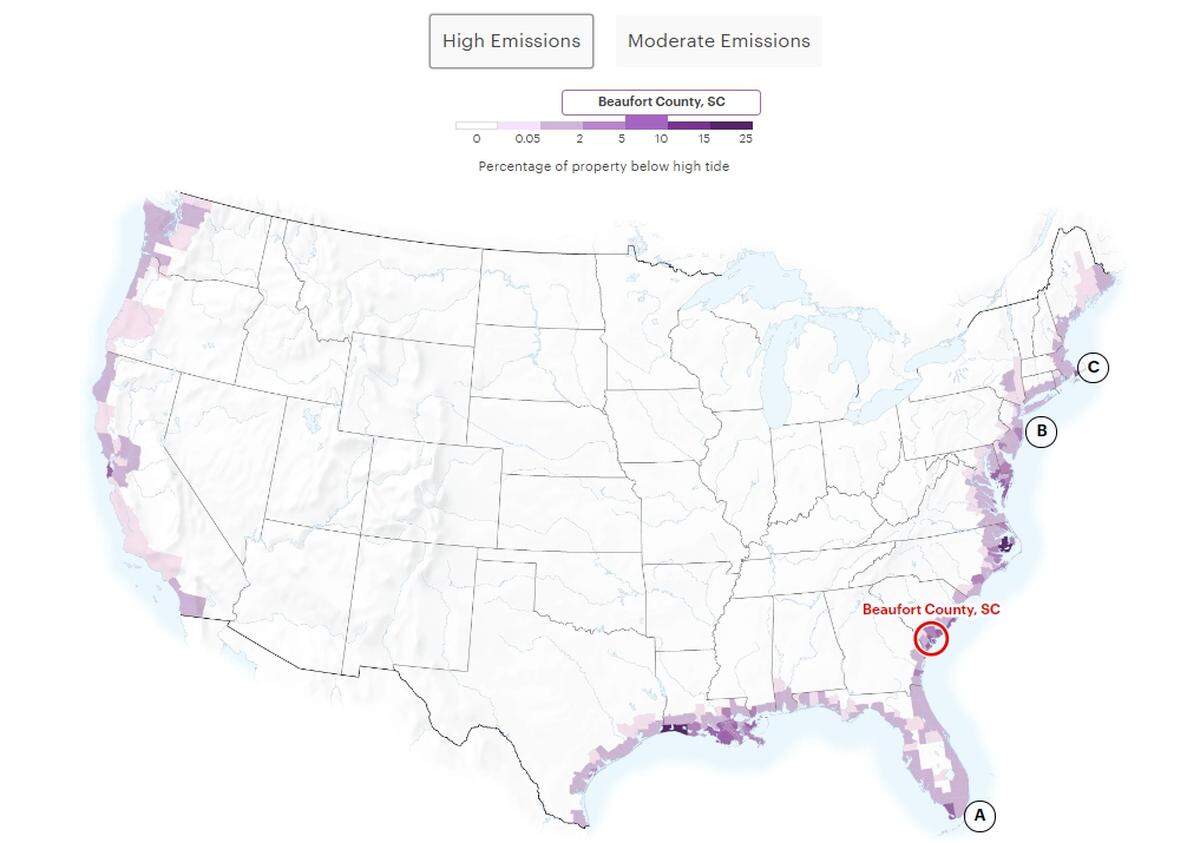
In Beaufort County, the amount of property that could be underwater at high tide was the same in both moderate and high emissions scenarios. Between 5% and 10% of all land in the county could be swallowed by the tide each day.
In Colleton County, the number falls to between 2% and 5% in both scenarios.
In Jasper County, its between 0.05% and 2% in both scenarios.
Beaufort County’s risks associated with sea level rise are ranked seven out of 10.
Colleton’s are ranked six out of 10, and Jasper’s are ranked four out of 10.
Large fires
None of the counties in the tri-county area is at particularly high risk for very large fires, although the factor seriously impacts areas on the west coast and in Arizona.
Beaufort County, Colleton County and Jasper County’s fire risk was ranked three out of 10.
Economic damage
For some economists, the bigger picture of climate change encompasses the major changes to human life based on economies that can crumble when places get too hot or too close to the ocean.
Economic damage comes in a variety of issues: Rising energy costs, lower labor productivity, poor crop yields and increasing crime.
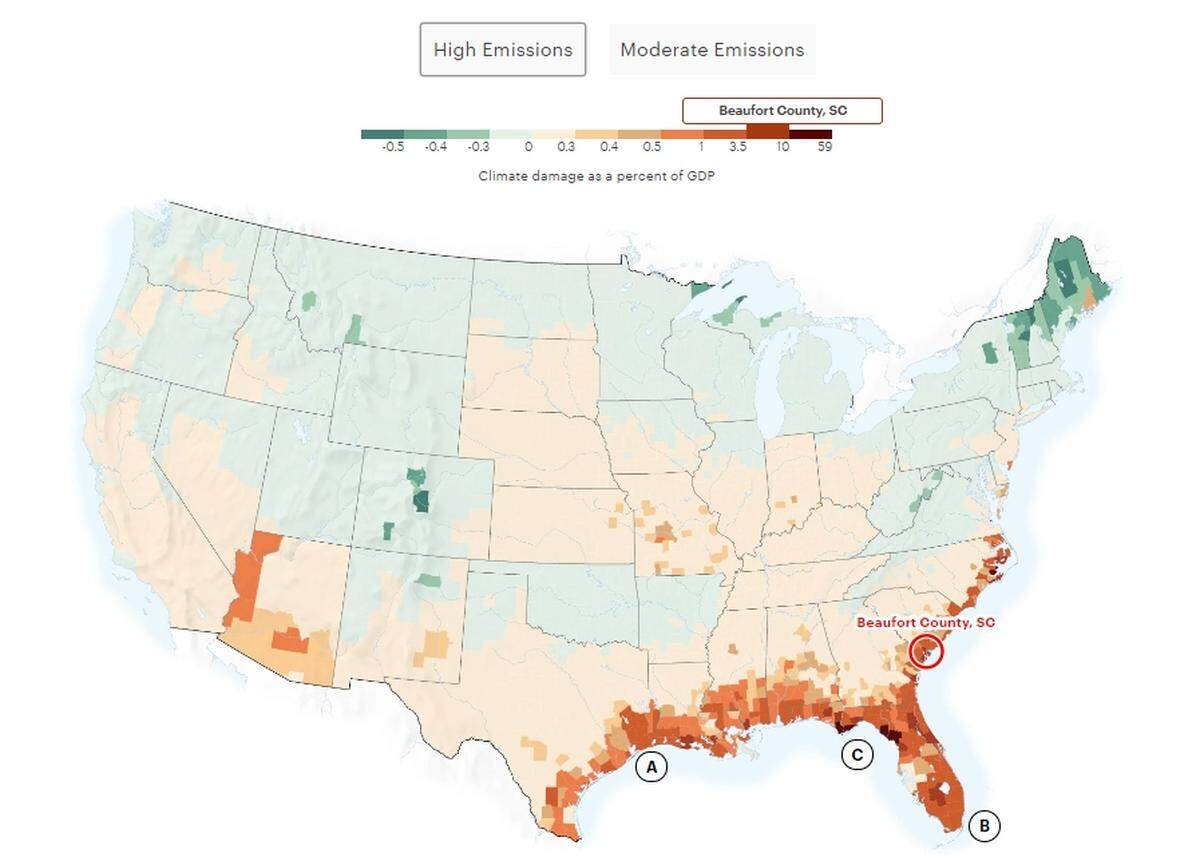
The analysis shows that these “climate-driven elements” will drag on the U.S. economy between the years 2040 and 2060. The impacts were measured in damage on the county’s gross domestic product, or the measure of all goods and services produced within a country.
In Beaufort County, climate-driven changes could account for a 1% to 3.5% decrease in GDP in a moderate emission situation or between 3.5% and 10% decrease in a high emission situation. In an area highly dependent on tourism, changes in weather or hospitable conditions can threaten peoples’ ability to visit or buyers’ willingness to purchase real estate.
Beaufort County’s risk of economic damage to the economy was ranked nine of 10. Colleton and Jasper counties were ranked eight of 10.
Why does Beaufort County rank so high?
Beaufort County’s significance in climate change isn’t new, but seeing the county on the top of the national list when all climate factors are combined presents a new perspective on the county’s future.
Parts of the country often associated with high risks due to climate change such as New Orleans and New York City also made the list, and Beaufort County didn’t outrank counties on all the factors. In fact, Beaufort County does not rank 10 out of 10 on any of the factors.
For example, over 40 counties in Arizona, California and Texas were ranked the highest for heat-related risks due to climate change.
And Cameron Parish, Louisiana (just East of Houston), Hyde County and Tyrrell County (both near or including parts of the Outer Banks) in North Carolina, will experience rising sea levels even more intensely than Beaufort County, the data show.
Counties in California, which The New York Times has called “Ground Zero for climate change,” are also spread throughout the tops of the lists, including in risks for very large fires and sea level rise.
ProPublica’s analysis allows users to sort out the risks by county or by the risk itself, and aims to give a full picture of what life will be like between 2040 and 2060 with heat, “wet bulb” temperatures, sea level rise, lower crop yields, and more large fires.
“Combined, these factors will lead to profound economic losses — and possibly mass migration of Americans away from distress in much of the southern and coastal regions of the country,” the report said.