Hundreds of thousands of taxpayer dollars spent without any oversight. And there’s nothing stopping it
Beaufort County has spent hundreds of thousands of taxpayer dollars in the past four years without any oversight. Payments were made without County Council approval to various consultants, organizations and events, including a controversial $24,000 consulting contract with former Administrator Josh Gruber and annual contributions to a motoring festival totaling $43,000.
Council members learned about some of the spending in fall 2018 and have cut the administrator’s $215,301 contingency account by $115,301 — more than half — for fiscal year 2020. They say they expect new Administrator Ashley Jacobs to right the ship.
However, the county has no rules outlining how money in the contingency fund can be spent. In fact, Beaufort County, which continually promises financial transparency, has enshrouded — whether on purpose or by oversight — some of the previous administrators’ purchases from the public eye.
Unlike most county governments, Beaufort County does not have an online budget document that lists appropriations and expenditures line by line. Instead, it boasts a “transparency site” that’s anything but.
The administrator’s contingency account isn’t mentioned in budget documents posted online; it’s not established by any ordinance; and many of the entries on the county’s financial transparency website are wildly inaccurate.
Administrator Jacobs acknowledged Thursday that the county’s budgeting process “is not very good” — something she says she plans to change.
When a government operates with complete transparency, when citizens can see that their tax dollars are being spent exactly as intended, their trust in all government functions increases. Without financial oversight, even in a contingency account representing a fraction of a percent of the county’s $286.5 million budget, questions arise about the misuse of money, over-billing and motives behind favors for government officials.
Pages of emails and financial documents obtained by The Island Packet under the Freedom of Information Act reveal that county administrators, without any checks on their spending power, have authorized hundreds of thousands of dollars in purchases for whatever they’ve deemed necessary.
Several current and former council members said they have grown increasingly alarmed with the purchasing authority granted to administrators. Those concerns came to a head last September and October, when council found out about former Administrator Josh Gruber’s consulting contract and his yearly contributions to the Hilton Head Island Concours D’Elegance Motoring Festival.
“They both exposed a weakness in the contingency fund,” Councilman Brian Flewelling said. “When I first got on County Council, we would receive regular comments from the county administrator on where that money was going. At some point, we stopped receiving reports.”
Where Are The Rules?
The administrator’s contingency fund, sometimes called a “discretionary account,” is set in place by council and provides the administrator a budgeted amount of money out of the county’s general fund for unexpected circumstances or emergencies each year. However, rules on how the administrator can spend this money don’t exist. The county does not have records on when the account was first adopted, and veteran county employees said it’s been around for as long as they can remember.
The only real guidelines for discretionary spending are in the county’s purchasing ordinance, amended by council in 2014. According to the ordinance, the administrator can spend up to $50,000 for each purchase without council approval. Five years ago, the administrator’s purchasing limit was $25,000 before the council doubled it and Gruber, then county attorney, approved it.
.jpg "gruber (1).jpg")
It’s up to the administrator to decide what “unanticipated circumstances” warrant money from the contingency fund. Former Administrator Gary Kubic said the fund allows the administrator to react to conditions or events that require immediacy.
For the 2018-19 budget year, the council budgeted $215,301 for the fund. Some council members, like Flewelling, said that amount was too high. At council’s recommendation during the budget process, Administrator Jacobs agreed to cut her contingency budget to $100,000 for the current budget year.
Between 2016 and 2019, contingency fund spending has varied: $75,526.11 in 2016, $128,236 in 2017, $156,313 in 2018 and $148,877 in 2019. The amount budgeted for the fund has also changed widely over the years, ranging from $322,000 in 2016 to $100,000 in 2020.
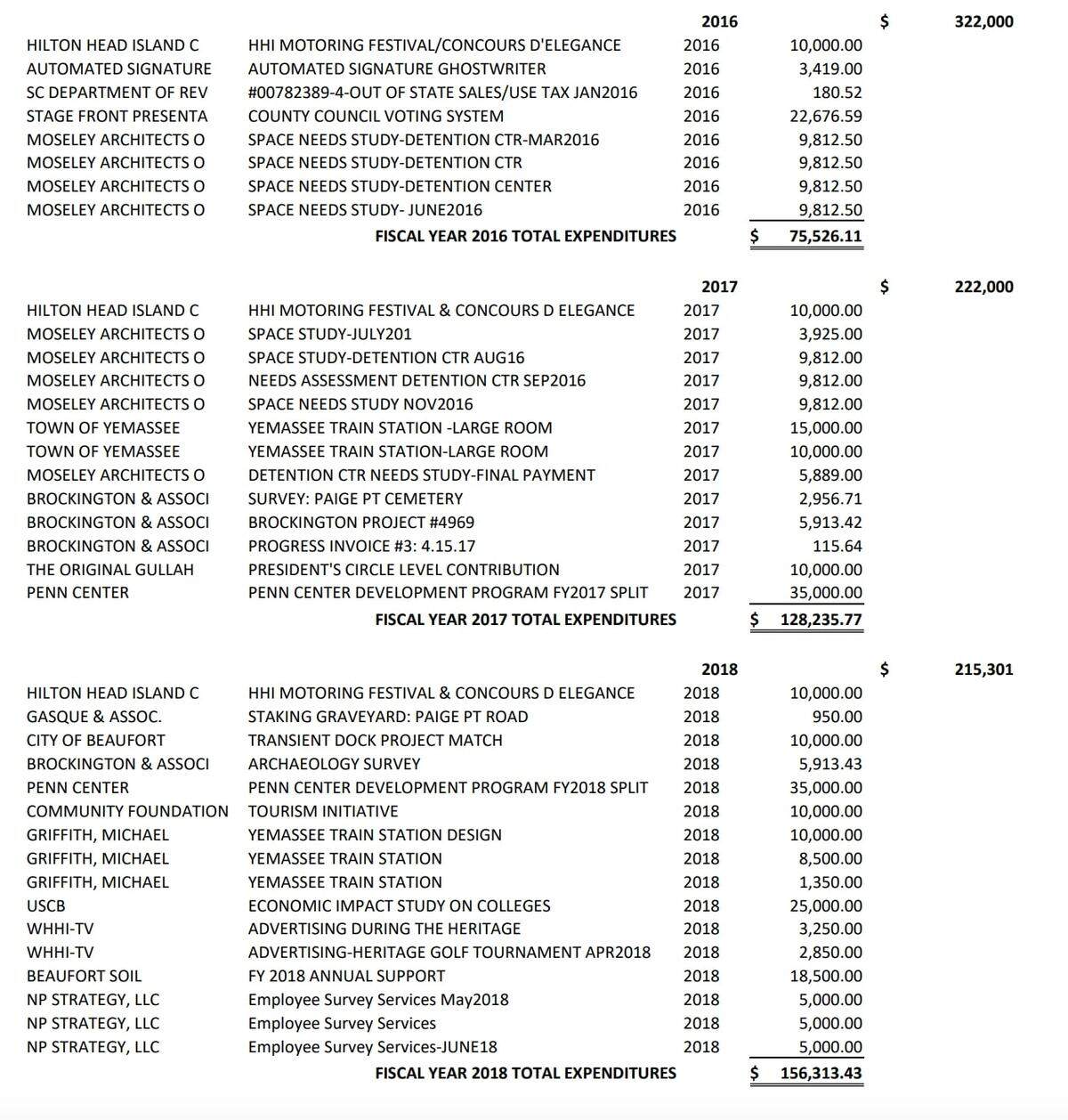
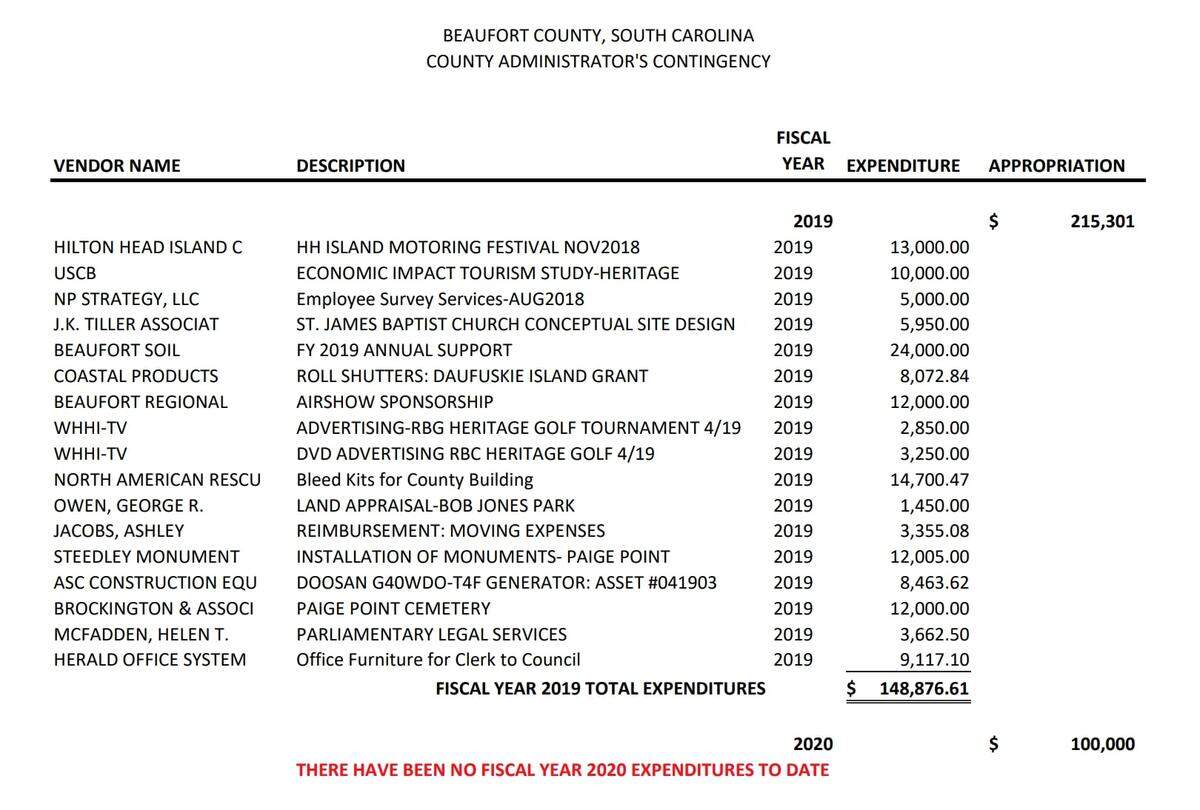
To obtain this information, The Island Packet filed a Freedom of Information Act request with the county.
In an email, County Chief Financial Officer Alicia Holland responded that the information was “available online via the County’s Citizen Transparency portal. The transparency portal allows any user with internet access to see EVERY expenditure for a four (4) year time period including appropriation information.”
However, some of the expenditure numbers for the administrator’s contingency fund on the site were off by tens of thousands of dollars, and only one of the yearly budgeted amounts was listed.
Over the years, administrators have used the contingency fund to pay for anything from advertising at golf tournaments to $9,117 for office furniture.
Any money from the contingency fund that isn’t spent is rolled into the county’s general fund.
Previous county administrators have allocated money to some of the same groups in back-to-back years, including the Penn Center, an African-American cultural center on Saint Helena Island; the University of South Carolina-Beaufort; and the Hilton Head Island Concours D’Elegance, a nonprofit that runs the yearly high-end motoring festival and is funded through donations.
Concours D’Elegance, the French phrase for “competition of elegance,” is a multi-day festival in which prestigious vehicles are displayed and judged.
Undisclosed Payments, ‘Problematic’ Thank-You Gifts and Fancy Cars
From 2016 through 2019, former Administrators Gary Kubic and Josh Gruber allocated a total of $43,000 to the motoring festival, with annual payments of $10,000, $10,000, $10,000 and $13,000, respectively.
Kubic said he originally paid the group using the contingency account when Carolyn Vanagel, retiring festival president, asked him to help with site improvements after Hurricane Matthew damaged the festival area. It was a one-time, unexpected circumstance.
However, Gruber, the deputy administrator at the time who became Kubic’s successor, continued to pay the festival group from the contingency fund in subsequent years. Those expenditures mean the county was making two payments to the group each year, as Concours already received between $25,000 and $26,000 in yearly funding through the accommodations tax process — funded by a 2 percent tax on rental properties.
According to the minutes of a finance committee meeting on Oct. 22, 2018 and an Oct. 16 email between Councilman Jerry Stewart and Chief Financial Officer Alicia Holland, council members, including Paul Sommerville, Stewart and Rick Caporale, became aware of the payments sometime in October. They wondered why the group was being paid on top of its funding from the accommodations tax.
Because the yearly payments of $10,000 and $13,000 were below the $50,000 limit on administrative spending, council approval was not required, and council members were not notified of the contingency fund payments.
According to emails between Gruber and festival president Vanagel, Gruber paid $13,000 to the Concours group in 2019 for “lighting, sound, security and other infrastructure costs.” The emails also show that for each year that Kubic and Gruber contributed county money to Concours, they received gifts from Vanagel in the form of sponsor badges and admission to the Flights & Fancy Aeroport Gala, a fancy evening of cocktails, fast cars and private jets organized by Concours. Tickets to the airport gala are between $195 and $295 per person.
Vanagel first referred to these gifts in a July 2016 email to Gruber: “Thanks to you and Gary for this support. As a thank you, we would like to offer you 4 Sponsor Badges which will give you access to all our public events.” Gruber did not report the gift to the State Ethics Commission in 2017, as required by law. However, at 6:53 p.m. on Feb. 7, 2019, he amended his 2017 report to show he received $820 in gifts from Concours D’Elegance. Gruber made the change the same week the county began its investigation into the $24,000 consulting contract.
Councilman Flewelling was not happy to learn that Gruber received personal gifts after giving taxpayer money to Concours.
“It’s problematic,” Flewelling said. “It just doesn’t smell right.”
Already Funded?
In an email from Oct. 29, 2018, Councilman Mike Covert asked Chief Financial Officer Holland and County Attorney Tom Keaveny about an invoice from the Concours group that asked for $13,000 on top of the $39,000 that had already been paid from the administrator’s contingency fund and the accommodations tax. The extra $13,000 would have brought the total to $52,000. In the email, Covert was concerned about who, besides the administrator, actually oversaw daily purchasing practices to avoid “overbilling and improper invoicing.”
Holland responded that the invoice was “an oversight” and that the county had paid the group $39,000 in full for the year. However, the emails show what can happen when a government official has sole purchasing authority without any kind of oversight. Without proper checks in place, the county was over-billed — and almost paid — an extra $13,000.
Another issue addressed in the Oct. 29 email is the use of the contingency fund to make up the difference of what isn’t awarded by the Accommodations Tax Board. After requesting $30,000 in ATAX funding for 2017-2018, the Concours group received $26,000. The ATAX funding for the group has remained about the same over the past four years: $25,000 in 2016; $25,000 in 2017; $26,000 in 2018 and $26,000 in 2019. After those ATAX funds were awarded each year, Carolyn Vanagel asked either Gruber or Kubic for more funds. The two former administrators paid the group out of the contingency fund.
What Now?
With all of council’s concerns about the administrator’s purchasing power, several members have considered increasing restrictions and oversight. Flewelling said all purchases made through the administrative contingency fund should be reported to council and that the ordinance should explain the circumstances the fund may be used for.
John DeLoache, senior staff attorney for the South Carolina Association of Counties, said most counties in the state give administrators a certain amount of spending authority that doesn’t have to be approved by council. However, in a Council-Administrator government where the administrator answers to council, he said, it’s the council’s responsibility to address concerns about the administrator’s spending power.
Councilman and Finance Committee Chairman Joe Passiment said the council will look at how the new administrator uses the contingency fund each month and may adopt rules for the fund in 2021.
Administrator Jacobs said most counties she’s familiar with have a budget document online that lists expenditures by each department. She said she plans to create one for the next fiscal year.
“I don’t think we have that. We should have that,” Jacobs said. “For whatever reason, that process has fallen by the wayside here.”
Jacobs said she recently received an email from the Concours group asking for money, but she said she wasn’t sure if she would fulfill the request.
“For me, contingency is for emergencies or unforeseen circumstances,” she said. “Something you know you’re going to fund, that should be part of the budget.”
This story was originally published July 27, 2019 at 6:00 AM.