
At 33, Beaufort Co. nursing home resident lost his independence. Then strangers stepped in
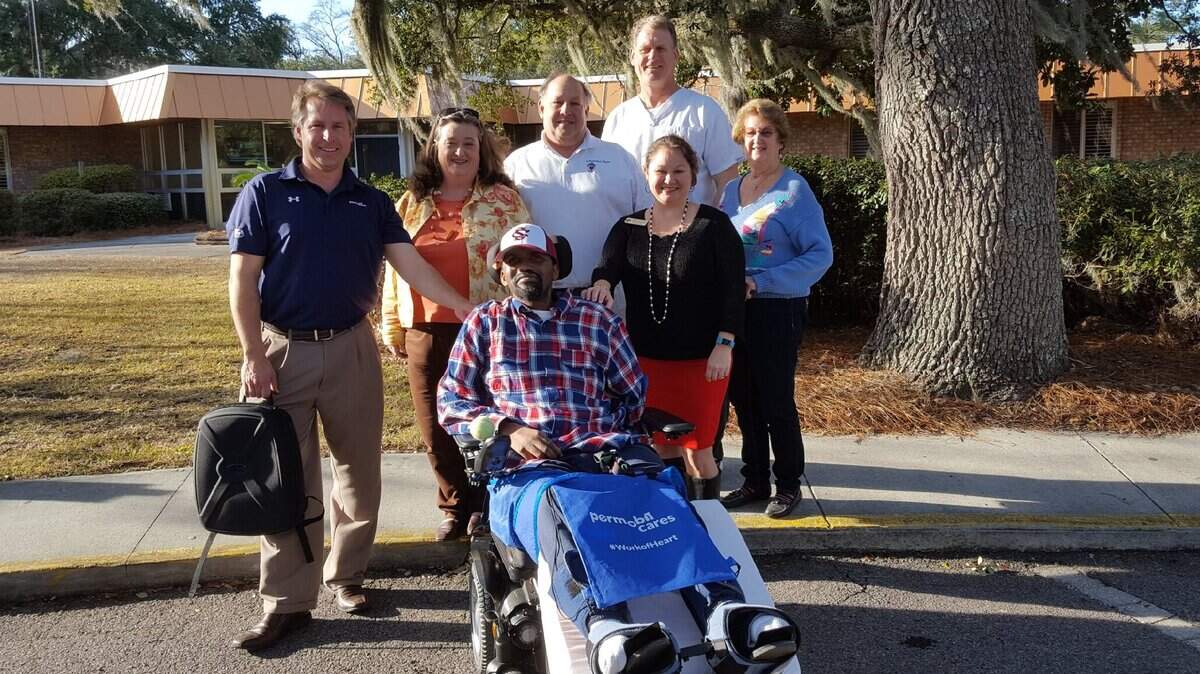
Like clockwork, Bradley Cummings starts off his day by rolling down the hallways of Bayview Manor nursing home in Beaufort and making it a point to tell each staff member good morning.
In spite of his wheelchair, Cummings, 33, remains active all day. When he’s not chatting with the secretary at the front desk, he can be found relaxing outside or — more often than not — partaking in whatever activity is offered in the activity room that day.
From the cooks to the nurses to the administrators and custodians, everyone at Bayview Manor knows Cummings.
"He’s independent and very social, so he's out and about most of the day," said Tanisha Magwood, his unit supervisor at Bayview Manor.
Independence was always a constant for Cummings, but twice he has been forced to overcome enormous obstacles in his path.
The first hurdle came when Cummings lost the strength required to move on his own and the second came when the his last vehicle for autonomy — his wheelchair — stopped working. The first time Cummings found a solution himself by moving into a nursing home, but the next time the answer to his problems found him.
Cummings is younger than the average Bayview Manor resident by at least 30 to 40 years, but that doesn't stop him from bonding with the other residents.
"This is my family. I met a lot of older people that I can talk to," Cummings said. "I get to learn (from them.)"
Cummings said the most important thing he's learned from the older residents is respect.
"They’ve adopted him as their son," Magwood said. "Everyone looks out for him and takes a special interest in him, since he's the youngest one.”
Cummings grew up in Hardeeville and by about the age of 6, he began having trouble balancing and would fall unannounced.
Doctors performed surgery on both Cummings' calves, but the problems persisted. Cummings’ sister, Natasha Murray, believes he was misdiagnosed then.
By the time he got to Jasper County High School, Cummings would hold onto the walls to stabilize himself while walking down the hallway. When graduation rolled around, Cummings decided not to walk in the ceremony for fear of falling on his way to accepting his diploma.
As years went on, Cummings grew increasingly more weak and continued to struggle while walking.
Eventually, in 2010, doctors performed an MRI and discovered Cummings suffered from both multiple sclerosis and muscular dystrophy.
Muscular dystrophies, also referred to as MD, are a group of genetic diseases that cause progressive weakness and loss of muscle mass.
Multiple sclerosis, more commonly referred to as MS, is an often disabling disease of the central nervous system that cuts off the flow of information between a person’s brain and body.
Around the time that Cummings was first diagnosed, he was living in his own apartment, working as a security guard in a gated community and later as a clerk at Goodwill and pushing his wheelchair back and forth to Walmart to pick up groceries.
But as time went on, Cummings could no longer lift himself from his bed onto his wheelchair by himself and he realized he was in need of further assistance.
"He’s always been a very independent person and very responsible when it comes to finances," Murray said. "But it seemed like once he was diagnosed, the progression took effect really quick."
Murray said Cummings’ decision to admit himself into an nursing home was all his doing.
"He decided, especially when he lost the ability to move on his own, that he needed around-the-clock care, so he signed himself up," Murray said.
Although many people with MS remain able to walk, Cummings suffers from the more severe symptoms, such as slurred speech, tremors, troubles swallowing and a full loss of mobility. His left arm is also amputated above the elbow.
Mentally, however, he’s as strong as ever.
"I always say, his body may be weak, but his mind is not," Murray said.
‘The worst feeling in the world’
Cummings’ primary source of independence comes from his electric wheelchair — which he can operate on his own and allows him to get where he wants when he wants. But last year, he found out what reality would be like without his chair.
In October, his wheelchair stopped operating properly and his only means to get around the facility was being pushed by staff in a manual wheelchair.
For about two months, Cummings was restrained in his mobility and was forced to ask someone to take him wherever he needed to go.
"It was miserable. I couldn't move at all," Cummings said. "When you can't move, it's the worst feeling in the world."
Wheelchairs like the one Cummings needs cost more than $20,000.
Medicare will not cover the cost of a chair while Cumming is in a skilled nursing home and neither Bayview Manor nor his family had the funds to buy a new one.
Looking for other alternatives, administrators at the nursing home took the chair to Allan Snyder, who owns Independent Again, a medical equipment company in Beaufort.
In spite of realizing Cummings' wheelchair was beyond repair, Snyder knew he was inclined to do something more for Cummings.
"This poor guy, with all his stuff going on, he’s got to be able to at least get around," Snyder said.
‘A sense of hope’
After explaining the situation to a local sales representative for a national power wheelchair company, Allan said he was informed about a program where the company donates demo products to community members in need.
Allan gathered recommendation letters from the Bayview staff, submitted all the necessary application materials and teamed up with the local nonprofit The Lending Room to help facilitate the operation.
Weeks later, Allan received the good news: Cummings had been chosen to receive the new, fully fashioned wheelchair for free.
Once it arrived, Allan personally worked on the chair to make sure it all functioned properly and fit Cummings' needs.
Cummings described his initial reaction simply: "Yayyy!"
Murray said the fact that the community, including some strangers, came together to help make the operation possible keeps her family optimistic.
"It gives us a sense of hope for him, because despite living in a nursing home, he’s still a young man," she said. "It’s a blessing for him to have that and to be able interact with people every day."
As for Murray, he’s back to roaming the halls in his wheelchair and using it to attend his favorite activity offered at the home — bingo.
This story was originally published March 21, 2018 at 8:15 AM with the headline "At 33, Beaufort Co. nursing home resident lost his independence. Then strangers stepped in."