We’re getting a Lowcountry Oyster Trail and here’s what you should know about it
By Maggie Angst
The concept is simple: Lowcountry oysters are some of the best in the world. So, shouldn’t everyone get to see, taste and experience them for themselves?
In November 2015, the Virginia Oyster Trail was officially launched, and for the first time, attractions spanning across 250 miles were seamlessly connected to provide Virginia visitors with nearly every aspect of the state’s oyster production and consumption.
Bluffton resident and entrepreneur Larry Hughes admired this from afar as the project blossomed, but he harbored one major critique.
“They (the organizers of the Virginia Oyster Trail) are spectacularly good at what they do, which is promoting the oysters in the state. The problem is their oysters aren’t the greatest. Ours are,” Hughes told The Island Packet in a recent interview. “I looked at that business model, looked at what they were doing, and then I looked at our incredible marine ecosystem and our treasures. Any way you want to judge them — competition wise or consumer-wise — our oysters are better.”
With that idea in mind, Hughes has spent the past year trying to create a vehicle to prove this to the world.
The trail, which closely mirrors Virginia’s, is an experiential tourism, economic development and environmental initiative. While the focus is on food and discovery, a majority of net profits will be used by its philanthropic arm, S.C. Lowcountry Oyster Trail Foundation, to promote and enhance marine ecological research and environmental stewardship for the region.
“This plan formed to use the oysters as a device to draw people off of 95 and to reinvigorate the residents of the Lowcountry to not only appreciate this wonderful little mollusk, which was right under their nose, but also to begin to become more consciously aware of the marine ecosystem,” Hughes said.
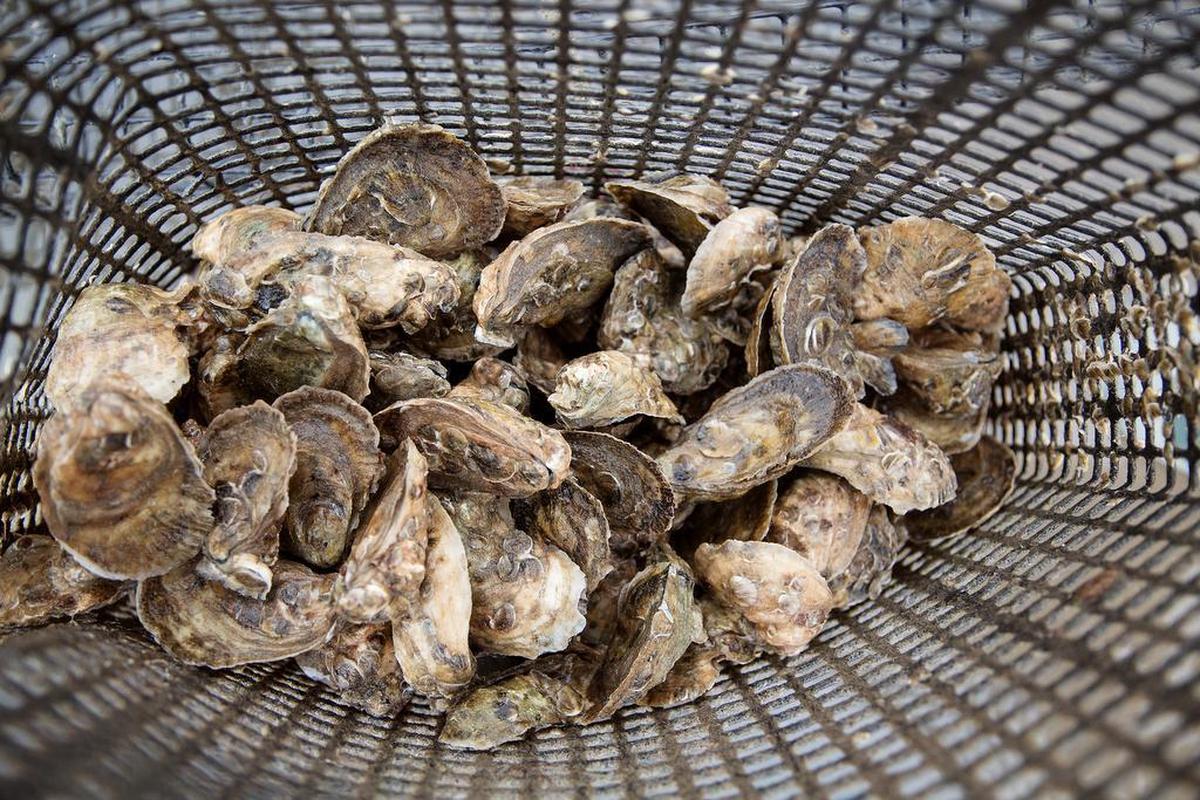
Today, an oyster renaissance is underway in the Southeastern U.S. thanks to the adoption of aquaculture — fish or shellfish farming — that supplies nearly half the seafood eaten in the United States and abroad, according to the National Oceanic and Atmospheric Administration.
One of Hughes objectives with the trail is to bring more attention to those oyster farmers in the Lowcountry, including Frank Roberts at Lady’s Island Oyster Co.
Lowcountry Oyster Trail logo Submitted- Lucy Rosen
What will the Trail look like?
The Lowcountry Oyster Trail, which will officially launch at The Taste of Waddell on Sunday, will spread from Charleston all the way down past the Georgia border, and will include Chatham and Effingham counties.
The website, which is currently up and running, is being updated daily, according to Lucy Rosen of Smart Marketing Communications, the marketing agency Hughes is working with to promote the trail.
The site features itineraries for oyster-related activities along the trail based on who you are and how much time you have, a list of oyster events in the Lowcountry and soon, it will feature a map with all the trail partners.
“There’s going be an actual map on the website that they can download,” Rosen said. “Each partner will have a pin and when you click on it, it’ll open up to their individual profile page, which will have everything you want to know about the operation.”
Followers of the trail will be able to learn about the watermen who harvest the oysters, the local restaurants that serve them, as well as tour companies and other cultural attractions that are tied to Lowcountry oysters found along the way.
In time, Rosen plans to promote the trail with a digital billboard on Interstate 95, an app and geofencing, which sends a cellphone notification when a person is driving or walking near a Lowcountry Oyster Trail partner.
“The marketing and the outreach of this thing is going to dramatically increase heads in beds at hotels, butts in seats at restaurants and people spending money at a local level,” Rosen said.
The concept just started as an idea, but like the Virginia trail, Hughes hopes to see the Lowcountry Oyster Trail grow into something significant in terms of the tourism economy.
“The thing that makes it so remarkable as an economic development initiative is because it’s aquatourism, it’s an economic development play and its philanthropic,” Hughes said. “Nothing else has the three legs to the stool.
“It’s also great for the residents. That’s what misses in a lot of the other tourism play...we’re saying all in— residents and tourists alike. It’s your trail,” he said.
The Lowcountry Oyster Trail is set to officially launch Nov. 5. Submitted
Why now?
Wild oysters reefs are one of the most critically threatened marine habitats in the world. Poor water quality due to microfibers, plastics and personal pharmaceutical products, diseases caused by warmer temperatures and overharvesting are all of concern for the wild oyster population.
“I was truly alarmed,” Hughes said about first learning the issues.
In order to understand these impacts on Lowcountry oysters, Hughes plans to use funds transferred and donated to the S.C. Lowcountry Oyster Trail Foundation to create a regional lab to study our unique local ecosystem and oysters.
The regional lab is still a concept, but Hughes hopes with the help of the Lowcountry Oyster Trail, in 10 or so years it’ll start to become a reality.
“We can’t go to the legislative delegation and say with any declarative authority we’ve got a serious problem, because we just don’t know,” Hughes said. “We know we’ve got problems, but we truly don’t know how serious they are or how non-serious they are.