When will the pandemic end? SC health experts weigh in on the future of COVID-19
READ MORE
COVID-19 spikes again in South Carolina
Here’s the latest on the omicron variant surge, COVID-19 guidance and more in South Carolina.
Expand All
When the first coronavirus cases in South Carolina were detected in March 2020, state health officials sprang into action.
The Department of Health and Environmental Control established a COVID-19 incident command team composed of employees from across the sprawling agency to coordinate the state’s emergency response.
Nearly 600 days — and some 12,800 deaths — later, they’re still at it. How much longer they’ll be needed is anyone’s guess.
Local infectious disease specialist Dr. Helmut Albrecht likes to joke that the pandemic will be over by April. He just doesn’t know what year.
What is clear is that COVID-19 isn’t going away anytime soon. The delta variant has made sure of that.
The ease with which delta spreads makes it so that herd immunity — the point at which enough people have protection from the virus that outbreaks are stopped in their tracks — almost certainly cannot be achieved by vaccination alone, especially given the current level of COVID-19 vaccine hesitancy.
For that reason, the eradication of COVID-19 appears highly unlikely.
A more plausible scenario, according to public health experts, is that the pandemic will end when about 90% of the population has either been vaccinated or infected. In a state like South Carolina, where the vaccination rate sits at 53% of the eligible population, the road to herd immunity likely involves significantly more suffering and loss.
Eventually though, as more people develop some level of immune protection, the virus’ spread will abate. While there will continue to be reinfections and breakthrough cases in vaccinated people, far fewer of those who catch the virus will be hospitalized or die.
“It doesn’t mean no one will get COVID,” said Dr. Rick Scott, Prisma Health’s chief clinical officer and COVID-19 incident commander in the Midlands. “It just means that it’ll start to look more like a cold and less like a terrible thing because our immune systems will be partially activated to fight it.”
Most experts agree that COVID-19 won’t disappear entirely, but instead will become something like influenza or the four human coronaviruses that cause the common cold — a predictable, seasonal virus we come to live with.
“If the other coronaviruses are any sort of indication, (COVID-19) will become a disease that’ll flare up in children, in sort of small outbreaks, probably forever,” said Albrecht, who serves as medical director of the Center for Infectious Disease Research and Policy for Prisma Health and the University of South Carolina.
Virus mutations could change pandemic endgame
All this could change, however, if a virus strain emerges that supplants delta as the nation’s predominant variant, officials say.
Delta and delta-like variants have accounted for virtually all COVID-19 cases in South Carolina since August, but a new strain that outcompetes delta and can maneuver around our existing immune defenses could throw a wrench in health experts’ predictions of the pandemic’s demise.
As more people are infected with COVID-19 and the virus continues to replicate, mutations are inevitable. The vast majority of mutations won’t have a significant impact on the virus’ fitness, but the possibility that a mutation or series of mutations eventually spawns a more dangerous variant is always a possibility. That’s one of the primary reasons why reducing coronavirus spread is so important.
“There are certain delta-plus variants and certain others that are distinctly different from delta, and they’re probably two or three steps away from overcoming a lot of the vaccine and previous infection responses,” Albrecht said. “So it clearly is possible and therefore it’s really worrisome.”
The irony is that because delta is so infectious, other concerning variants have so far been unable to gain a foothold.
“It’s so fit as a virus … that all other variants that we were worried about have no chance, whatsoever, when delta is introduced in a community,” Albrecht said. “We talked about mu (another COVID-19 variant) a couple months ago because we have thousands of cases in the U.S., and it’s essentially disappeared into the background.”
While a new variant that outcompetes delta could have serious implications for COVID-19 vaccination efforts and monoclonal antibody treatments, the mRNA technology used in the Pfizer and Moderna vaccines allows for relatively easy modification to target strains capable of evading existing vaccine-induced immunity.
“The good news is this vaccine approach is probably the easiest to modify,” Albrecht said. “You can really very easily design a new mRNA spike protein, and therefore I think we’ll get a handle of this and next year we will have a new normal.”
Depending on whom you ask, we could see a new normal as soon as spring or it may take another year or more before the pandemic peters out and COVID-19 becomes endemic.
Michael Sweat, director of the COVID-19 Epidemiology Intelligence Project at the Medical University of South Carolina, believes at least one more significant surge lies ahead this winter.
By his calculation, roughly 30% of South Carolina residents, or about 1.5 million people, remain vulnerable to COVID-19.
“When you look at what just happened across the U.S. — and it’s continuing to happen — there’s clear evidence, just on experience, that the level of immunity we have right now is not stopping waves,” said Sweat, who doesn’t think the number of residents vulnerable to COVID-19 will change dramatically between now and winter. “When you add it all up, you are likely to see a fairly big bump in the winter.”
DHEC creates permanent COVID-19 office
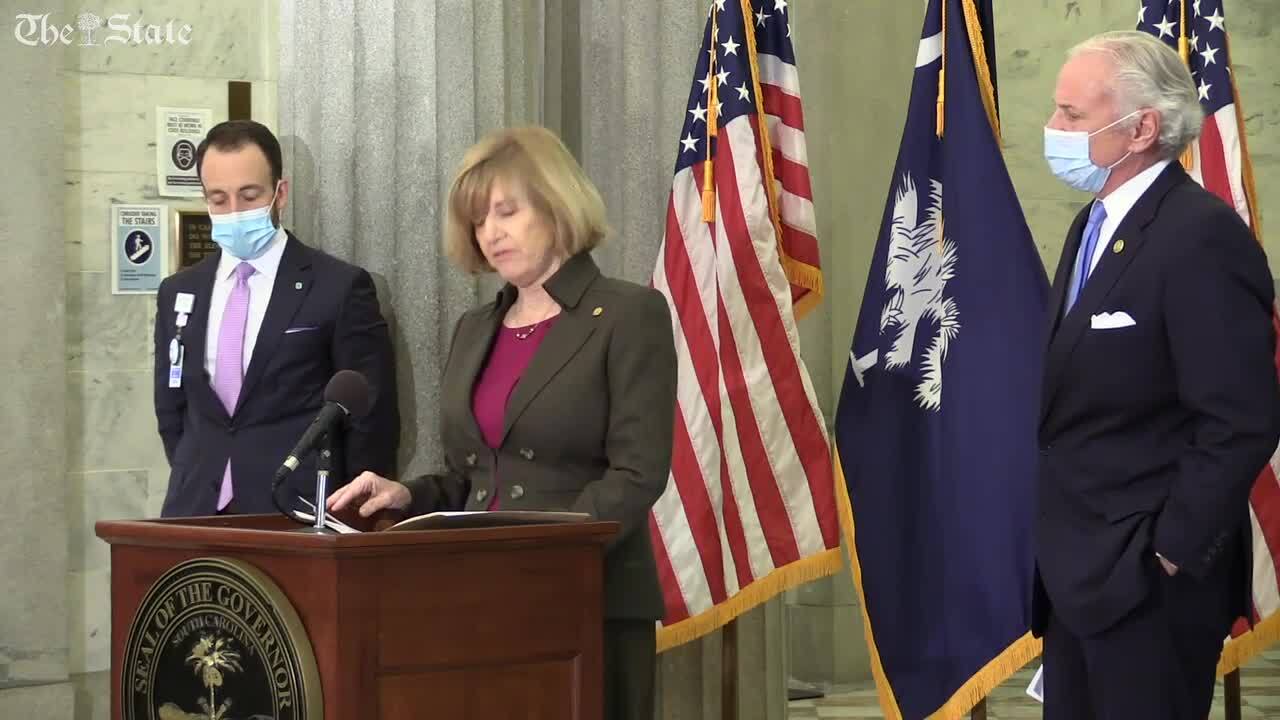
Recognizing that likely reality, the state’s health department has chosen to plan for a future with SARS-CoV-2 in it.
The agency is in the process of creating a permanent COVID-19 coordination office to carry out the daily functions its incident command team has performed on an emergency basis for the better part of two years.
“This is going to be a front-loaded effort,” said Louis Eubank, who will head up DHEC’s new COVID-19 office. “I don’t think anyone has any illusions about the fact that the hardest work, the best work, the most necessary work is going to be right now, for probably the next year, as we, hopefully, come off of the surge that we’re in.”
Eubank, who previously oversaw health care planning and construction activities across the state and has been involved in the agency’s COVID-19 response full time since January, expects the new office to be up and running by Thanksgiving.
The central COVID-19 office will be staffed by 19 full-time and temporary workers, with dozens more employees fanned out in regional offices across the state.
All COVID-19 office personnel will be paid through a federal public health workforce development grant specifically designed to maintain the current response while preparing for the next public health challenge, Eubank said.
Staff will focus on what he considers the primary tenets of DHEC’s COVID-19 response: case investigation, testing, vaccination and data reporting.
“I think those four things that drive the primary mission today should always drive the primary mission,” Eubank said.
Ensuring the state has an updated plan of attack to respond to the next major public health crisis will also be central among the new team’s duties.
“For many years the state has had pandemic preparedness plans … but against this novel coronavirus we still learned quite a bit about how things can change,” Eubank said. “We’ve got a pretty significant opportunity here to future-proof some of our pandemic operations.”
Developing a response plan informed by lessons learned from COVID-19 should set the agency on track to react decisively and systematically to the next viral pandemic.
“There’s gonna be no greater lessons learned than what we’ve had in the last 18 months,” Eubank said. “Being able to build that into a plan that anybody that’s sitting in our seats for years to come can pick up and run with is gonna be a huge, huge deal for the state.”
Sweat, of MUSC, commended DHEC for its work throughout the pandemic and said the agency was wise to establish a more permanent COVID-19 operation.
The decision illustrates the evolution in mindset public health officials across the country have undergone with respect to SARS-CoV-2, he said.
“We’ve all just come to realize that this is not going to just suddenly go away,” Sweat said. “It’s going to be around for a long, long time.”
Scott, Prisma’s COVID-19 incident commander in the Midlands, said he thought DHEC responded to the pandemic as well as could be expected given the circumstances, but that he hoped it would take more of a leadership role in future contagions rather than relying heavily on health systems and universities.
He also suggested the agency keep some dollars in reserve to attract traveling health care workers and incentivize current hospital staff to stay in South Carolina rather than seeking more lucrative contract work in other states.
“It was pretty much a bidding war for traveling health, and still is,” Scott said. “It would be great if we had a stay-at-home program that the state helped us with. Whether it’s tax relief, or a tax credit, or actual reimbursement. Anything that they could do to help keep our workforce at home would be a great Step One.”
This story was originally published October 10, 2021 at 5:00 AM with the headline "When will the pandemic end? SC health experts weigh in on the future of COVID-19."



%20(5).jpeg)