What will it take for Beaufort Co. to achieve COVID-19 ‘herd immunity’? Experts explain
It’s the question on everyone’s minds as pandemic “fatigue” sets in: When will all of this be over?
For Beaufort County — and the rest of South Carolina — that answer lies in how quickly an effective SARS-CoV-2 vaccine can be distributed to a large number of people, experts say.
The state can achieve “herd immunity” through mass vaccination.
But what if Lowcountry residents let the novel pathogen “rip” through a given population?
Could enough people be infected to create “natural herd immunity”?
While that’s possible, it would come at a high price.
Experts stressed that a push to achieve herd immunity before the roll out of a vaccine would be devastating and lead to scores of deaths.
“It’s basically just throwing up our hands and saying ‘Well, you know, I’m kinda sick of staying home and wearing a mask, so we’re just going to let a bunch of people die,’” said Dr. Stephen Kissler, a postdoctoral research fellow at the Harvard University T.H. Chan School of Public Health who models the spread of infectious diseases.
What exactly is herd immunity?
Herd immunity is a “game of probability,” Kissler said.
He put it this way: Once enough people in a population are immune to the coronavirus, the chance that residents will run into someone infected will drop so low that the outbreak sputters out.
Scientists’ estimates range widely for what percentage of the country’s population would need to be infected by SARS-CoV-2 to achieve such immunity.
And there are other complications.
Herd immunity can be specific to neighborhoods or individual communities. For example, the herd immunity threshold for Bluffton might be different than St. Helena Island’s.
Kissler said that, on average, accounting for locations with a significant amount of COVID-19 spread, about 60% of a given population would have to be infected by the virus to achieve the immunity.
Dr. Asish Goyal, a postdoctoral research associate at the Fred Hutchinson Cancer Research Center in Seattle, also said it’s often estimated that 60% of the population would need to be immune to achieve SARS-CoV-2 herd immunity.
But that figure is influenced by social norms.
In an area where everyone kisses one another as a greeting, the virus’ R0 — pronounced “R naught” — would be higher than in a community where people use “elbow bumps,” Kissler said.
R0 is a value that illustrates how contagious a disease is. It’s used to calculate the herd immunity threshold.
Goyal said some researchers have estimated that as low as 40% of the population would need to be immune to reach that COVID-19 threshold or as high as 80%.
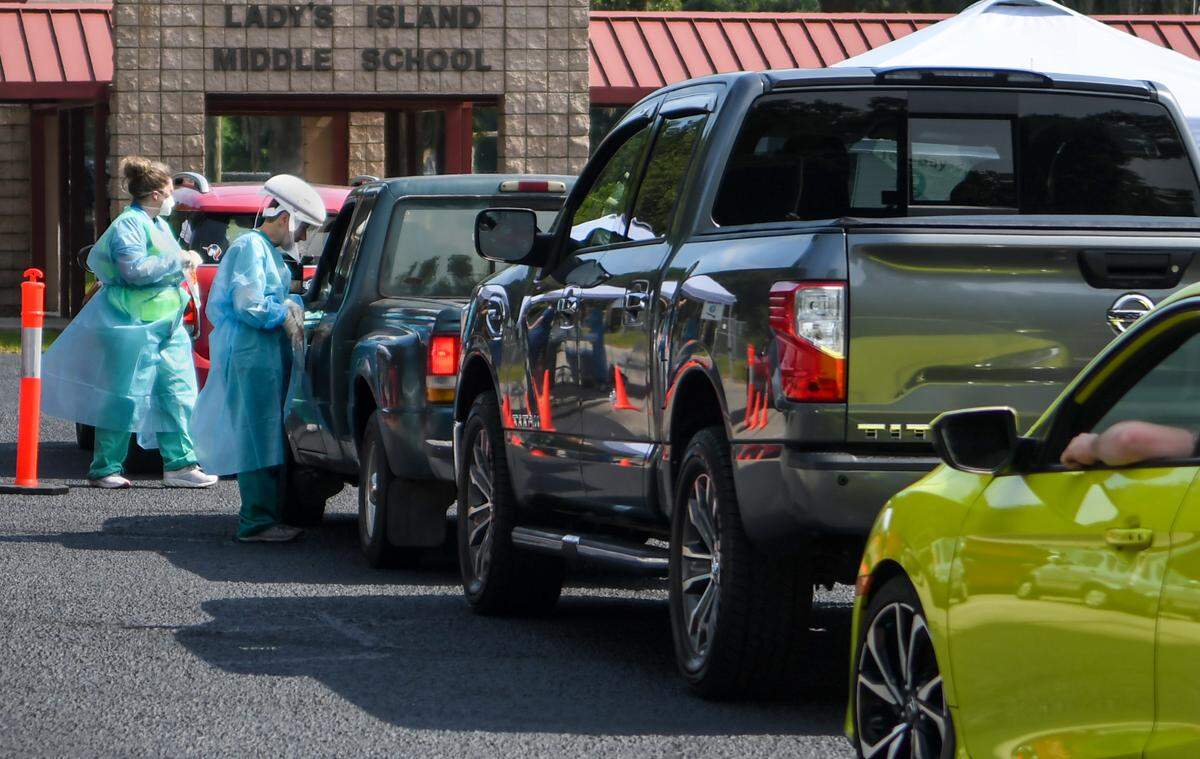
What does that mean for Beaufort County?
It’s unclear how many people in the county would need to be infected to achieve natural herd immunity.
As of Thursday, 5,299 coronavirus cases have been confirmed in Beaufort County since March, according to the S.C. Department of Health and Environmental Control.
If working off the 60% herd immunity estimate, more than 115,000 county residents would have to contract SARS-CoV-2 before the area reached that threshold.
But that calculation only factors in static countywide population estimates from 2019.
“It can change from community to community,” Goyal said.
Dr. Michael Kacka, a DHEC physician and chief medical officer of the state agency’s COVID-19 Response Team, said he preferred not to speculate on what South Carolina’s exact herd immunity threshold might be.
“There’s some things that complicate this a little bit. The fact that we don’t know if people can get reinfected, we don’t know how long the resistance to infection lasts,” Kacka said.
“We have these populations that are very mobile as well, so we’re going to have people moving out, people moving in and then the demographics change. The immunity that those people have will be very different. So, it’s really hard to lock it down to an estimate.”
He stressed that DHEC’s strategy is to slow the pathogen’s spread until a vaccine is widely available. The state agency is encouraging people to wear face masks and practice social distancing.
Dr. Robert Redfield, director of the Centers for Disease Control and Prevention, on Wednesday said that most Americans likely won’t have access to a vaccine until the “late second quarter, third quarter of 2021.”
‘A surrender’
Allowing the virus to work its way through communities unchecked is an unacceptable mitigation strategy, experts say.
It would constitute “a surrender,” Kissler said.
In the absence of a vaccine, a natural herd immunity approach would probably lead to more than 10 million deaths worldwide, Goyal said.
For proof, look to New York City, Goyal said, the early epicenter of the country’s COVID-19 outbreak.
The city has confirmed roughly 19,100 deaths and more than 230,000 cases. Yet data released by the city last month show that over 27% of residents had tested positive for antibodies.
That’s still well below the 60% threshold referenced by Goyal and Kissler.
Some people, meanwhile, have argued that creating natural herd immunity among younger residents will help protect older, at-risk populations, Kissler said.

But that idea is flawed, he said. Consider the possibility of kids living with their grandparents.
“There’s a demographics side to this, too,” Kissler said, “where the people who will be really at risk are people who live in multigenerational households. And those might not be white, upper middle class households, but they’ll be the people who have already borne the brunt of this virus.”
People of color have been disproportionately affected by COVID-19, according to the CDC. That’s due, in part, to long-standing disparities in the nation’s health care system, the CDC says.
Kacka, the DHEC official, said a vaccine is key to safely achieving herd immunity around the Lowcountry.
“We all have people that we know, people that we care about, who fall into that vulnerable category, and these are people who may be very difficult to protect if we don’t get the vaccine,” Kacka said.
“If we’re relying on that natural herd immunity approach, it’s going to cost a lot of lives.”