
Corporate brands build differently on Hilton Head
There was the time Colonel Sanders' face wasn't allowed on the Kentucky Fried Chicken sign.
Or when McDonald's had to paint its golden arches a dull yellow.
But of all the quirky stories about Hilton Head Island's design rules, the Red Roof Inn stands as the favorite for island architects.
In the late 1980s, the hotel chain wanted to build on Hilton Head. But town rules didn't allow a red roof.
"So for about 15 years the Red Roof Inn had a gray-green roof," said Tom Parker of Lee & Parker Architects.
The hotel finally got its red roof. But corporate brands still wrestle with Hilton Head's uncommon design guidelines.
Rules for buildings, colors, signs and lighting help businesses blend with nature. They also force builders to think outside the big-box format, local designers say. As a result, Hilton Head has one-of-a-kind versions of what is otherwise standard corporate architecture.
"What's intended to be a typical franchise building is not going to fly here," architect Tom Crews said. "The intent is to have design fit with the surroundings. ... That means people get creative."
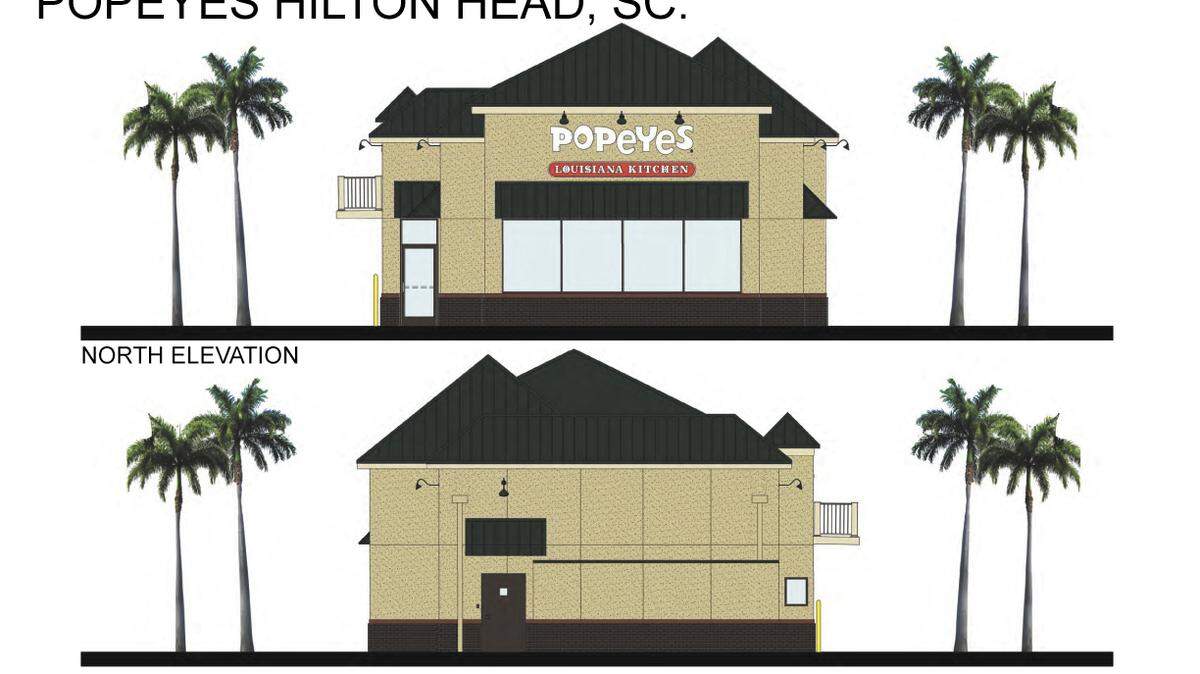
Popeyes Louisiana Chicken, which is slated to start construction in March, is the latest franchise to enter the design gauntlet.
The restaurant doesn't look like a typical Popeyes, said Gale Brown, an island resident who will own it.
Its roof is sloped, not flat. The building is a muted beige -- no bright red and yellow accents -- to match the Park Lane Hotel next door, she said. She's talked to town staff about how large the sign can be, where the Dumpster will go and what color to paint the concrete parking cylinders.
The designs were initially approved Jan. 6 and need one more vote from a town panel before permitting can begin. The building will rise at the site of the former Pasta Garden at 15 Park Lane.
Before moving here, Brown had visited Hilton Head for 20 years. She said the design guidelines help maintain the island aesthetic.
"I've been to places that are overly commercial, and I don't want to go back," she said.
The guidelines were inspired by Hilton Head's early developers, said local sign designer Alex Sineath. Their philosophy was to disguise development.
"We call it the 'squint-and-you-don't-see-it' philosophy," he said. "Everything should blend. If you squint, you shouldn't be able to see that building."
That means using subdued earth tones such as beige, brown and green. It also means using materials such as wood, stucco and tabby.
Signs should have matte colors and be made of sandblasted wood. Buildings should sit back from the road and be hidden by foliage.
And whatever you do, don't use stone, Crews said.
"This is an island on sand," he said. "Stone is not an indigenous material. We don't want it, we shouldn't see it."
A collection of architects and designers -- including Crews, Parker and Sineath -- has worked on the island for more than 30 years. The group has developed a cottage consulting industry, guiding out-of-town builders through the sometimes confusing rules.
Sineath has designed many of the island's signs, such as those in Indigo Run and on Main Street.
He was there when the former Wendy's on the south end couldn't have the eponymous girl on its restaurant logo; he was there when Wendy's on the north end was finally allowed.
"They changed that rule," he said.
To him, the key to designing signs is context.
"You have to look at it as a piece of furniture that's going to be set into the environment," he said.
His other tip: "Do your homework and read the design guide."
The town has used its current design guide since 2003. The booklet outlines rules for lighting, landscaping, architecture and vegetation, among other things.
In the next few months, staff members will update the guide. The town is taking public comments and working with the Design Review Board to make it easier to understand.
"The island character has not changed," said town urban designer Jennifer Ray. "But we thought this could better communicate things that those of us who live and work here understand. It's better for people who come here to know what to expect."
Ray said she doesn't think the rules ward off fast-food restaurants and other chains.
For one, not many try to move to Hilton Head. The last one before Popeyes was Zaxby's, in 2013. That chicken restaurant plans to build near Yacht Cove.
Mostly, the rules force franchises to do something different.
And that's not a bad thing, Parker said. He tells companies to use it to their advantage.
"We know it's really important to have a corporate brand," he said. "And as part of your branding, you should have a building that reflects the community it's built in. I think you can promote that specific location and it becomes an asset."
Follow reporter Dan Burley at twitter.com/IPBG_Dan.
Related content:
Popeyes Chicken considers Hilton Head, Nov. 21, 2014
This story was originally published January 17, 2015 at 6:08 PM.