‘I can take this and teach it to my children’: Hardeeville training program offers hope
Rondell Herring now has a gift no one can take away from him — he knows how to use a torch to weld materials together.
Currently a manager at a Wendy’s in Hardeeville, Herring enrolled in the city’s 10-week workforce training program, which graduated its inaugural class Sept. 1. A collaboration between the city and Palmetto Training Inc., the initiative aims to equip 30 aspiring professionals with expertise in welding, construction safety or driving a forklift. A separate four-week program leads to commercial drivers’ licenses.
A $350,000 grant from EJF Philanthropies makes both programs — each valued at $5,500 per person — free for six months of training for Jasper County residents.
“I can take this and teach it to my children,” Herring said of his new skill. “It’s something that can keep going on … You can build a career behind this. It’s not just going to get a job. You can go get a job anywhere, but a career, skill, trade — you need to be skilled in a trade to get picked for this.”
Herring was one of the first eight graduates of the welding program, which is held at Hardeeville’s public works facility on Plantation Drive. Despite the social-distancing precautions participants took to prevent the transmission of COVID-19, Herring said the students all got very close throughout the summer and have formed a network that will help them professionally.
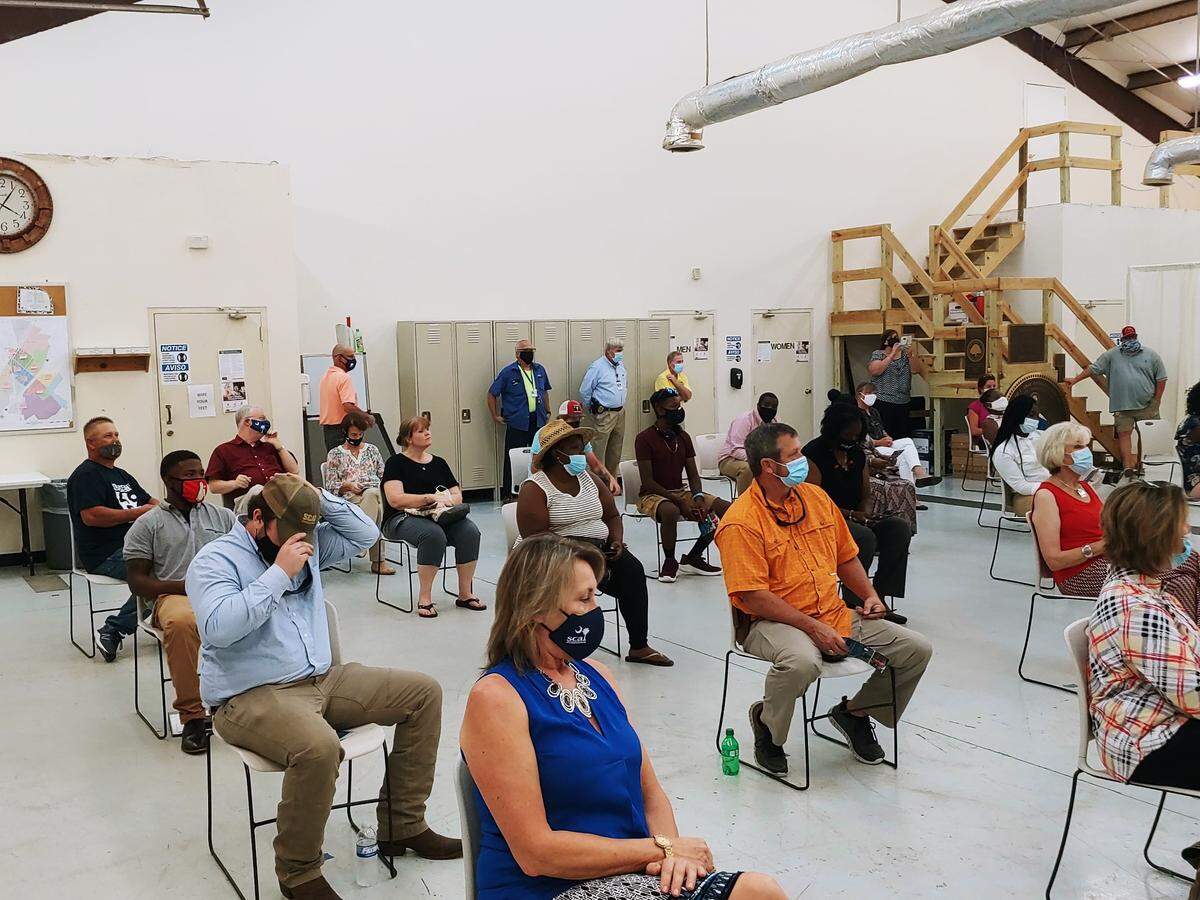
“I know it’s a couple guys here who are outstanding welders, even better welders than me,” Herring said. “We all look out for each other. It’s like a family.”
Herring said he has begun applying for welding jobs. Participants in the Hardeeville program are awarded national certifications in welding and forklift use and undertake a 10-hour Occupational Safety and Health Administration course — assets that industry experts say give them the ability to take their skills around the country.
“Specific skills trade equals upward mobility for our citizens,” said Sandy Steele, director of operations for the SouthernCarolina Regional Development Alliance, which works to create jobs in the Lowcountry. “That’s what economic development is all about. It’s landing a job, but it’s also moving through to a better-paying job, and then the next, and the next, as your personal lifestyle dictates.”
And as they begin their careers as welders, Herring and the others are helping to close the growing skills gap: More welders are needed to staff South Carolina’s large manufacturing and construction industries than the region has ready to do so safely.
“The economy can’t survive without building airplanes and welding things together,” said Eddie Jackson, who taught the welding students as president of Palmetto Training. “It’s just like glue. That’s what welding does. It’s just a major subject, a trade that will never die. There’s no way to replace it.”
Closing the skills gap
The manufacturing industry employs the majority of welders across the country according to the Bureau of Labor Statistics. One of the largest industries statewide, manufacturing is expected to grow in South Carolina by 9.1% between 2018 and 2028, data from South Carolina’s Department of Employment and Workforce indicates.
According to more recent national data from the BLS, employment of welders, cutters, solderers and brazers is expected to grow by 3% between 2019 and 2029, on par with the growth rate for other occupations.
“The nation’s aging infrastructure will require the expertise of welders, cutters, solderers, and brazers to help rebuild bridges, highways, and buildings,” the BLS website states.
But people are needed to fill those slots, now and into the future. A 2018 skills gap study by the Manufacturing Institute — a branch of the National Association of Manufacturers — and Deloitte found that 2.4 million jobs could go unfilled between that year and 2028. At the time of the study, the authors noted, half of all positions for skilled workers were vacant. Reasons for this included negative perceptions of manufacturing, a shift in preferred skill sets toward advanced technologies, and an aging workforce.
“Everything has to be welded or put together,” Jackson said. “If not, the economy won’t succeed.”
Yet he said he’s seen some poorly trained welders try to join materials together and end up killing or injuring someone, which is why it is crucial to have proper training.
Program graduate Jeannette Dunham, a former high school gym teacher from Hardeeville, said welding is a lot harder than it seems.
“Now, I love it,” Dunham said. “As a matter of fact, now when I’m going places I’m looking to see how the welds are on machines or buildings.”
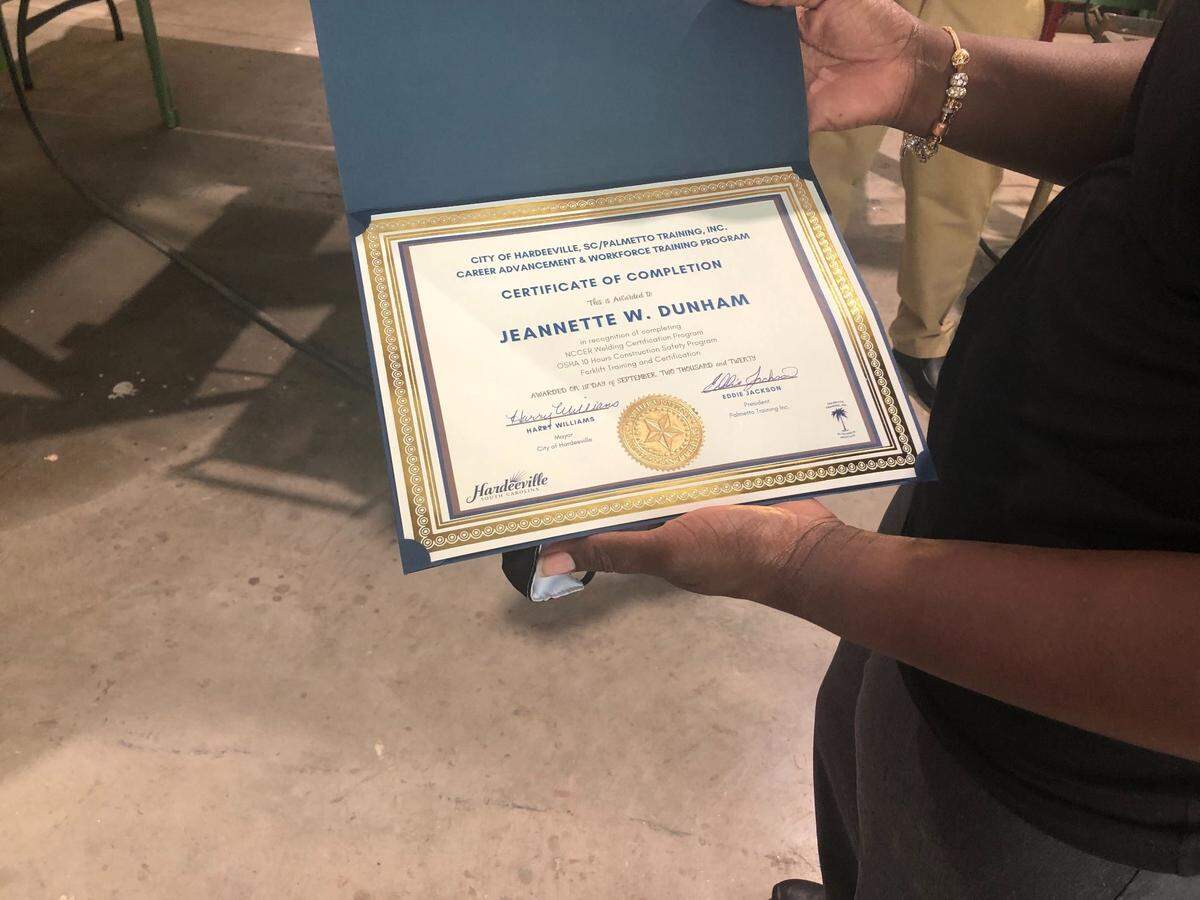
A self-declared “outside girl,” Dunham plans to use her newfound skills to help her husband with his trucking business because sometimes the trucks get damaged and he can’t find anybody to help with the welding.
She will also be trying to find a job as a welder and forklift operator in a warehouse.
Dunham said she is not aware of many other programs like Hardeeville’s that offer non-K-12 students an opportunity to build trades skills. “I think once more kids hear about it, then maybe it will allow them — the children who don’t go off to college — to do something different and figure out a new journey in their life,” she said.
Hardeeville’s second 10-week welding program began Tuesday. The third is slated for after Christmas, Hardeeville administrative services director Neil Parsons said.