
Walk through history at Rose Hill Mansion
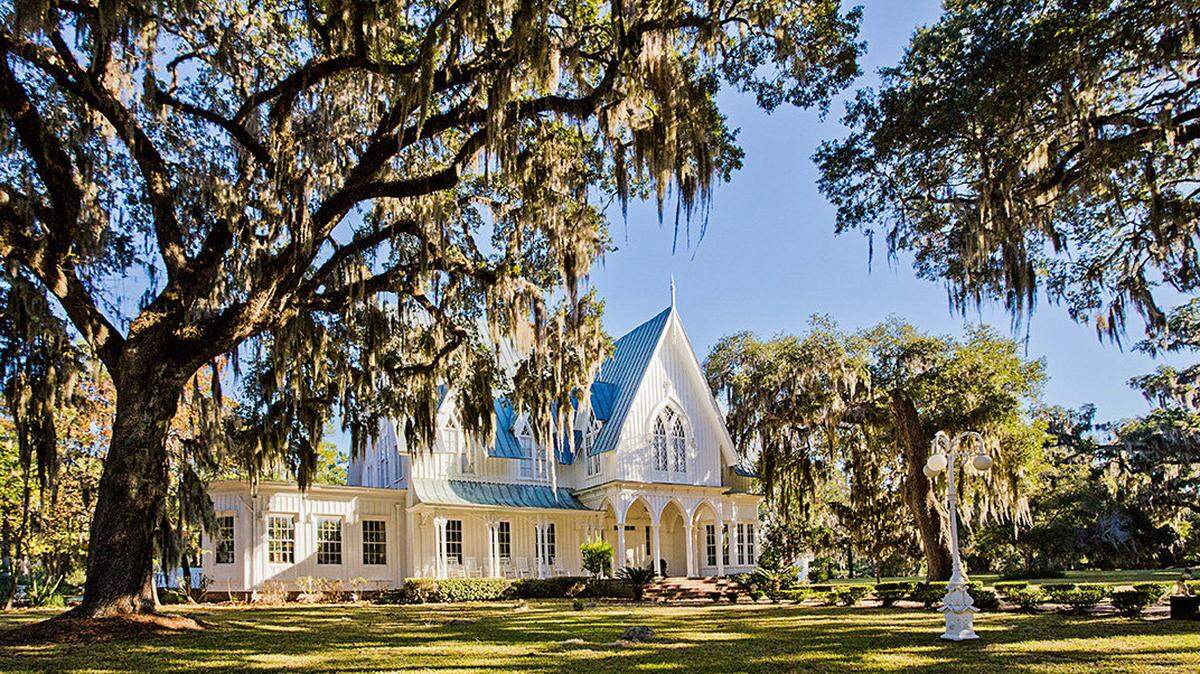
It was their desire to share the history they have gathered about Rose Hill Mansion that prompted Robert and Robin White to open their private home to the public for tours.
In welcoming visitors, their hospitality includes inviting guests to sit on the furniture — virtually unheard of in historic homes — and offering them a glass of wine they can take with them on the tour. At the tour’s conclusion, treats are served at a tea party.
It’s all part of their desire to make guests comfortable and have fun.
What the guests see is a beautiful home filled with antiques, oriental rugs and historical pieces carefully collected which were part of the building’s rich past.
However, the now resplendent structure, with its 14-foot ceilings and with its unusual carpenter Gothic architecture giving it soaring peaks around the roof, was an uninhabitable shell open to the sky in places after being heavily damaged by a disastrous fire in 1987 when the Whites first laid eyes on it in 1995.
Robin said she and her husband visited the mansion, built in 1858 and located on 12 acres in the Rose Hill Plantation in Bluffton, after seeing it listed for sale in Historic Preservation magazine. The magazine advised would-be buyers about the fire and warned “substantial renovation” would be necessary before occupancy.
“It was uninhabitable. Nobody could live in it for years,” Robin recalled of their first impression. “But we fell in love with it and began the process to try to purchase it.”
A WORK IN PROGRESS
It took a year to complete the sale and they closed on the house April 12, 1996.
“A long time before any photographs or any information about how the house had been before the fire came forth, we did the best we could in working with the fire damage,” Robin said. “We wanted to take it back closer to its 19th century roots.”
A student of art, history and English literature, Robin wanted to be as accurate as possible. In time, she and her husband collected a lots of information.
“Can you imagine bringing all this history back and then we wouldn’t have anybody to share it with?” Robin asked incredulously. “Really, the tour business evolved as a way to share what all we learned because we didn’t know anything at the beginning. Then we found out we had a pretty important house. A lot of people have been married here, born, died. A lot of history of the area is in this house.”
Robin and her husband made the house safe and complete enough to open it in 2007.
“This is the only plantation house you can get in to see and it’s an important piece of local history and we decided we needed to share it,” she said. “It’s too rare a structure to keep it all to ourselves. And it’s a landmark in the community.”
HISTORY STEPS FORWARD
After word got out that the mansion was open for tours, descendants of former owners began stopping in to see it. Descendants also have donated antiques dating back to the days they and their ancestors lived in the house.
“Every room has at least one piece of the original Civil War-era furniture which has been gifted back,” Robin said. “We also have display cases of artifacts in every single room in the house.”
A favorite room for many visitors is the Gentlemen’s Hunt Room with stuffed animal heads lining the walls, the largest of which is a 2,000 pound buffalo head from the 1890s.
Cynthia Glendinning, tour guide for the mansion, said the 1987 fire occurred when the heat wasn’t working and heat pumps were installed. She mused over the irony that the mansion, which was occupied by Union troops during the Civil War, escaped unscathed during enemy occupation but then succumbed to a more modern enemy.
“I can’t tell you how many times people who come to the house tell me, ‘I just felt so welcome. I now know what Southern hospitality is,’ ” Robin said. “Every day people feel shocked that they are welcome to sit down.”
THE MANSION'S MANY OWNERS
Rose Hill plantation, comprising 12,000 acres at the time, was given in a grant by King Charles II of England to Lord Colleton, one of the eight proprietors of South Carolina in 1718, according to Glendinning, the tour guide for the mansion. Glendinning said Lord Colleton worked it as a rice plantation.
By the 1770s, John Rose had purchased 1,000 acres of the plantation. When he died in 1799, he left it to his stepson, James B. Kirk, co-founder of the town of Bluffton, Glendinning said. She said Kirk named it Roseland and, in 1804, he purchased an adjacent 1,000 acres. Glendinning, who is a four-great granddaughter of Kirk, said he added sea island cotton, indigo and mustard to the crops grown on the plantation.
Glendinning said Kirk gave the plantation to his daughter Caroline and her husband, Dr. John Kirk, as a wedding present in 1838. Up until then there was no house on the plantation. The owners lived in Bluffton. In 1858, Caroline and her husband built the original Rose Hill Mansion in the carpenter Gothic style.
“It was very unusual architecture for the South, according to Glendinning.
When Yankee troops invaded Bluffton, they spared the mansion because of its resemblance to a church and they felt it was too beautiful to burn.
The house remained in Caroline and John Kirk’s family until 1928, when they were followed by William E. Pinckney. He was followed by John and Betsy Sturgeon — she was a Gould from the northeastern banking family — in 1946, who undertook major renovations, then by William M. Wilson in 1980, who owned it until Robin and Robert White bought it.
This story was originally published August 31, 2014 at 12:01 AM with the headline "Walk through history at Rose Hill Mansion."