
Palms are our kind of trees
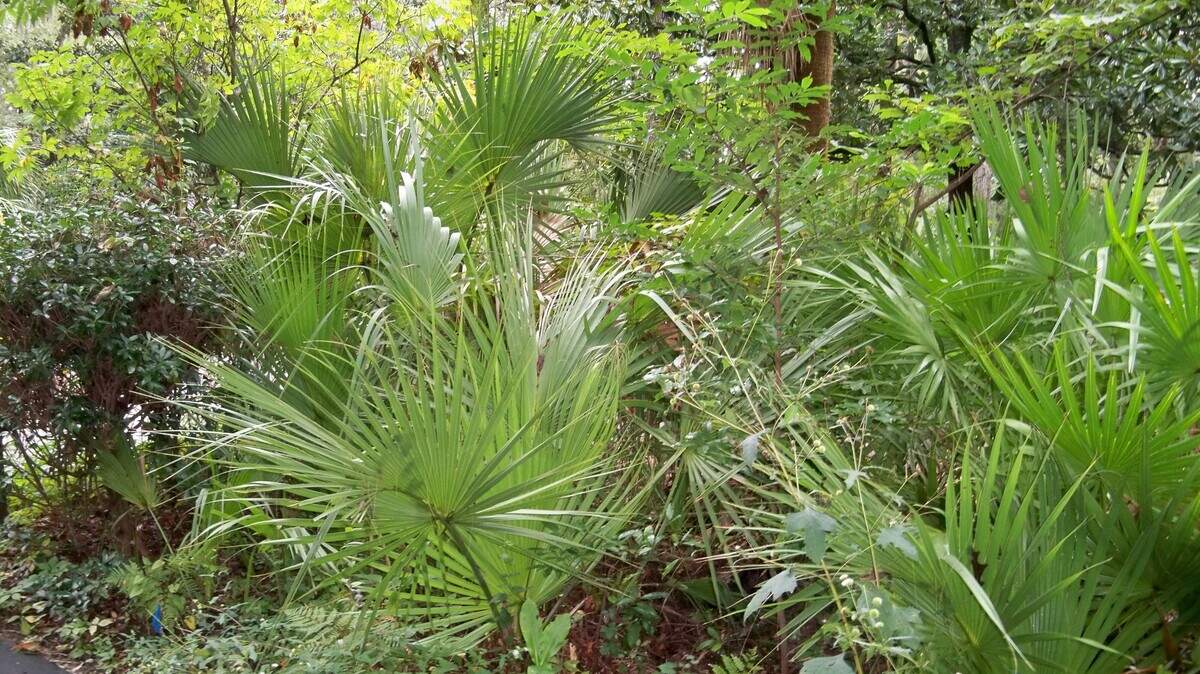
Palms are for people like us. We live in an almost tropical area that allows us to grow some plants that are common in areas where there's never a freeze, such as palm trees, camellias and ginger. We like the look of the palm in our yards, our public places and along our highways.
To find out more about palm trees, The Avid Gardeners on Hilton Head Island discussed the trees with Kathy Varn of Taylor's Quality Landscape Supply at their first fall meeting. Before attending the meeting, I talked to owner Gerrick Taylor, who said they install only palm trees, as they require special equipment, but will refer a customer to a contractor if he doesn't have one. It was from Taylor that I learned that a palm tree grows only three to six inches a year.
The social room of Spring Lake Pavilion in Hilton Head Plantation was filled with Avid Gardener members; many are Master Gardeners, and I knew there would be a lively question and answer following Varn's talk -- and there was. We learned that the sabal palmetto cabbage palm and the Washingtonia fan palm are the most popular. The sago palm is winter hardy if planted in the right place, but if temperatures are going into the low 30s, it is best to cover them. Plant covers should always be towels or sheets; do not cover with plastic.
If you've got white dots on the foliage, it could be a disease or insect damage. Apply a systemic. Is the foliage yellow on your palmettos? This could be an irrigation problem, such as too much water. Got pine straw in the center of your sagos that covers the boot? Remove the straw and boot if it pulls out. Those yellow berries on your sagos make good-looking floral arrangements.
During our hot and humid summer, you might want to cut lower branches if they are close to the ground. As the sun hits wet ground, it produces a vapor that's not healthy. Be sure to check your irrigation lines.
Varn said fall is a great time to transplant. Two weeks before moving your palm, take a spade and cut roots all the way around. Feeder roots will have grown. If the palm goes into shock, don't you; the plant will soon recover.
And, of course, the answer to the most important question: What palm trees are hardy where we live? That would be the windmill, the pindo, the sago, the European fan and the saw palmetto, Varn said.
In my Sept. 7 column, I wrote that the beautyberry bush, a native of the Lowcountry, would not grow in Pennsylvania. A gentleman from Pennslyvania wrote me to say they are, in fact, grown in his state.
It turns out there are two varieties of Callicarpa. The Lowcountry variety is the Callicarpa americana; in the north, they have Callicarpa bodinieri.
Sixty-year master gardener and environmentalist Betsy Jukofsky has spent three decades on Hilton Head Island learning the peculiarities of Coastal Lowcountry gardening.
RELATED CONTENT
- Herbs so easy to grow in Lowcountry climate
- Crazy weather, bumblebees and gardening questions from readers
- Native plants holding up well in Lowcountry thunderstorms
- All columns by Betsy Jukofsky
This story was originally published September 27, 2014 at 4:01 PM with the headline "Palms are our kind of trees."