
The skinny on Spanish moss, a Southern symbol: It isn’t actually moss / Natural Lowcountry
In the winter, when I’m less distracted by other plants, I’m struck by just how much Spanish moss we have in the Lowcountry.
It’s hard to find a spreading live oak that isn’t draped with long, beardlike garlands of this familiar native plant, so evocative of the Southeast.
In the continental U.S., Spanish moss (Tillandsia usneoides) grows in the swamps, marshes, and lowlands of parts of Virginia, south to Florida and west to Arkansas and Texas.
Despite its common name, Spanish moss isn’t a moss, but actually a flowering plant related to pineapples.
And it isn’t a parasite — it’s an epiphyte (“air plant”), using trees just for support and making its own food via photosynthesis.
Its wiry, greenish-gray stems, which may reach lengths of 20 feet, bear tiny leaves with numerous overlapping scales. The scales retract during drought, but open outward during rainy weather, allowing the plant to absorb moisture.
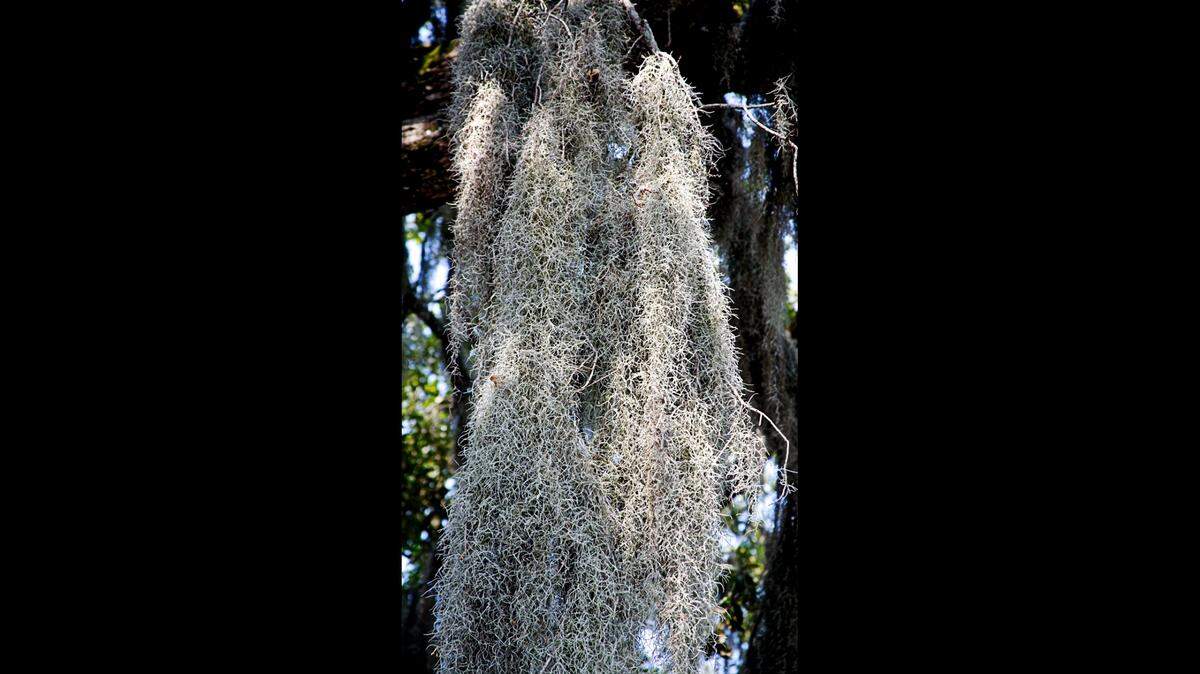
Spanish moss seems particularly common on live oaks, as well as bald cypress, because of the rich supply of minerals leached out by rainwater from their leaves. But crape myrtles, sweet gums, and some other tree species may be festooned, as well.
In the spring, Spanish moss produces small, inconspicuous, yellowish-green flowers. These give rise to capsules filled with tiny, wind-dispersed seeds, some of which fall into the cracks and furrows of tree bark, where they may sprout and flourish. Windblown fragments of mature stems may also spread the plant to new locations.
Spanish moss provides food for deer and wild turkeys; nesting material for egrets, warblers and other birds; and shelter for insects, spiders, snakes and anoles. Studies have shown that, contrary to common belief, chiggers are not all that common in Spanish moss.
Coastal South Carolina is also host to a close relative of Spanish moss called ball moss (Tillandsia recurvata) because of its rounded, tuft-like growth form. Ball moss was probably introduced accidentally to our area as a hitchhiker on nursery plants shipped from Florida. Look for its Spanish moss-like clusters on young crape myrtles, live oaks, and other shade trees in suburban parking lots and other recently landscaped areas.
This story was originally published January 6, 2022 at 11:02 AM.