
Yaupon holly berries add cheer to the woods, feed the songbirds / Natural Lowcountry
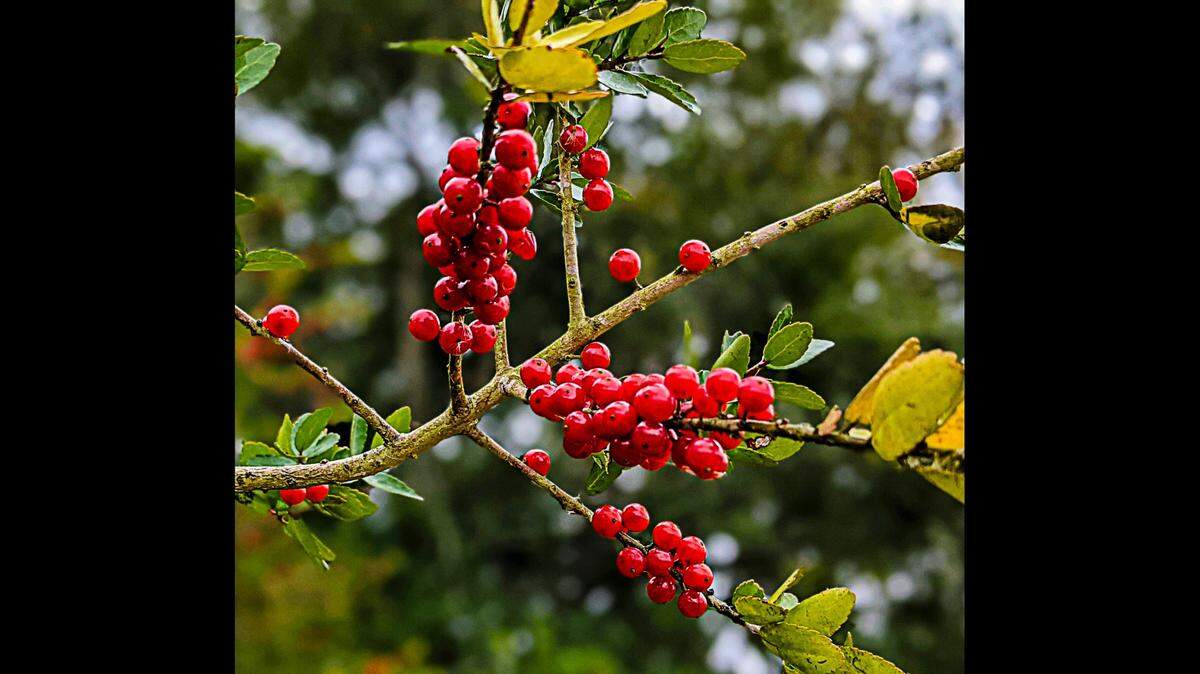
Holly is, course, a traditional symbol of the Christmas season, and in the Lowcountry we don’t have to search very hard to find it.
The Southeast has several native species, including yaupon holly (Ilex vomitoria), a popular landscaping plant with various cultivars. Its natural habitats include the coastal plain and maritime forests, where it grows as a small tree or shrub, sometimes forming dense thickets. Look for yaupon holly in sandy woods and fields, and near dunes and forest edges.
The species occurs along the coast from Virginia south to Florida and west to Arkansas and Texas. It’s one of over 400 species of holly found worldwide (estimates vary). Close relatives include English holly (I. aquifolium), which is native to parts of Europe, Africa and Asia, and yerba mate (I. paraguariensis), a South American holly used widely as a beverage.
Yaupon holly has glossy, leathery, evergreen leaves with toothed margins. In spring it produces small, greenish-white flowers, either male or female, which are borne on separate trees. In the fall, female plants bear red berry-like fruits.
Yaupon fruits are toxic to humans, but they’re an important winter food source for a host of songbirds, as well as raccoons, skunks, and armadillos. And deer browse on the leaves and twigs.
Native Americans used yaupon leaves and twigs — which (like yerba mate) are rich in caffeine — to make a popular beverage. This “black drink” was ingested on ceremonial and other social occasions, when it seemed to induce vomiting (hence the vomitoria part of the plant’s scientific name).
We know now the apparent emetic property of yaupon “tea” likely came from the traditional practice of drinking huge quantities at one time. Also, sometimes other plant ingredients were added that may have promoted vomiting, or ritualistic purging.
Today, yaupon holly tea is considered safe when consumed in moderate amounts — and as long as you’re absolutely sure of your identification.
Recent studies have shown that, in addition to caffeine, yaupon leaves contain theobromine (the stimulant found in “regular” tea, made from a camellia-like plant), plus other bioactive substances still to be investigated for potential health benefits.
If you’re curious about yaupon tea, it’s probably easier and safer to sample a commercially made preparation — just check the internet for reliable sources. These include Yaupon Brothers American Tea Company, which harvests plants from Florida, and Yaupon Teahouse and Apothecary Company, based in Savannah.