
The seeds of this oddly beautiful weed stay viable in the soil for over 100 years
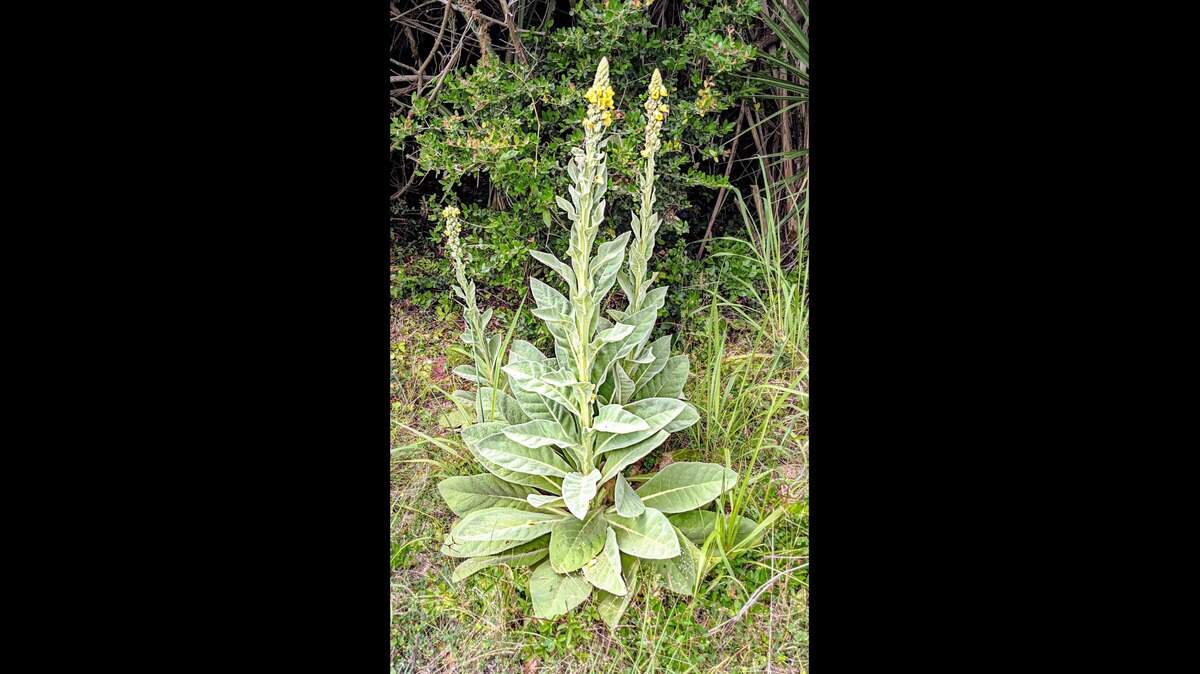
The mullein had finished blooming, and stood up out of the pastures like dusty candelabra ... — Elizabeth Enright
Common mullein (Verbascum thapsus) is one of some 360 species of mulleins native to Europe, Africa, and Asia. This odd-looking weed — which can grow five or six feet tall — has other, more colorful names, such as lungwort, candlewick, blanket-leaf, feltwort, and Quaker rouge.
Since its introduction into North America in the 1700’s, common mullein has spread throughout most of the U.S., including the Lowcountry. Look for it in fields, roadsides and abandoned lots, where it often grows in stately patches, towering over other plants.
Mullein is a biennial, taking two years to complete its life-cycle, then dying after it forms flowers and seeds.
At first, it’s just an inconspicuous rosette of greenish-gray, velvety leaves growing close to the ground.
Then, in its second year, mullein enters a growth spurt, sending up a tall, thick stalk of densely packed, yellow flowers. These start blooming gradually in an irregular spiral pattern, from the bottom up. Each flower stays open for less than a day.
Like other weeds, mullein is tough and prolific. As a pioneer plant, it’s adapted to colonizing open, dry areas with poor soil — places where most other species can’t grow.
Its tiny seeds, packed into brown capsules, stay viable in the soil for over 100 years. A single plant, moreover, can produce over 100,000 seeds.
Mullein has a long history of human use. Ancient Romans coated the flowering stalks with tallow and used them as torches. Early American colonists used crushed mullein seeds as a fish poison. The thick, soft leaves were used to line shoes and, when rubbed against the face, to substitute for rouge.
In traditional and folk medicine, concoctions from the roots and leaves provided treatments for skin diseases, respiratory infections, warts, earaches, migraines, hemorrhoids and a host of other ailments.
There are even a few ornamental varieties of mullein available today at specialized plant nurseries. But even common mullein can be a striking addition to a wildflower garden.
During its long blooming period, the plant provides abundant flowers attractive to a variety of pollinators, from halictid bees to tiny flies and bumblebees.
Even after mullein goes to seed and dies, its arresting flower spike persists for months, adding visual interest and its own craggy character to the winter landscape.