
Meet the toxic plant that rattles when you shake it -- and the insect that depends on it
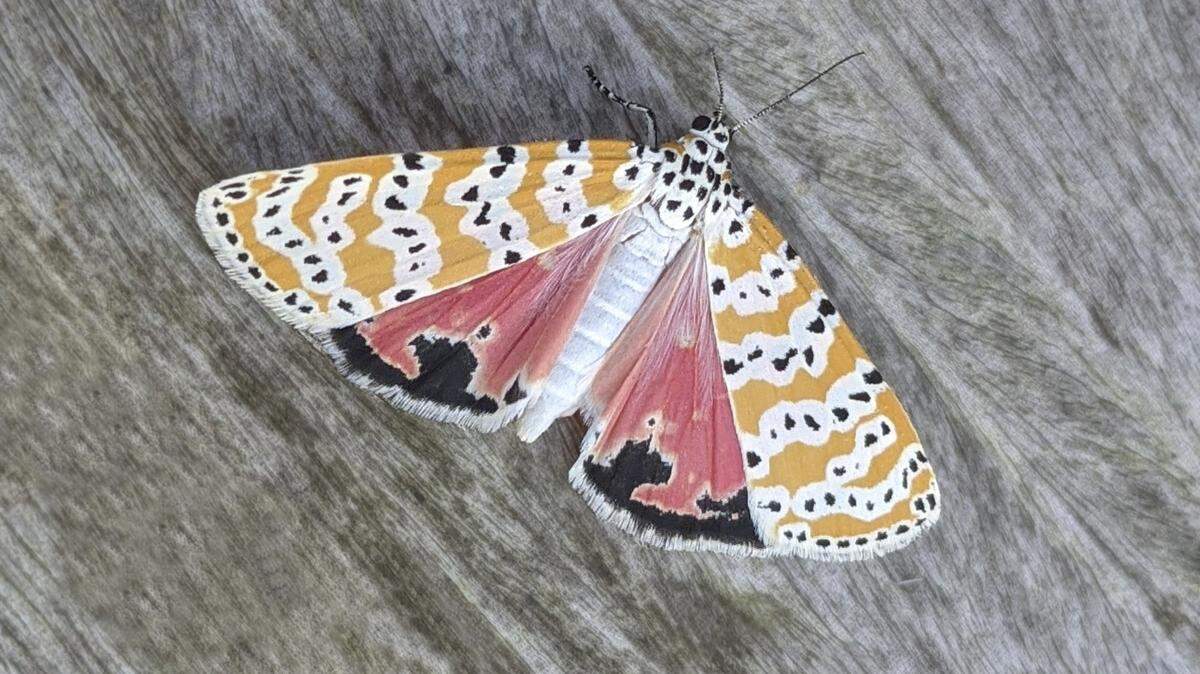
Ornate bella moths (Utetheisa ornatrix) are dainty little insects that appear as flashes of pinkish-red as they flutter by. In the Lowcountry, they may stay active even on mild days in early winter.
Though less than 2 inches across, bella moths are packed with color. Their forewings are yellow with white bands and rows of black dots; the hindwings, pink with black markings. They’re found throughout much of the Eastern and midwestern U.S., down into Central and South America.
Unlike most other moths, bella moths fly even during the daytime, and they’re often seen near patches of a tall legume called showy rattlebox (Crotolaria spectabilis). It’s an arresting plant with large, yellow flowers and sausage-shaped seed pods that rattle loudly when you shake them.
Native to Africa and Asia, showy rattlebox was introduced to the U.S. in the early 1900s as a soil-building cover crop. Since then, the species has become widespread throughout the Southeast in fields and waste areas.
Unfortunately, it’s now considered an invasive plant in South Carolina and other parts of its range because it competes with native species. Also, it turns out that all parts of the plant, especially the seeds, contain toxins (pyrrolizidine alkaloids) that are poisonous to cattle, sheep, and other farm animals.
But for bella moths, rattlebox is vital to life.
Not only do the caterpillars feast on it without ill effects, but they also sequester the plant’s alkaloids inside their bodies while feeding. These poisons make them toxic to a wide array of predators.
Female bella moths lay their rounded, yellowish eggs on rattlebox leaves. Newly hatched caterpillars start off by chomping on the foliage, but they soon switch to the developing seeds, which contain five times more toxin. Sometimes there aren’t quite enough pods on a plant to go around, and caterpillars must compete for them.
When a larva appropriates a pod for its own, it chews its way inside and takes up residence. Eventually, once the seed cupboard is bare and the larva is fully grown, it migrates from the food plant and forms a cocoon amidst leaf litter or dense vegetation nearby. Several generations of moths may be produced throughout the year in the warmer parts of the species’ range.
Research has shown that rattlebox toxins stored by larvae persist in their bodies even through the pupal and adult stages of the life cycle. In fact, the vivid colors of adult bella moth adults may well function as “warning coloration,” advertising their unpalatability to predators.
Not surprisingly, rattlebox plants serve as meeting places for bella moths searching for mates. This happens at dusk, when perched females release pulses of sex attractant pheromones, advertising their location and receptivity.
Mating takes up to 12 hours, and females may pair up with four or five males, sometimes more, during their three-week lifespan as adults. Even their eggs are laced with rattlebox alkaloids, some derived from the female, the rest donated by the male and packaged with his sperm. The toxins make the eggs unpalatable to ants, ladybugs, lacewings, and other predators.
In fact, rattlebox alkaloids are so important to egg survival that females choose males based on how much toxin they’re likely to contribute to the eggs during mating. This is ultimately a chemical “decision.” During courtship, males release a substance called hydroxydanaidal (HD) from specialized scales at the tip of the abdomen.
Since HD is a chemical precursor of rattlebox alkaloids, males that exude high concentrations of HD tend to have rich stockpiles of toxins. Females, via their sensitive antennae, can sense these differences among males.
The complex, intricate relationship between rattlebox and the bella moth has become a classic illustration of finely tuned plant-animal interactions, prompting a host of scientific studies.
And this tiny, little-noticed moth now plays an important role in controlling the reproduction and spread of an attractive but invasive exotic plant.