
Here a schmear, there a schmear. Bagels get around the South
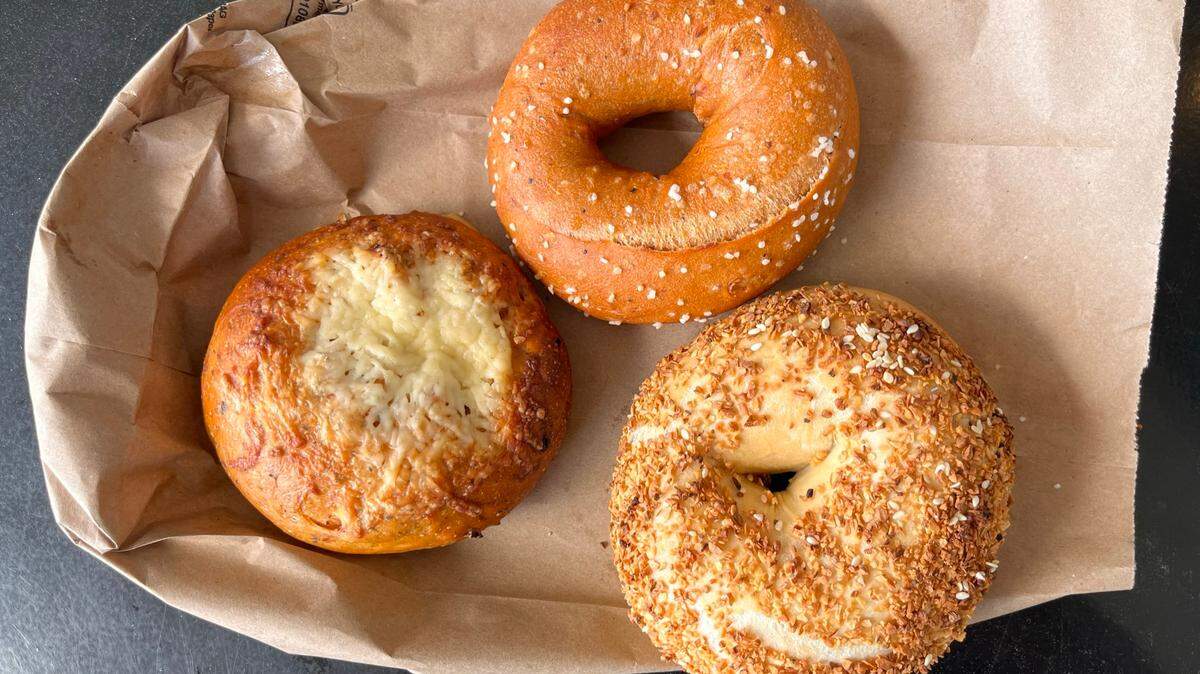
You know the old Northeastern expression about waiting five minutes if you don’t like the weather? Much the same could be said about bagel scenes across the American South.
Bagelries are opening throughout the region at an astounding rate. In Charleston County, where I live, there were three dedicated bagel shops at the start of the pandemic. Now there are more than twice that number, including Ruby’s Bagels, which reports it’s selling 4,000 bagels a day. The store in February celebrated its four-month anniversary by announcing plans to open three more locations in the Charleston area.
And it’s not just the Lowcountry which has suddenly developed an insatiable appetite for bagels. In 2022, South Carolina issued food service permits to more restaurants with “bagel” in their name than restaurants named after Mama.
Since South Carolina gained 89,368 people from other states over the same period, roughly 12 percent of whom moved here from New York, I assumed the recent bagel boom could be chalked up to migration patterns. Still, that made the phenomenon even more interesting, since flawed and exaggerated memories of motherland food have profoundly influenced how we eat in America today.
Soul food is probably the best-known example. It emerged in part as an homage to the celebratory meals recalled by Black Americans who went from Southern farms to Northern cities in the early 20th century. Unmoored from the seasons and cut off from arable land, relocatees from Brooklyn to St. Louis found comfort in the deliberately hyperbolic flavors of sauced ribs, fried chicken, and slow-simmered greens.
Nu? Could something similar be happening in bagelry? Might we soon see a Southern bagel designed to ward off Northeastern homesickness, with every classic element overemphasized? I pictured a tooth-chippingly dense bagel coated in poppy seeds and smeared with at least one cup of cream cheese.
Except as I sporadically sampled bagels from new places, I never encountered a bagel quite like that. Instead, I found a diverse array of bagels that weren’t the product of misty-eyed nostalgia. While the recent influx of Northerners may have sped the uptick in bagel shops-per-capita, I’m now persuaded that the Southern embrace of round bread with a hole in the middle doesn’t amount to the radical shift suggested by demographic data.
Even if it might seem otherwise when you’re munching on an asiago bagel with jalapeno cream cheese, the current frenzy represents a continuation of tradition — both for bagels and the Southerners buying them.
New York bagels
Bagels are synonymous with New York City in the U.S., which is just how Bagel Bakers Union Local 338 wanted it. From the 1930s through the 1960s, when decent bagel-making machines hit the market, union members “dominated bagel production,” according to Maria Balinska’s 2008 book, The Bagel: The Surprising History of a Modern Bread. (Really, it makes sense that the secret to New York bagels isn’t the water, but organized labor tactics.)
But the bagel story doesn’t begin in New York. While bagel scholars such as Balinska are still sorting out the historical record, since so many cultures have come up with ring-shaped breads, she believes the American bagel’s Polish predecessor may have been derived from an Italian specialty.
In other words, bagels have been on the march since the Middle Ages. It’s about time they found their way to a region that for decades has made do with Lender’s and Bruegger’s.
That’s the attitude of Southern bagel makers who exist on the far end of the “New York? Fuhgeddaboudit!” spectrum. While there are plenty of new bagel shops where the walls are plastered with signed Joe Torre pictures and “Never Forget 9/11” posters, there are also bagel bakers like Jeff McElwee of Crust Punk in Charlotte.
“I’ve never been to New York and had a bagel,” said McElwee, an Appalachian State University grad who switched from making tarts to bagels about two years ago. “I don’t know what a New York bagel is. I’ve heard from very skeptical people that my bagels are the closest they’ve gotten to it, but I’m not going to promote that.”
Toward the other end of the spectrum is Tara Mackintosh. She and her husband, Casey, opened Humble Bagel on Freret Street in New Orleans in 2014. While Mackintosh maintains there’s no singular standard for a New York bagel, since even bagels which share a zip code come in different sizes and densities, she got into the bagel business because she missed the bagels from her hometown on Long Island.
More accurately, she missed bagels.
“People who were born and raised in New Orleans, when we were building out, they’d say, ‘What’s a bagel?” she said. “We’d say, ‘Oh my God. We’re going to fail.’ But it was a great neighborhood response right away. We have customers who come in every day for their toasted cinnamon raisin with plain cream cheese.”
Southern bagels
When Katie Startzman launched Native Bagel Co. in Berea, Kentucky, as a farmer’s market cart in 2016, she had no intention of boiling and baking sweetish bagels.
“I was going to be a purist, and not do cinnamon raisin or blueberry,” said Startzman, who was inspired by the bagels that her ‘cool uncle’ from Kutztown, Pennsylvania shared with her as a kid. “But people were asking for them, and this is a business.”
By the time Startzman opened a standalone store in 2018, she had no compunctions about folding fruit into bagel dough. After all, what distinguished Native Bagel’s output in her mind was barley malt and a traditional process that starts with hand shaping.
“So many bagels are coming from steam-injected ovens, where the bagels aren’t boiled,” Startzman said. “I think if you’re into bagels, you know the best bagel is an ultra-fresh bagel, eaten within hours of being produced. There’s something special about spreading cream cheese on a bagel still warm from the oven.”
Or topping it with local ingredients, she added. Startzman wasn’t familiar with country ham before enrolling at Berea College in the 1990s, but it’s now one of her favorite bagel accoutrements, along with blackberry jam.
At that point, I had to interrupt. All this talk about ham and jam and fresh-from-the-oven didn’t sound like bagel commentary. It sounded like we were chatting about biscuits.
Startzman has previously experimented with overtly Southern bagels. She’s tried mixing cornmeal into the high-gluten flour, and boiled her bagels in sorghum until she had to admit it didn’t make any difference in their flavor. But what’s most distinctly Southern about her operation is the philosophy behind it, which emphasizes seasonality and community. When spring comes around, Startzman buys garlic scapes from a friend who farms them and makes pesto for bagel sandwiches.
Sandwiches are similarly reflective of place at Benchwarmers Bagels, which opened in Raleigh in 2019.
“Something that’s really special about not having a strong bagel culture up until recently is we’re not locked in by history,” said Joshua Bellamy, Benchwarmers’ co-owner and head baker. “We have the ability to go off script.”
That’s true of both Benchwarmers’ wood-fired, open-crumb bagel, and how it’s fixed as a sandwich. Among the food hall stand’s most popular menu items are the #7—topped with farm cheese and pepper jelly, in a spreadable salute to old-school Raleigh dinner parties—and the #8, starring fried bologna.
There’s also a lox sandwich, except Benchwarmers forgoes the standard cream cheese and capers for a sauce gribiche-style deviled egg spread. In other words, it’s more indebted to French cooking and Southern culture than anything associated with Lower Manhattan.
Perhaps, then, the best Southern bagels aren’t wistful replicas of a Northern past. They’re new gateways to Southern food and its future.
This story first appeared in The Food Section, a Charleston-based newsletter covering food and drink across the American South. To learn more about the James Beard Award-winning publication, visit thefoodsection.substack.com.
This story was originally published October 25, 2023 at 9:49 AM.