
ACE Basin: A 'Last Great Place' turns 25
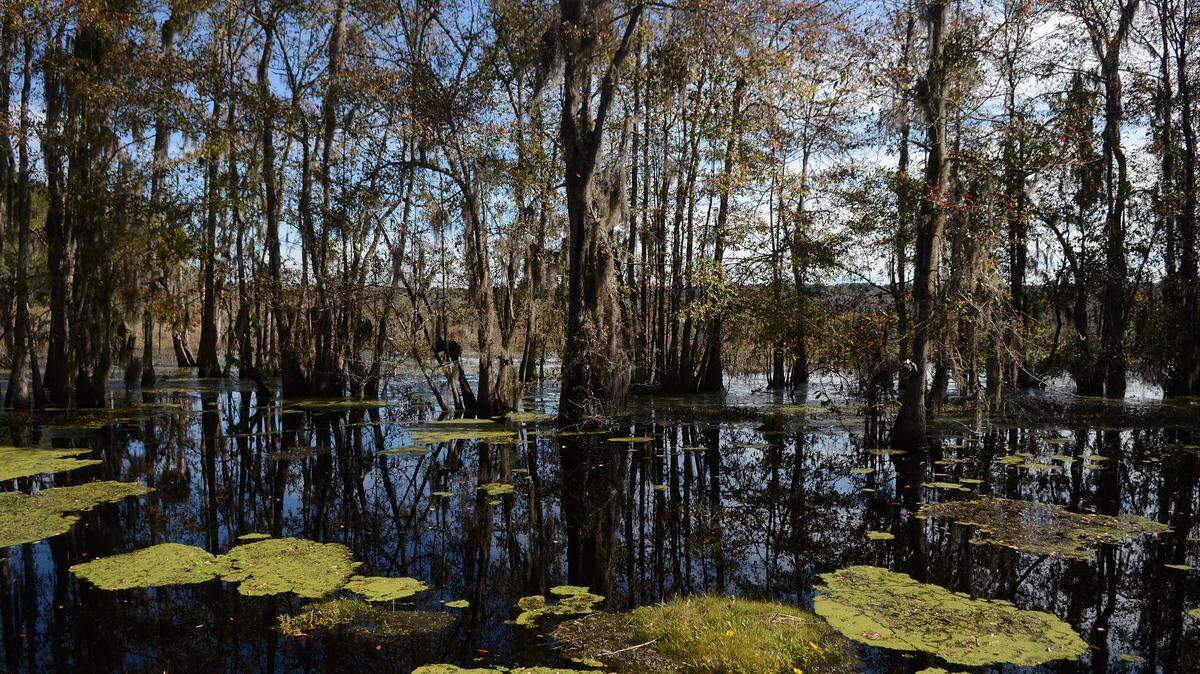
It has no town square, no dot on the map, no mayor or executive director.
The ACE Basin, one of the "last great places" on Earth as described by The Nature Conservancy, has none of those things because it never needed them.
The collection of properties, mostly private and totaling 217,000 acres, have been voluntarily preserved forever against development. Each is a piece in an unfinished conservation puzzle in the rural expanse between Beaufort and Charleston, a place where the everlasting value is called love of the land.
Its datelines are Green Pond, Walterboro, Jacksonboro, Adams Run and Edisto Beach. The closest thing to an attraction is the Edisto Island Serpentarium, run by brothers Ted and Heyward Clamp, who have hunted snakes in these woods for more than half a century.
It is where the bald eagle made its comeback.
It is gospel choirs and duck blinds, arrow heads and john boats, university researchers and political activists, the Tomato Queen and Geechie Boy grits.
It is white shrimpers' boots for sale on shelves next to a sleeping Labrador at B&B Seafood at Bennetts Point.
Its rivers echo the names of Native Americans, and the squawks of egrets.
It is a scenic byway, a roadside stand and miles of crackling salt marsh.
Resting between its busy bookends -- Charleston and Hilton Head Island -- the ACE Basin is something because it is nothing.
THE BIG PICTURE
This month, the coalition driving ACE Basin conservation celebrated its 25th anniversary.
It's a time to remember how it came to be, why it is still important today and what we can learn from its existence.
Nora Murdock was a young biologist with the U.S. Fish & Wildlife Service when she first saw the pearl of the Lowcountry in 1978.
"I will never forget the first time I flew in a small plane south out of Charleston, sweeping across the vast intact forests, extensive marshlands, swamps, meandering rivers and wild barrier islands," she wrote in remarks prepared for a 25th anniversary affair this month.
"The impact of that sight was jaw-dropping, and everything I found on the ground reinforced that first impression. I was determined to convince my superiors, and anyone else who might play a part, that this was a place that MUST be protected forever."
On the ground, she found people of like mind.
William P. "Bill" Baldwin Jr., who did the first loggerhead sea turtle research in North America as a Fish & Wildlife biologist at Cape Romain in the late 1930s, took her to every corner of the area.
Murdock was there to find potential locations for a National Wildlife Refuge for President Jimmy Carter's "Unique Ecosystems Program." Baldwin helped gather data for Murdock's report that focused on the ACE Basin. In it, Murdock coined the phrase ACE Basin for the three rivers -- Ashepoo, Combahee and Edisto -- that feed it.
The antebellum era of rice plantations left a unique ecosystem with its diked wetlands. It also left land ownership in large, rural tracts that Baldwin was working as a real estate agent to keep intact.
Murdock recalls the first reaction of her bosses to the report: "This will never work. It's too big."
Her report sat on a shelf.
"What they weren't thinking about is the very kind of coalition that has formed since then," Murdock said.
This month's National Geographic magazine describes the coalition's remarkable achievement in a story by South Carolinian Franklin Burroughs.
"It looked more like the South Carolina I had heard my father describe than the one I had rummaged around in half a century earlier," he writes.
THE CORNERSTONE
Gaylord and Dorothy Donnelley of Libertyville, Ill., bought their first piece of the Lowcountry in 1964.
The same year he moved up to chairman of his family's Chicago business, the world's largest commercial printer, cranking out the Sears, JCPenney and Land's End catalogues, 250 magazines and reams of Yellow Pages.
Gaylord Donnelley had a degree from Yale University and studied philosophy at Cambridge University in England. He was a World War II veteran. He chaired the University of Chicago board. He headed Ducks Unlimited in its period of greatest growth. Dorothy, whose father ran International Harvester, loved to fish, hunt and train dogs. The Donnelleys were civic leaders and philanthropists, but not showy.
Their skills came along with the yelping dogs and shotguns to the Lowcountry, where today people say the Donnelleys laid the cornerstone of the ACE Basin.
Gaylord Donnelley's 1992 obituary in The Chicago Tribune said:
"In 1928, when Mr. Donnelley was 18, he helped his sister run a dude ranch she owned near Sheridan, Wyo. He met Nobel Prize-winning novelist Ernest Hemingway, a neighbor there, who was trying to finish his novel, 'A Farewell to Arms.' The two often fished and talked hunting together, and the friendship helped encourage Mr. Donnelley's interest in conservation."
In the Lowcountry, that interest led the Donnelleys to give 6,000 acres to the public, and place conservation easements on another 19,000 acres.
"Clearly, they lit the match," said Charles G. Lane, the first and current chairman of the ACE Basin Task Force.
Donnelley realized that groups such as Ducks Unlimited and The Nature Conservancy could achieve more by working together. And when he and others helped run off a business that seemed intent on polluting the Ashepoo River, they realized that saving one of the last great places was going to take more than good stewardship by individuals.
A committee including representatives of the S.C. Department of Natural Resources, The Nature Conservancy and Ducks Unlimited began meeting regularly, and a conservation movement that has exceeded all expectations began to take shape.
THE COLLABORATION
Ted Turner was the first private property owner in the ACE Basin to put a conservation easement on his land.
He worked through LaBruce "Brusi" Alexander and the South Carolina chapter of The Nature Conservancy in 1988 to restrict development forever on the 5,200-acre Hope Plantation on the Edisto River.
Turner's high profile and long record of conservation helped put the idea of easements in the minds of other property owners. He encouraged others to join him.
"Now we had gone from theory to having something concrete," Alexander said.
Many locals expressed fear during early years of the movement that the government wanted to take over their land, that timbering would be halted or that they would no longer be able to hunt and fish as they wished.
But proponents kept pushing. DNR scientists such as Tom and Sally Murphy of Sheldon pushed the concept of a broad conservation area, and many people played key roles over the years, including John Frampton, Mike Prevost, Mike McKenzie, Mike McShane and countless more.
People involved say that it worked because they collaborated -- they did not duplicate or compete -- and everyone agreed to leave their egos at the door.
They listened to the people, stressing that traditional land uses would continue, including logging, and that there would be no condemnation of land. All land conservation would be voluntary.
In 1989, the ACE Basin Task Force was organized with original members DNR, the U.S. Fish & Wildlife Service, Ducks Unlimited, and The Nature Conservancy. They realized how important private landowners were to making it happen, and they put one of them, the energetic Charles G. Lane, in charge.
The next year, Lane's father, Hugh C. Lane Sr. of Charleston, put the family's Willtown Bluff property into a conservation easement. In the same era, they fought a proposed Hilton Head Island-style housing and marina development proposed for neighboring property.
Hugh Lane was one of South Carolina's leading bankers and a widely known leader in civic affairs. People began to think that if business leaders such as Lane, Donnelley and Turner thought a conservation easement was a good idea, it must be smart. Nationally, foundations took notice and awarded grants.
And Ducks Unlimited unleashed its secret weapon, Coy Johnston.
FRIENDSHIP AND KINSHIP
Coy Johnston of Summerville is so Lowcountry, he almost quacks like a mallard.
He was born in the not-so-wide spot in the road of Luray, in Hampton County. As a boy, he ran bird dogs up and down both sides of the railroad track from Estill and Gifford.
"My motto is more ducks, fewer people," Johnston said, and at 84 he still gets up every morning with land conservation on his to-do list.
Johnston earned a degree in forestry from the University of Georgia and went to work for Westvaco in forestry and in timber procurement. He learned the land and the people of the ACE Basin, and they hadn't forgotten each other after his 25-year stint in customer relations for Westvaco.
He was a natural to be the point man when landowners were approached about conservation easements, and he started another career with Ducks Unlimited. Friendship and kinship opened many doors.
"You know, in South Carolina everybody is kin to each other -- my wife's third cousin is your wife's fifth cousin once removed. That's the way life goes in the Lowcountry."
He said he used Gaylord Donnelley and Hugh Lane as his personal advisory board.
It didn't hurt that his daughter was an assistant to U.S. Sen. Strom Thurmond, while Lane was a personal friend of U.S. Sen. Ernest F. "Fritz" Hollings.
Johnston recalls being in Hollings' office seeking money for a National Estuarine Research Reserve in the ACE Basin. He said it went something like this: Hollings turned to his aide and asked, "Don't we have one?" The aide said no. Hollings responded, "Well, get one then." The Lowcountry ended up with two.
Thurmond found money for the public purchase of Mary's Island Plantation, a key piece of the puzzle that had developers drooling. It is now the Donnelley Wildlife Management Area, open to the public.
They also found support from U.S. Rep. Arthur Ravenel Jr. of Charleston and Gov. Carroll Campbell.
Congress was influenced not only by the legendary seniority of South Carolina's two senators at the time, but by the large number of members in Ducks Unlimited and The Nature Conservancy, Johnston said.
CONSERVATION EASEMENTS
But Johnston has always been at his best dealing with landowners, person-to-person, in the decision to put their treasured asset into a conservation easement in perpetuity. The tack had been used by The Nature Conservancy before in South Carolina: in 1977 for the Whooping Crane Pond Conservancy on Hilton Head Island, and in 1981 on St. Phillips Island in Beaufort County with owner Ted Turner.
Easements, which offer tax advantages to the landowner, became the leading tool for the ACE Basin Task Force. Johnston has been at the heart of many of the negotiations.
"I sit down and ask, 'What do you want? Do you want this to be passed to your children and grandchildren?' They say, 'Yes, we do.' Then you talk about their plan. 'Do you want commercial development on the land?' They say, 'No.' 'Do you want it to be subdivided?' And they say maybe for two or three family members. And those are the two strongest rights you give up. After that, it is directed by them just about like a will."
Landowners may want to protect magnolias, or permit only Angus cows on the land. They come up with a plan that is largely to protect the ambiance of the place, Johnston said.
"They had this land for a reason," Johnston said. "We were selling stewardship to the land, and they were already good stewards and didn't know it. We'd say, 'Why don't you put another lock on the smokehouse?' "
One of those good stewards is Charlie Webb, who grew up in Beaufort when kids knew fiddler crabs, climbed trees and played in the woods. As an adult, he has put his 550 acres in the ACE Basin in a conservation easement.
"I'm not anti-development in any way," Webb said. "But it has its time and place."
Today, Webb still loves the feeling when he can get out of his truck and step back in time.
A WAY OF LIFE
Charles Lane is quick to say that a lot of blind luck went into the ACE Basin success. A recession helped slow developers. The lay of the land and nature of the land's owners cannot be replicated elsewhere.
"We've been on a lean horse for a long run," Lane said. "Good luck, hard work and teamwork has gotten us here."
The task force has grown to include private landowners, the Nemours Wildlife Foundation, the National Oceanic and Atmospheric Administration, MeadWestvaco, Beaufort County Open Land Trust, Edisto Island Open Land Trust and the Lowcountry Open Land Trust.
The people doing conservation easements also have changed, with a little more than half the 155 easements representing tracts much smaller than the old plantations. They range from 40 acres to 10,000 acres, Lane said.
The model featuring multi-agency cooperation has helped shape state and national policy, and it is now being used nearby along the Savannah River, Winyah Bay, Cooper River, Sewee to Santee and the Congaree-Wateree basin. The model also has been used in Virginia, south Georgia and north Florida.
The ACE Basin has become an important research center. The Nemours Wildlife Foundation on the 10,000-acre Nemours Plantation was established in the will of Eugene DuPont III in 1995. It funds research to better use the old rice fields. It has helped black rails, mottled ducks and whooping cranes. It has worked on restoration of land for the red-cockaded woodpecker and longleaf pine. It also raises "our next generation of professionals out there taking care of our natural resources," said Nemours president and CEO Ernie P. Wiggers.
Veteran ACE Basin real estate agent Calvert Huffines said it's still hard for some to find the place with no dot on the map. "You don't see the condos, golf courses and sewer lines," he said. "You do see the eagles, osprey and people fishing. What I see is a quality of life, a way of life."
Looking ahead, state Rep. Kenneth Hodges of Green Pond sees potential in widening the focus from the environment to the area's historical and cultural assets.
Charles Lane said, "There was an awakening in coastal South Carolina. We could have lost the whole thing, but now it is a working landscape. What the ACE Basin did was show people that we can save it, but only if we get up off our butt and do something about it."
Artist Jonathan Green, one of the most prominent sons of the ACE Basin, is forcing people to take another look at its full story.
The splashes of vivid color that the Gardens Corner native uses to bring the Gullah culture into America's finest art collections are now focused on rice.
He has created the Lowcountry Rice Culture Project to bring to the fore myriad contributions made by the enslaved workers of the ACE Basin and their descendants.
Rice cultivation was common in the ACE Basin before the Civil War, and the impoundments still give the land value for hunters and wildlife.
Last year, it sponsored a forum. And 25 of Green's original works were shown in an exhibit called "Unenslaved."
A forum focusing on the arts is scheduled for Sept. 17 to 20, 2015, in Georgetown.
The ACE Basin metropolis of Green Pond starred in the first Spoleto Festival USA in Charleston.
Walterboro native Mel Marvin, a New York City composer, was influenced early by the land, as was his cousin, the late landscape architect Robert Marvin.
When the portion of U.S. 17 known as the ACE Basin Parkway was widened to four lanes in 2006, it opened a new avenue for one of America's greatest stories.
The bridge over the Combahee River was named the Harriet Tubman Bridge after the "conductor" of the Underground Railroad who participated in a raid there during the Civil War.
As a result, 700 slaves were freed. Many ended up on Hilton Head Island. Many joined the U.S. Army.
Because the road was widened and moved to make way for the new bridge, a major study took place to find and preserve the area's history. The S.C. Department of Transportation hired archaeologists whose work led to the creation of the Combahee Ferry Historic District to protect and preserve these sites.
Eighteen important sites were identified, touching on transportation that dates to the founding of the Carolina Colony, rice plantations, local taverns and stores and military activities during the Revolutionary and Civil wars.
DOT sponsored an exhibition of the many storylines for this area on the northern border of Beaufort County at Nemours Plantation. It now has a detailed traveling exhibit available for loan, documenting "A Crossing to Freedom."
Locals were angry and the world was mesmerized when Carolina Snowball, the albino porpoise, was netted in the waters of the ACE Basin in 1962.
Snowball attracted millions at the Miami Seaquarium in the three years she lived in captivity. Snowball was immortalized in Pat Conroy's "The Prince of Tides." And she resulted in a ban on the capture of marine mammals in Beaufort County, and later a state ban on putting them on public display.
But that was not the end of the story in the ACE Basin.
Billie Baldwin of Bennett's Point wrote about the subsequent pursuit and capture of another white dolphin that ended up at the Seaquarium. Baldwin was born on Fenwick Island in 1933 and managed ACE Basin hunting plantations for 43 years, mostly for the D.D. Dodge family.
His memoir, "Reflections of My Island Life," came out at about the time of his death in 2012.
Baldwin, who also was a shrimper and a Colleton County Council member, tells about catching a white porpoise in the summer of 1968, and the fight that took place with another crew trying to do the same.
Baldwin didn't know what happened to the porpoise after it was flown to Miami and set up in a special tank. But the veterinarian in Miami said it was not an albino.
The green "Cuckold's Creek Landing" sign on U.S. 17 in the ACE Basin has long piqued curiosity.
The dictionary says a cuckold is a man whose wife has committed adultery, but the history books are silent on how Cuckold's Creek got its name.
Either way, the locals call it "Ker-kels Creek."
This story was originally published November 12, 2014 at 11:40 AM with the headline "ACE Basin: A 'Last Great Place' turns 25."