
This noisy bird keeps a vast harem of mates. And he’ll dive bomb you if you get too close
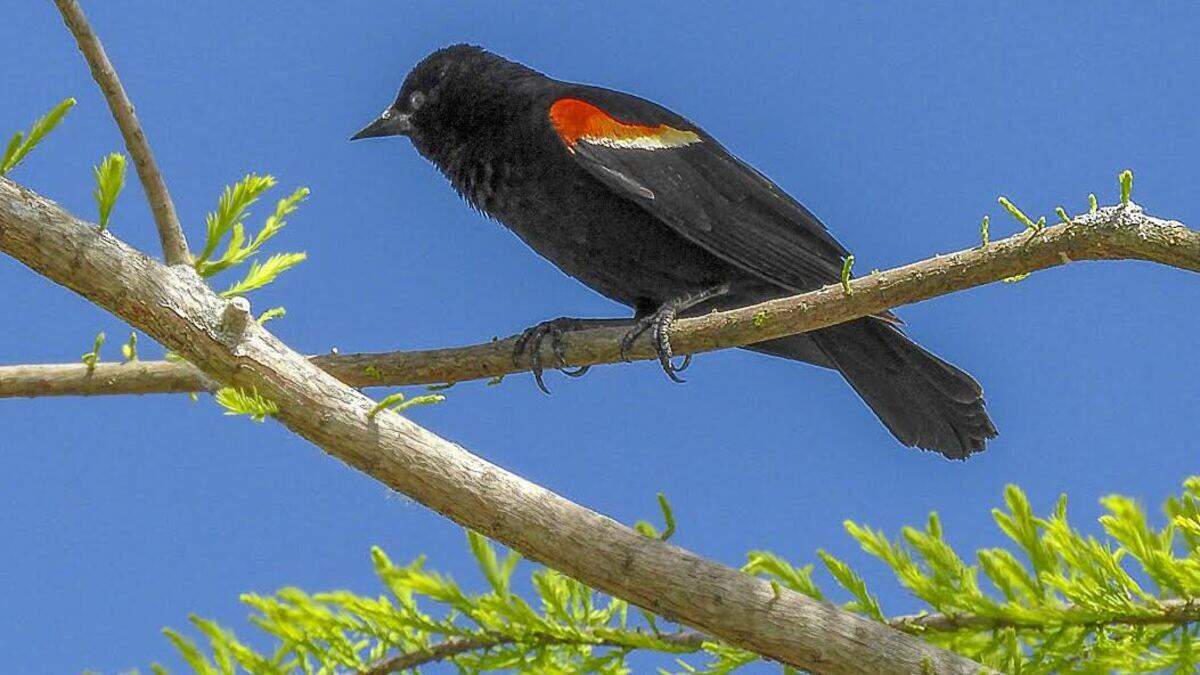
Red-wing Blackbirds rule the marsh. At least, they think they do.
It’s hard to find an expanse of cat-tails without also seeing at least a few glossy, black males perched on swaying vegetation, loudly advertising their presence via their distinctive gurgling song (“ok-a-lee”).
True to their name, they’ve got bright red and yellow shoulder patches, which they often puff up during territorial or courtship displays. Females, on the other hand, are quieter and more cryptically colored, resembling brown, streaky sparrows.
Red-wing Blackbirds are common and abundant across most of North America. They breed in marshes and other wetlands, but you’ll also see them foraging over fields, pastures, and golf courses, and perched prominently on telephone wires in open farmland. During the breeding season they feed on numerous insects and other invertebrates, but their diet also includes a variety of seeds and fruits.
The species has been intensively studied by biologists, particularly because of its polygynous mating system. During the breeding period, a single male may have several different females nesting within his territory — in some cases, up to fifteen mates at one time. The territory owner spends most of his day vigorously defending his area and his “harem” from other males, as well as from potential predators such as crows and hawks.
Red-wing Blackbirds will even threaten unsuspecting humans who venture too close. In Chicago, for example, cyclists and joggers along Lake Michigan in June regularly face the risk of being chased and dive-bombed by territorial males. And the city’s Lincoln Park Zoo puts up signs near ponds warning visitors about blackbird attacks.
Meanwhile, female blackbirds are hardly passive while all this is going on. Compared to males, they may be less demonstrative toward humans, but they’re still hostile to one another. In fact, studies suggest that inter-female aggression may limit the number of females that can nest simultaneously within a male’s territory. And despite the territory owner’s vigilance in chasing off rivals, as many as half the baby blackbirds in the females’ nests may be fathered by other males.
After the breeding season ends, and with the approach of fall, Red-wing Blackbirds start congregating at large, noisy roosts. Often other species, such as European Starlings, Boat-tailed Grackles, and Brown-headed Cowbirds, join the mix. Each morning, over the course of the winter, the birds disperse to forage over the surrounding countryside, traveling as far as fifty miles. Then the flock reassembles at night.
In some areas of the U.S., winter roosts of blackbirds may comprise thousands or even millions of birds.
This story was originally published September 17, 2018 at 10:15 AM.