
You know the ladybug rhyme. But do you know why farmers love these little critters?
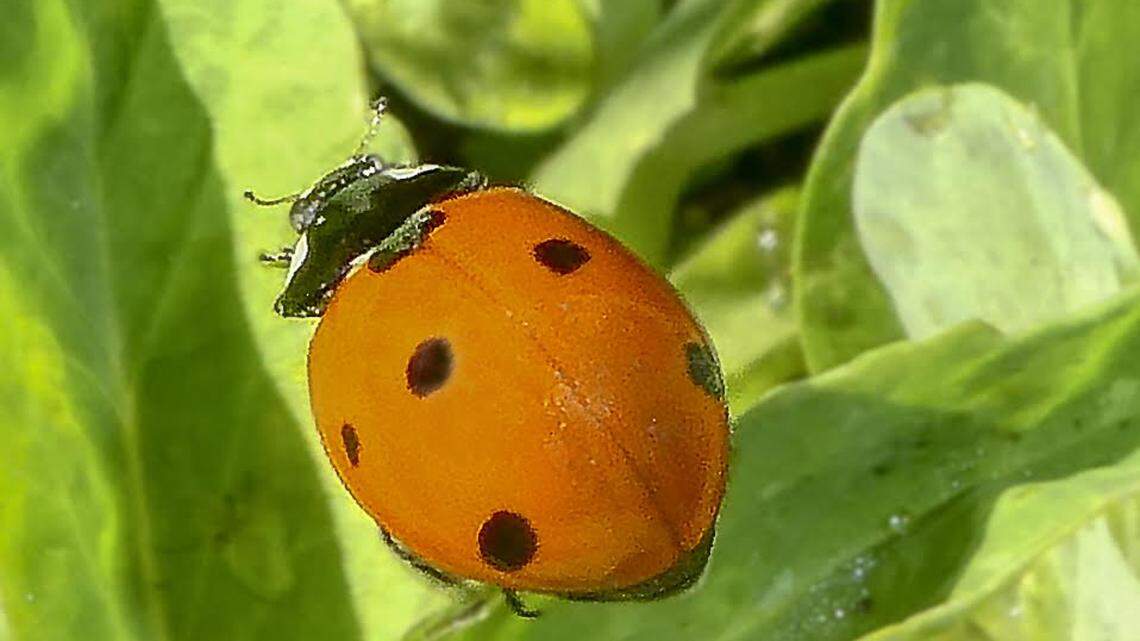
Ladybugs are arguably among our most familiar and “popular” insects, with a history of cultural and religious associations dating back hundreds of years.
In many countries, they’re a symbol of good luck. Their colorful, spotted bodies have inspired designs for countless products, from greeting cards and clothing to gift wrap and jewelry. Five states (though not South Carolina) have declared them their state insect. And their lives, “adventures” and general cuteness have been depicted in numerous children’s books.
Ladybugs, or ladybirds, are also featured in various versions of this traditional nursery rhyme, which as a child I found both bewildering and troubling: "Ladybird, ladybird, fly away home, Your house is on fire and your children are gone." The origin of this ancient verse is unknown. Since some cultures have traditionally associated ladybugs with Catholicism and the Virgin Mary, the rhyme may refer to the persecution of Catholics in sixteenth century England. Or it may have arisen from the practice of farmers setting fire to their fields after the last harvest.
From a scientific perspective, ladybugs are actually beetles, members of a huge group of insects called the Coleoptera. Worldwide there are about 6,000 kinds of ladybugs, including 450 in North America. They come in a variety of colors – yellow, orange, red, even brown. The pattern on their backs varies from one species to another, from many spots (or stripes) to none at all.
The bright colors seem to function as warning coloration, advertising the insects’ unpalatability. When threatened by birds or other predators, ladybugs release drops of toxic blood from “leaky” leg joints, a defense mechanism called reflex bleeding. The beetles can also fold up their legs and “play dead.” Or, of course, they can simply fly away.
As in other beetles, the tightly-closed forewings of a ladybug are modified into thick, protective shields. When the insect is about to take off, it raises its forewings to reveal a second pair of delicate, membranous hind wings. These are the only wings that actually function in flight.
In contrast to the winged, dome-shaped adults, larval ladybugs are wingless, elongated creatures that look rather like miniature lizards or alligators. After hatching from eggs laid near potential food sources, they eat and grow steadily, shedding their “skins” several times. Eventually they enter the pupal stage, during which they morph into adult beetles. Depending on the species, total lifespan is typically one to two years.
Ladybugs are most active from spring to fall. During cooler weather, they may hibernate en masse under rocks, within rotten logs, or even inside houses. These masses of inactive beetles may contain thousands – even hundreds of thousands – of insects.
For humans, a highly useful feature of ladybugs is their diet. Both the larvae and adults of most species feed on aphids, scale insects, and other common pests. For this reason, they’re welcome inhabitants of farms and gardens, and some species have been used extensively in biological control programs.
They can be voracious predators, using visual, tactile, and chemical cues to locate their tiny prey. Depending on the species, and on food supply and temperature, a single larva can eat 30-50 aphids per day. An adult might eat 5,000 insects, or more, during its lifetime.
This story was originally published June 4, 2018 at 9:07 AM with the headline "You know the ladybug rhyme. But do you know why farmers love these little critters?."