
How POW bracelet of Vietnam suffering found its way home after 50 years
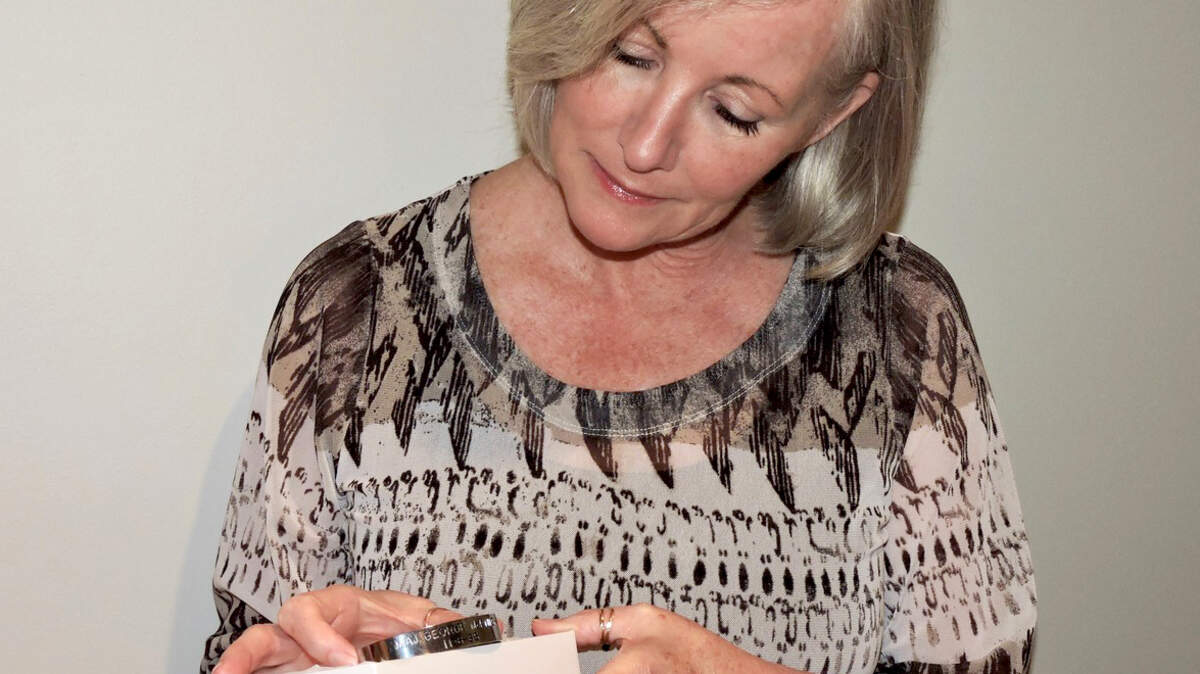
A worn piece of metal. The Hanoi Hilton. Agent Orange. A newspaper column. An email from a stranger.
They all play a role in the story of a POW bracelet that has come full circle.
But they also tell a larger story of the best of the United States of America, in the face of the worst of mankind.
On the bracelet is etched, "Maj. George McKnight 11-6-65."
That was the day my former Hilton Head Island neighbor of 22 years was taken as a prisoner of war in Vietnam.
He was a U.S. Air Force pilot who was tortured "for seven years, three months, two days, four hours and three minutes," he would say. That was before dementia and PTSD stole those details from his bright mind.
McKnight spent years in solitary confinement. For two years, he was a cellmate of John McCain at the prison they called the "Hanoi Hilton."
Civilians can't truly comprehend what he gave to our country.
But here's a glimpse from the book, "Defiant: The POWs Who Endured Vietnam's Most Infamous Prison."
Author Alvin Townley writes:
"For 34 nights, (the prison camp commander) cuffed George's hands behind his back at sundown and shoved him into the 4-foot-deep air raid trench beneath his bed. There he stayed for the next twelve hours. His 6-foot-2 frame barely fit the damp confines of what seemed like a grave. Worms and bugs crawled across his body and mosquitoes feasted upon him. His immobilized hands could do nothing to help. The slightest itch became torture and no amount of screaming or pleading would convince guards to exhume him before his twelve hours had expired. He passed each minute in blackness and near silence. The dirt walls seemed to creep ever closer, and he desperately combated intense claustrophobia. During the day, he lay on his bed listening to the screams of fellow POWs and dreading sunset. When it came, guards forced him back into the trench."
McKnight was in a group they called the Alcatraz 11, the most defiant of the prisoners. One time McKnight and another of the 11 escaped, but were captured within 12 hours. Townley called McKnight "one of the toughest resistors among the American POWs."
Maybe that's why a young Army medic also serving in Vietnam would wear a George McKnight POW bracelet.
That young man also would suffer greatly for his country. Soon after his retirement as a lieutenant colonel in the Army Reserve, which sent him to serve in Desert Shield and Dessert Storm, Joseph Andrew Adamski Sr. developed multiple myeloma. The cancer that claimed his life at 63 in 2008 is linked to exposure to Agent Orange in Vietnam.
This month, his widow decided she wanted the quiet hero who was my neighbor to have the old bracelet bearing his name.
"I would like him to know that my husband wore it and never forgot about him," said Jackie Adamski of Diamondhead, Miss.
'Smoked Yanks'
Jackie Adamski found me on the internet.
Her search for McKnight turned up a column I wrote in 2015 about McKnight and another POW hero, the late U.S. Marine Corps Col. Jesse V. "Davy" Booker of Beaufort. It was in response to then-presidential candidate Donald Trump's remark on McCain: "He was a war hero because he was captured. I like people who weren't captured."
After Vietnam, McKnight married Air Force nurse Suzanne Sexton and continued to serve honorably, retiring as a colonel in 1986. Among his many honors is the Air Force Cross, its citation concluding: "Through his extraordinary heroism and aggressiveness in the face of the enemy, Colonel McKnight reflected the highest credit upon himself and the United States Air Force."
On Hilton Head, he rode horses and stayed fit with running and tennis. He and some buddies had a small plane on Lady's Island and he flew a lot. He tolled the bells at 11 a.m. at our community Veterans Day service. He wrote short, pointed, crystal clear letters to the editor.
He tried to write a book, but dementia wouldn't allow it. It was to be called "A Tale of Two Yanks," linking his experiences with that of his great-grandfather Melvin Grigsby. He was a Union soldier during the Civil War who was captured by the Confederates. He survived the notorious Andersonville, Ga., POW camp and wrote about in an 1888 book, "The Smoked Yank."
Suzanne said the producer of the documentary on the Hanoi Hilton, "Return With Honor," was interested in a screenplay of the book McKnight wanted to write.
A couple of the Alcatraz 11 visited McKnight at his island home. He introduced McCain to the audience when he came to Hilton Head for a political speech. McKnight did not like public speaking, but at least once he went over to address recruits at the Marine Corps Recruit Depot Parris Island, Suzanne said.
And he was faithful at St. Francis by the Sea Catholic Church on Hilton Head, known for always sitting in the back row.
Suzanne said he credited his faith for surviving all that torture for his country. In his worst moments, he often thought of a particular priest who influenced him at the St. Martin's Catholic boarding prep school in Washington state.
That whole time, Joseph Adamski, who now rests at Arlington National Cemetery, kept a small wooden box with things important to him from his time in Vietnam and throughout his Army career.
That's where Jackie found the POW bracelet.
'Be strong and keep your faith'
The McKnights moved to Florida two years ago.
He is in a special memory care unit, and Suzanne lives across the street.
"He is not doing well," Suzanne said.
My new neighbors who bought the McKnight house helped me find Suzanne for the stranger who sent the email.
Suzanne said her husband has received other POW bracelets over the years. She welcomed Jackie to mail her bracelet to them. She said her husband loved the bracelets.
"When they came home and found out about the bracelets, they were very touched by it," she said.
Jackie said, "I held on to this because my husband held onto it."
It was a part of him that he needed to hold on to, she said, but he didn't want to talk about Vietnam and they didn't.
Her husband has been added to the Vietnam Veterans Memorial Fund list of troops who died because of their Vietnam service but are not on The Wall.
It was hard to see him suffer, right when his life was to enter a grand new chapter of retirement.
And now, she said, her fiancé was on duty at a U.S. Navy Reserve Center in Chattanooga, Tenn., when a gunman ran through his building in 2015 and mortally wounded a sailor.
"He went to work as one person," Jackie said. "He came home a different person. I don't know if he'll ever be the person he was again."
Suzanne said her husband's message was, "Be strong and keep your faith."
He always said if you weren't there, at the Hanoi Hilton or serving in the jungles of Vietnam, you don't understand what sacrifices were made.
"People just don't know what military families go through — separation, and early death many times," Suzanne said. "It's mostly because they don't want to know, and that's sad. They take it for granted. But that's life."
The medic whose life was cut short by Agent Orange never forgot about McKnight.
And now that simple act of respect has come full circle.
This story was originally published March 23, 2018 at 3:22 PM with the headline "How POW bracelet of Vietnam suffering found its way home after 50 years."