In ‘own the libs’ era, is SC’s Tim Scott just too nice to make up ground in presidential race?
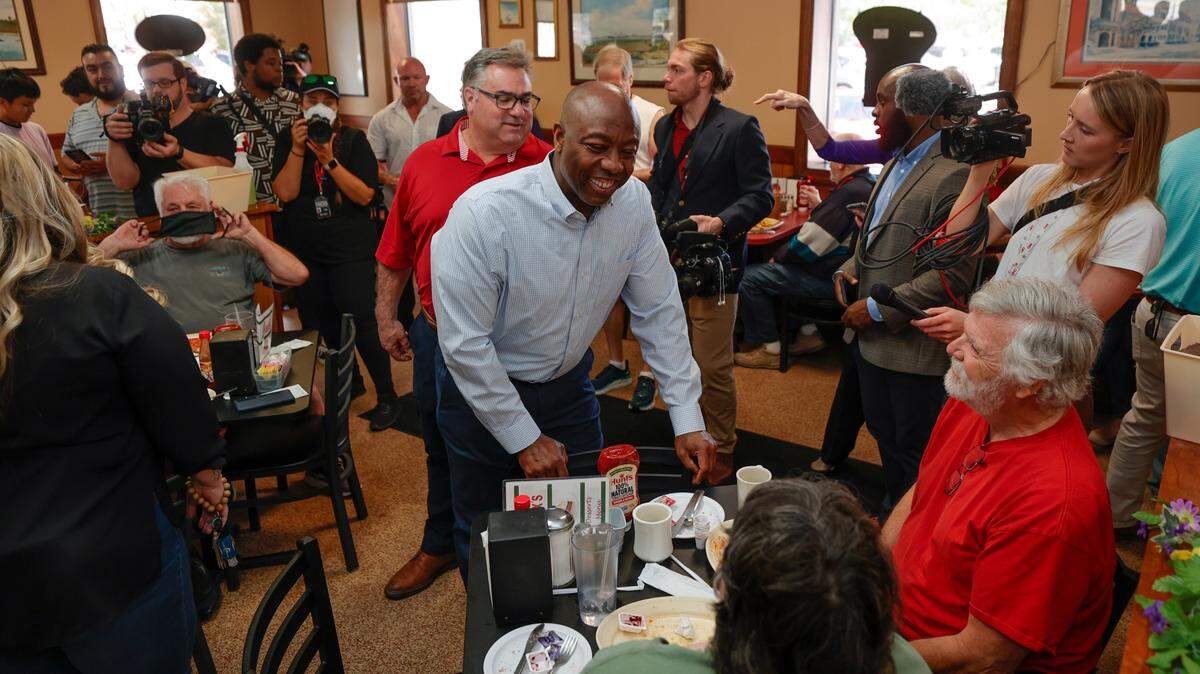
U.S. Sen. Tim Scott needed to show he could be aggressive and assertive.
Scott’s reputation as the nice person, a happy warrior with an optimistic message, has given him one of the best, if not the highest, net favorable ratings in early voting states heading into Republican presidential nominating contests.
But despite being seen as widely liked, Scott has continued to poll in the single digits in Iowa and New Hampshire and even trails in a distant third place in Republican polls in his home state of South Carolina.
So when he took the stage for the second GOP candidate debate late last month — after a largely forgettable debate performance a month prior — Scott changed his tone, showing he, too, could throw punches at the competition, balancing fiery moments and with an optimistic attitude.
And this time around, Scott received better reviews.
“He seemed much more aggressive,” said Robert Cahaly, the chief pollster for the Trafalgar Group.
With the clock ticking to close the gap in the polls, the man who some believe is too nice to make it to the White House is showing signs of a more aggressive style, hoping to move closer to the GOP front-runner, former President Donald Trump — the brashest candidate of them all. The question is whether Scott will be able to parlay his likability into support on enough ballots to come away with the Republican nomination.
Scott’s high favorable ratings
South Carolina’s junior senator has the highest net favorable rating among Republican candidates in early primary states, which his campaign has said shows he has the highest potential out of anyone in race.
“More than anything else, ballots are a lagging indicator that trails a candidate’s image and favorability,” Scott campaign manager Jennifer DeCasper wrote in a memo to donors Sept. 20. “How favorably a candidate is viewed shows you their ceiling and floor. What you see from these numbers is that — more than anyone else in the field — we have the most room to grow.”
Scott is polling in low single digits nationally. The nomination, however, isn’t determined through a national primary, but through individual contests in individual states — and Scott is doing better in early states where candidates have been heavily campaigning.
In Iowa, his RealClearPolitics polling average is 6.8%. In New Hampshire, his polling average is 4.8%. Scott is doing better in his home state of South Carolina, where his polling average is 11%.
On the campaign trail, Scott touts his personal roots of growing up in a single-parent household and pulling himself up by his own bootstraps, a positive personal story that conveys anyone can make it in America and that tends to resonate with conservative voters.
He keeps an optimistic attitude and in the first presidential debate stayed out of the food fight that broke out while other Republican hopefuls took shots at one another.
But it was that approach that led to him drifting into the background.
Scott is fighting for support in a party that nominated a famously brash Trump in 2016 and 2020. In 2008, it was John McCain’s scrappy combativeness that helped him to the Republican nomination.
Miles Coleman, associate editor of Sabato’s Crystal Ball at the University of Virginia Center for Politics, said Republicans may have the mentality of liking Scott and his “happy warrior” persona, but they are looking for someone who will throw a punch or could “own the libs.”
“Republicans really like this idea of someone who is a fighter, who’s going to go stick it to the Democrats for them,” Coleman said. “Trump, he’s not afraid to name check people who he doesn’t like. He’s not afraid to be unorthodox with his policy stances.”
During the Sept. 27 debate, Scott showed he could pick a fight and that he’s willing to interject himself into conversations and talk over fellow candidates even when he wasn’t called on by moderators.
He was involved in several spats with Vivek Ramaswamy and former South Carolina Gov. Nikki Haley, who appointed Scott to the Senate in 2012.
Scott generally maintained his optimistic tone while also challenging Ramaswamy for saying all the other candidates are “bought and paid for.”
When Scott spoke about money for the Ukraine war and degrading the Russian military, Ramaswamy tried to interrupt.
“How about waiting for your turn to talk?” Scott said to Ramaswamy.
Scott took on Haley after she said he was part of the problem in Congress for not passing a budget on time. Scott, South Carolina’s junior senator, shot back at Haley for calling for an increase to the state’s gas tax. (Haley had supported increasing the gas tax if it went along with an income tax cut.)
Scott criticized Haley for the $52,000 curtains, purchased under the Obama administration, that hung in her condo in New York when she was ambassador to the United Nations.
“Did you send them back?” Scott said.
“Did you send them back? You’re the one who works in Congress,” Haley retorted.
What do voters think of Scott’s style?
S.C. state Rep. Brandon Newton, R-Lancaster, who serves as the chief S.C. House majority whip, is backing Scott’s campaign.
“I think it’s safe to say there is no one that does not like Sen. Scott. I haven’t sensed any acrimony or displeasure, that’s for sure,” Newton said.
“(Scott) has a way of putting our principles and values in an optimistic point of view,” Newton added. “I think it adds something that is missing in politics, is that we don’t speak of optimism anymore. I think he’s a happy warrior who’s able to take what we believe and sell it in a way that makes you hopeful for the future.”
Ahead of the last debate, voters who weren’t supporting Scott’s candidacy at least found him likable.
Many voters do like his personal story of coming from a single-parent household, starting his own business and working his way up to the U.S. Senate.
“I think he’s a good guy. (He) certainly came from humble beginnings. It’s the great American story, but I think it’s too soon for him,” said Fran Gunkel, of Summerville, who said she is supporting Trump’s candidacy because of the former president’s toughness.
But asked if she thought Scott possessed that toughness characteristic, Gunkel had an unsure expression on her face.
“It’s OK to say he’s optimistic and whatever. I’m not sure he’s as tough as nails as he needs to be,” Gunkel said.
Donna Martin, of Anderson, shared similar concerns.
“He is very nice. I don’t think he has the chutzpah,” Martin said in an August interview.
Martin, however, watched the second debate and had a better review.
“He knew what he wanted to say, I liked what he said, I agreed with what he said, and he was forceful,” Martin said. “He spoke up for himself, which is good.”
This story was originally published October 8, 2023 at 5:30 AM with the headline "In ‘own the libs’ era, is SC’s Tim Scott just too nice to make up ground in presidential race?."